How to Drill Titanium: Bits, Speeds, Coolant and Step-by-Step Method
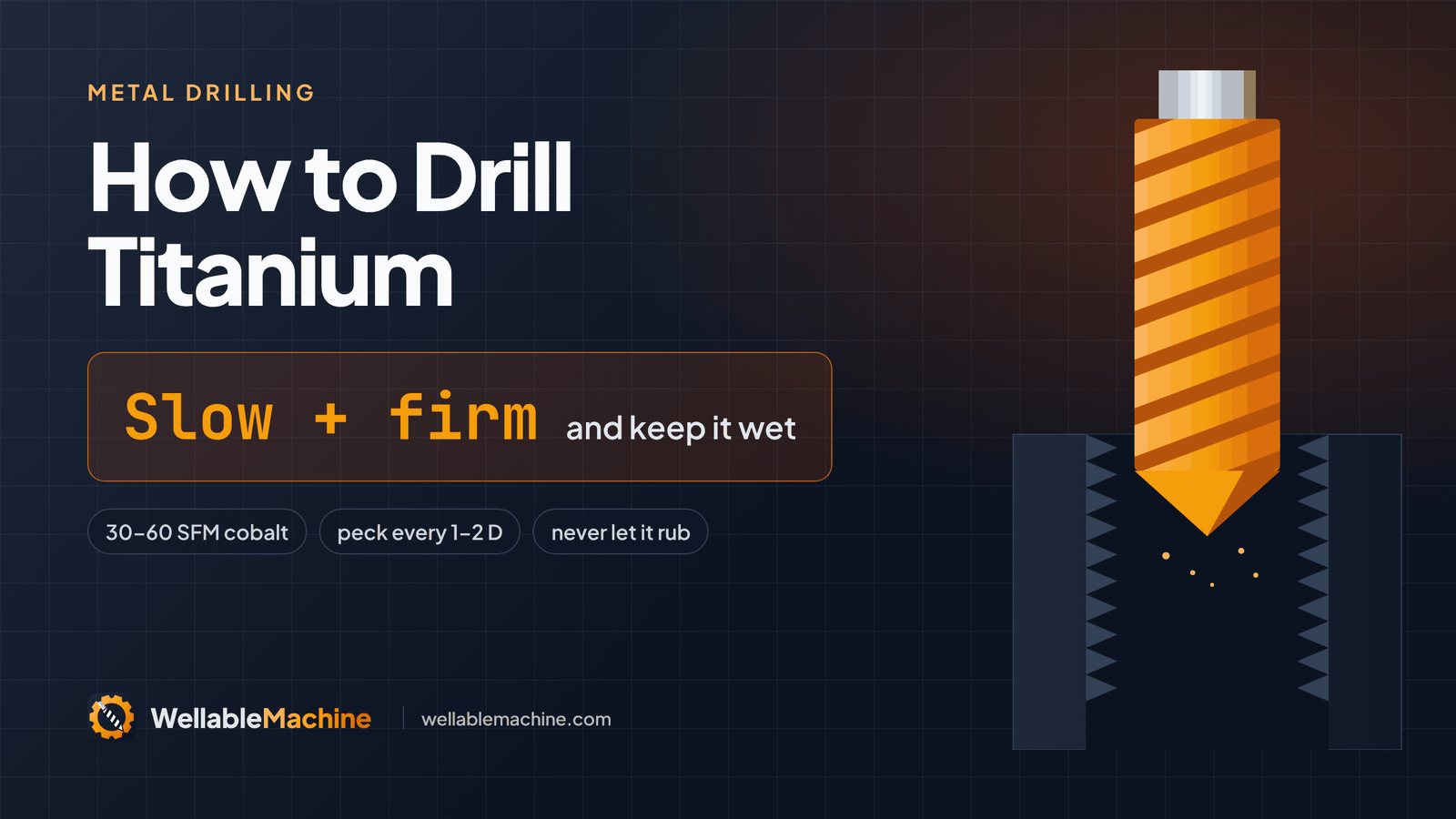
Quick answer: to drill titanium, use a sharp cobalt (M42) or solid carbide bit, run it slowly (about 30–60 SFM for cobalt, roughly 450–900 RPM for a 1/4 in bit), push with firm, constant feed so the bit never rubs, and keep the cut flooded with coolant or cutting oil. Clamp the work rigidly, peck to clear chips, and keep fine titanium chips away from sparks and flame.
Titanium has a reputation as a nightmare to drill, and the first attempt often ends with a squealing, glowing drill bit and a hole barely started. But titanium isn’t actually harder than many steels. The problem is how it behaves: it holds heat at the cutting edge, it springs back against the bit, and it sticks to tools. Once you understand that, the right method is straightforward. This guide covers grades, tools, speeds, step-by-step technique and safety.
Why Titanium Is Hard to Drill
- Low thermal conductivity. Titanium conducts heat about one-sixth as well as steel. Instead of flowing into the part and the chips, heat stays concentrated at the cutting edge, where it softens and burns the bit.
- Low stiffness (springback). Titanium’s elastic modulus is about half that of steel. Thin parts flex away from the drill and then spring back, rubbing the margins and pinching the bit.
- Galling. Titanium tends to weld onto the cutting edge, building up a lump that rubs instead of cutting.
- Work hardening (mild). Rubbing creates a hardened skin, especially in alloys like Ti-6Al-4V. A bit that dwells makes the next cut harder.
- Chemical reactivity at high temperature. Hot titanium reacts with tool materials and wears coatings quickly, which is why speed control matters so much.
The titanium article covers its properties in more depth.
Know Your Grade
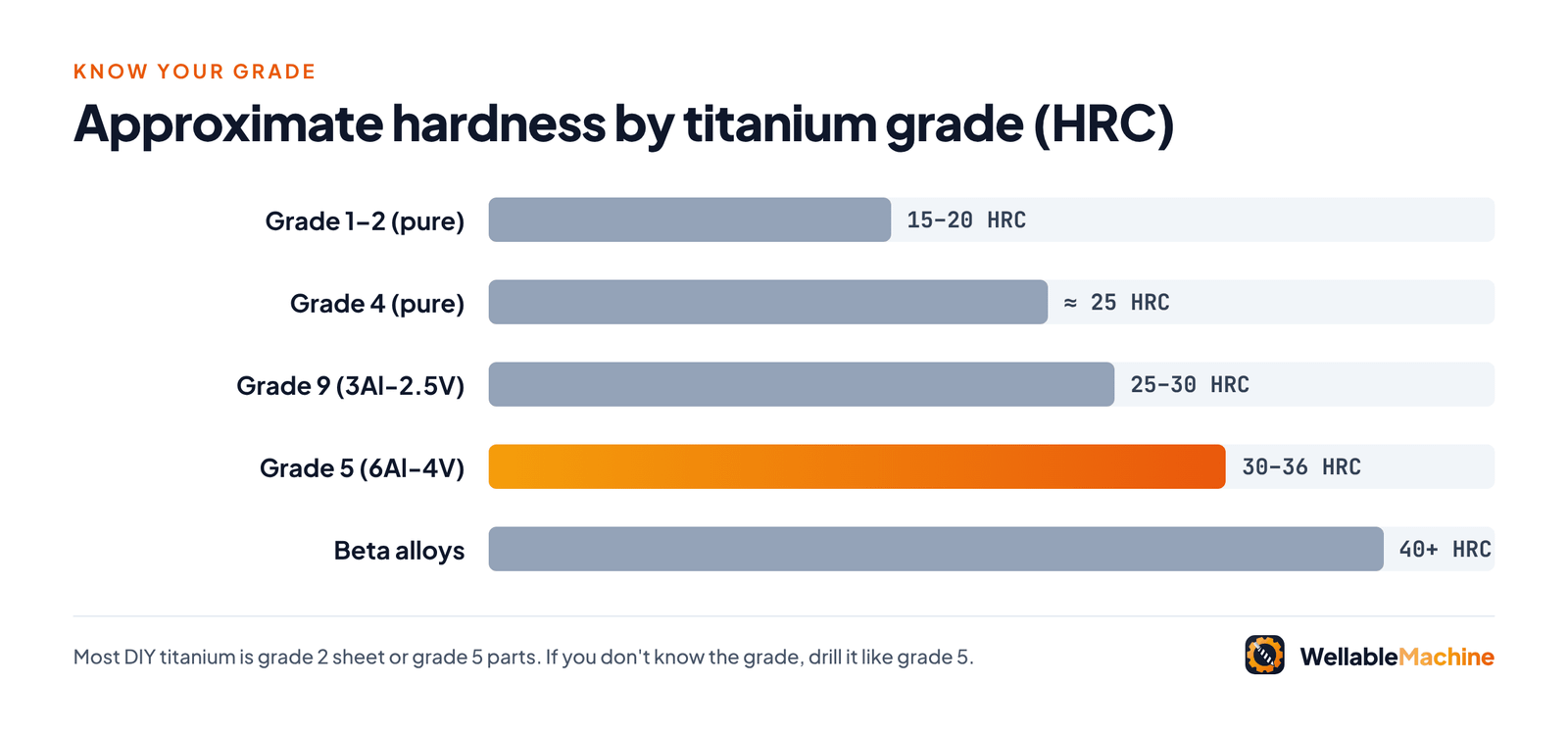
| Grade | What it is | Hardness (approx.) | Drillability |
|---|---|---|---|
| Grade 1–2 (CP) | Commercially pure titanium | about 15–20 HRC (soft) | Easiest; gummy, like soft stainless |
| Grade 4 (CP) | Stronger pure grade | about 25 HRC | Moderate |
| Grade 5 (Ti-6Al-4V) | The most common alloy; aerospace, bike parts, bolts | about 30–36 HRC | Harder; needs carbide or M42 and low speed |
| Grade 9 (Ti-3Al-2.5V) | Tubing for bikes and aerospace hydraulics | about 25–30 HRC | Moderate; thin walls flex |
| Beta alloys | Springs, high-strength parts | up to 40+ HRC | Difficult; carbide, slow, rigid |
Most DIY titanium is either grade 2 sheet and plate or grade 5 hardware and bike parts. If you’re not sure, treat it as grade 5.
Choosing a Drill Bit
| Bit | Use for | Notes |
|---|---|---|
| M42 cobalt (8% Co), 135° split point | Hand drill and drill press; most DIY work | Best all-round choice; tolerates some flex |
| M35 cobalt (5% Co) | Grade 2 and thin sheet | Works, wears faster than M42 in grade 5 |
| Solid carbide, 140° point | Drill press with good rigidity, mills, CNC | Fastest and longest life, but brittle; see carbide drill bits |
| Short (stub) length bits | Any accurate hole | Less flex, less wander, less rubbing |
| Plain HSS or “titanium” coated HSS | Only a few holes in grade 2 | Dulls quickly; the TiN coating doesn’t help on titanium. See black oxide vs titanium drill bits |
A 135° split point helps a lot: it starts without a center punch mark and cuts with less thrust, so thin parts deflect less. Make sure the bit is genuinely sharp. A slightly dull bit that’s fine in mild steel will rub and burn in titanium. Our HSS vs cobalt drill bits guide explains why cobalt handles the heat better.
Speeds and Feeds
| Bit diameter | Cobalt, grade 2 (50–70 SFM) | Cobalt, grade 5 (30–50 SFM) | Carbide, grade 5 (100–150 SFM) |
|---|---|---|---|
| 1/8 in | 1,500–2,100 RPM | 900–1,500 RPM | 3,000–4,600 RPM |
| 1/4 in | 750–1,050 RPM | 450–750 RPM | 1,500–2,300 RPM |
| 3/8 in | 500–700 RPM | 300–500 RPM | 1,000–1,500 RPM |
| 1/2 in | 380–530 RPM | 230–380 RPM | 760–1,150 RPM |
Feed: titanium needs a heavier feed per revolution than you’d expect, roughly 0.002–0.003 in/rev for a 1/4 in bit and 0.004–0.006 in/rev for 1/2 in. In a hand drill or manual drill press, that means steady, firm pressure that makes continuous curled chips. Light pressure is the most common cause of failure. The drill speed chart lists speeds for other metals for comparison.
How to Drill Titanium Step by Step
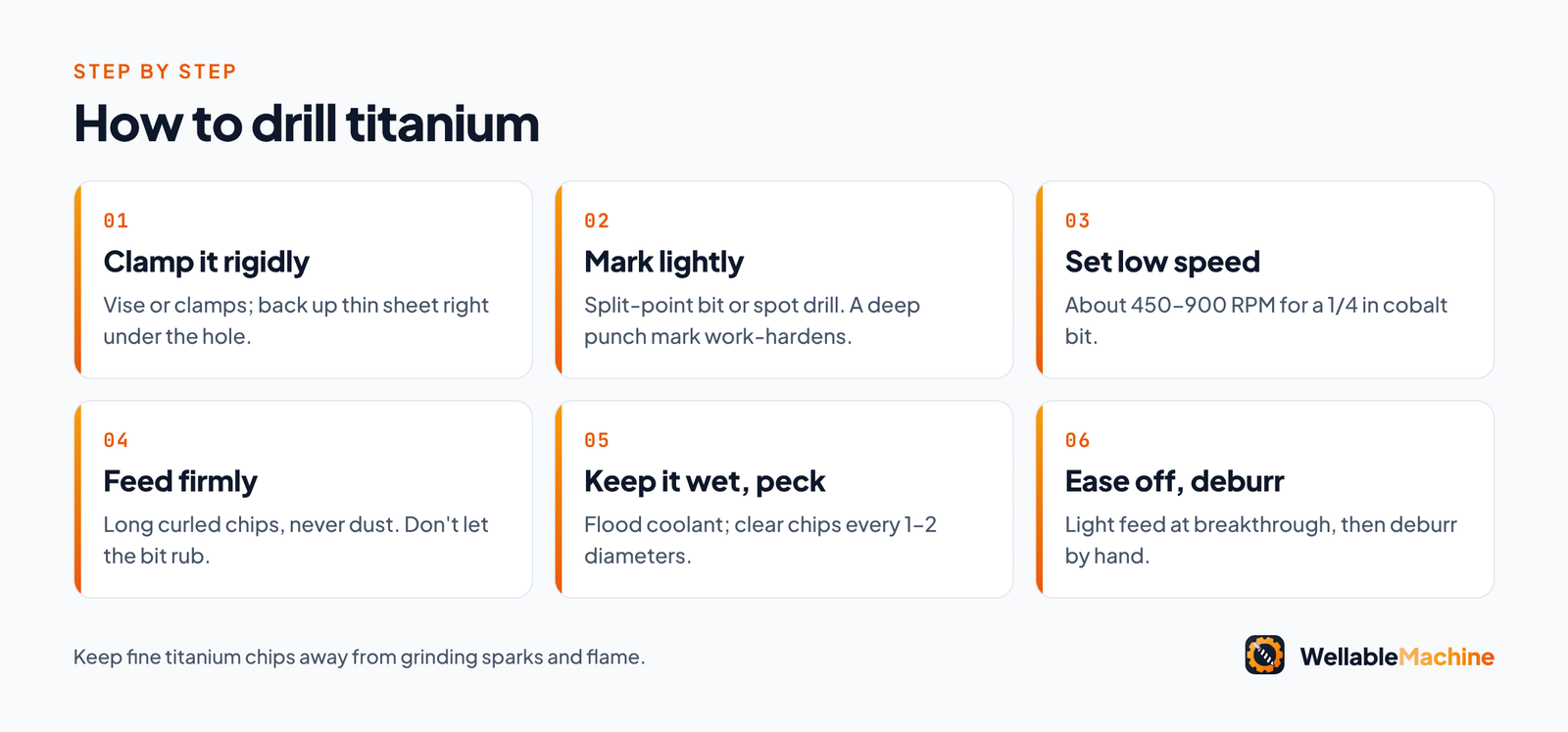
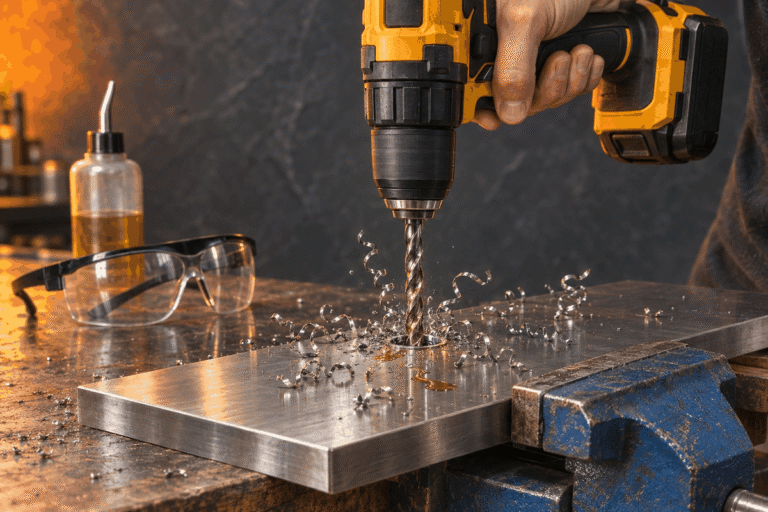
- Clamp the part rigidly. Use a vise or clamps on a drill press table. Support thin sheet on a wooden or aluminum backer right under the hole so it can’t spring away.
- Mark the spot. With a split-point bit you can start directly. Otherwise, use a spot drill or a light center punch mark; a deep punch mark work-hardens the surface.
- Set a low speed from the table above, and have coolant ready before you start.
- Start the cut with firm pressure. As soon as the bit engages, keep feeding. You want long, curled chips, not dust.
- Keep it wet. Flood coolant is ideal. By hand, use a sulfur-free cutting oil or a water-soluble coolant applied continuously. Some machinists avoid chlorinated fluids on titanium aerospace parts because of stress-corrosion concerns, so follow the spec if there is one.
- Peck every 1 to 2 diameters of depth. Pull out, clear chips, re-wet and go back in without letting the bit spin at the bottom.
- Ease off at breakthrough. Titanium tends to grab and leave a large burr; reduce feed for the last turn or two.
- Deburr with a countersink at low speed or by hand.
Large holes are best done in steps: pilot at about one-third of the final size, then open up. In thin sheet, a step drill at very low speed gives a rounder hole than a large twist drill; see how to use a step drill bit.
Drilling Titanium With a Hand Drill
It’s possible for small holes in sheet and tubing, with a few adjustments:
- Use the low gear and a slow trigger speed. Cordless drills often run too fast even in first gear for grade 5 above 1/4 in.
- Use stub-length M42 bits and brace the drill with both hands.
- Apply oil continuously; have a helper drip it on if needed.
- Stop if the bit squeals or the chips turn to powder. Check the edge before continuing.
- Keep the drill square. A drill guide block helps; see how to drill a straight hole.
Tapping Holes in Titanium
Titanium is notorious for grabbing and breaking taps. Make the job easier by drilling for a 60–65% thread rather than the usual 75%, using a sharp spiral-point or forming-style tap made for titanium, and using a tapping compound suited to it. In practice, that means choosing the next drill size up from the standard one listed in our tap drill size chart. If a tap does break, see how to remove a broken tap.
Safety With Titanium Chips
- Fine titanium chips and dust can burn. Large chips from drilling are hard to ignite, but fines and grinding dust can catch fire, and burning titanium is extremely hot.
- Never grind and drill in the same area as a pile of titanium swarf, and don’t let sparks reach it.
- Don’t use water on a titanium fire. Use a Class D extinguisher or dry sand.
- Collect chips separately and keep them away from oily rags.
- Wear eye protection and gloves when clearing sharp, springy chips.
Common Problems
| Problem | Cause | Fix |
|---|---|---|
| Bit glows or turns blue | Speed too high, not enough coolant | Halve the speed; flood the cut |
| Bit squeals, makes powder | Feed too light; bit rubbing | Push harder; resharpen or replace the bit |
| Bit seizes in the hole | Springback and chip packing | Peck more often; use a shorter bit; back up thin sheet |
| Material welds onto the edge | Heat and galling | More coolant; sharper bit; lower speed |
| Hole oversize or out of round | Flexing part or bit | Clamp closer to the hole; stub bit; pilot first |
| Large burr on exit | Too much feed at breakthrough | Ease off; back up the exit |
Titanium vs Stainless: What’s Different?
The method is similar to drilling stainless steel: slow speed, constant feed, sharp cobalt bits and plenty of lubricant. The main differences are that titanium needs even more coolant because of heat build-up, flexes more in thin sections, and produces chips that need fire precautions. If you’re comfortable with drilling stainless steel, you already have most of the skills.
Deburring Titanium Holes
Titanium leaves a sharp, tough exit burr. Remove it with a hand deburring tool or a countersink turned slowly by hand, rather than a power tool at high speed, which can rub and harden the edge.
Frequently Asked Questions
8 quick answers from our editors
01What is the best drill bit for titanium?
A sharp M42 cobalt bit with a 135° split point for most work, or solid carbide in a rigid drill press or mill.
02What speed should I drill titanium at?
Slow: about 450–750 RPM for a 1/4 in cobalt bit in grade 5 titanium, a little faster in grade 2.
03Can you drill titanium with a regular drill?
Yes, for small holes in sheet and tube, using low gear, cobalt bits, firm pressure and continuous oil.
04Why does my drill bit burn when drilling titanium?
Titanium keeps heat at the cutting edge. Too much speed, too little pressure or too little coolant overheats the bit.
05Do titanium-coated drill bits work on titanium?
Not especially. TiN coating doesn’t help much on titanium; cobalt or carbide bits work better.
06Is titanium harder to drill than stainless steel?
Grade 5 titanium is a bit harder to drill than 304 stainless, mainly because of heat and springback. Grade 2 is similar or easier.
07Are titanium chips dangerous?
Large drilling chips are low risk, but fine chips and dust can ignite. Keep them away from sparks, and never use water on a titanium fire.
08Should I use a pilot hole when drilling titanium?
For holes over about 1/4 in, yes. Pilot at about one third of the final size with a sharp cobalt or carbide bit, then open up. For small holes, a split-point bit can start without a pilot.
Bottom Line
Drill titanium with a sharp cobalt or carbide bit, at low speed, with heavy, constant feed and plenty of coolant. Clamp and back up the part, peck to clear chips, and never let the bit dwell. Treat unknown parts as grade 5, drill tap holes for a lighter thread, and keep fine titanium chips away from sparks.