#3 Drill Bit Size: 0.213 in (5.41 mm), 1/4-28 Tap Drill and Uses
Quick answer: a #3 drill bit measures 0.2130 in (5.410 mm). It sits between 13/64 in (0.2031 in) and 7/32 in (0.2188 in), and 5.4 mm is a near-perfect metric match. The #3 is best known as the standard tap drill for 1/4-28 UNF, and it doubles as a free-fit clearance hole for #10 screws.
If you have ever opened a tap drill chart and wondered why a 1/4 in fine thread calls for a “#3” instead of a normal fraction, this page explains it. Below you’ll find the exact size, the drills around it, where a #3 is used, what to buy if you don’t own one, and how to get a clean, round hole with it in metal.
#3 Drill Size Specifications
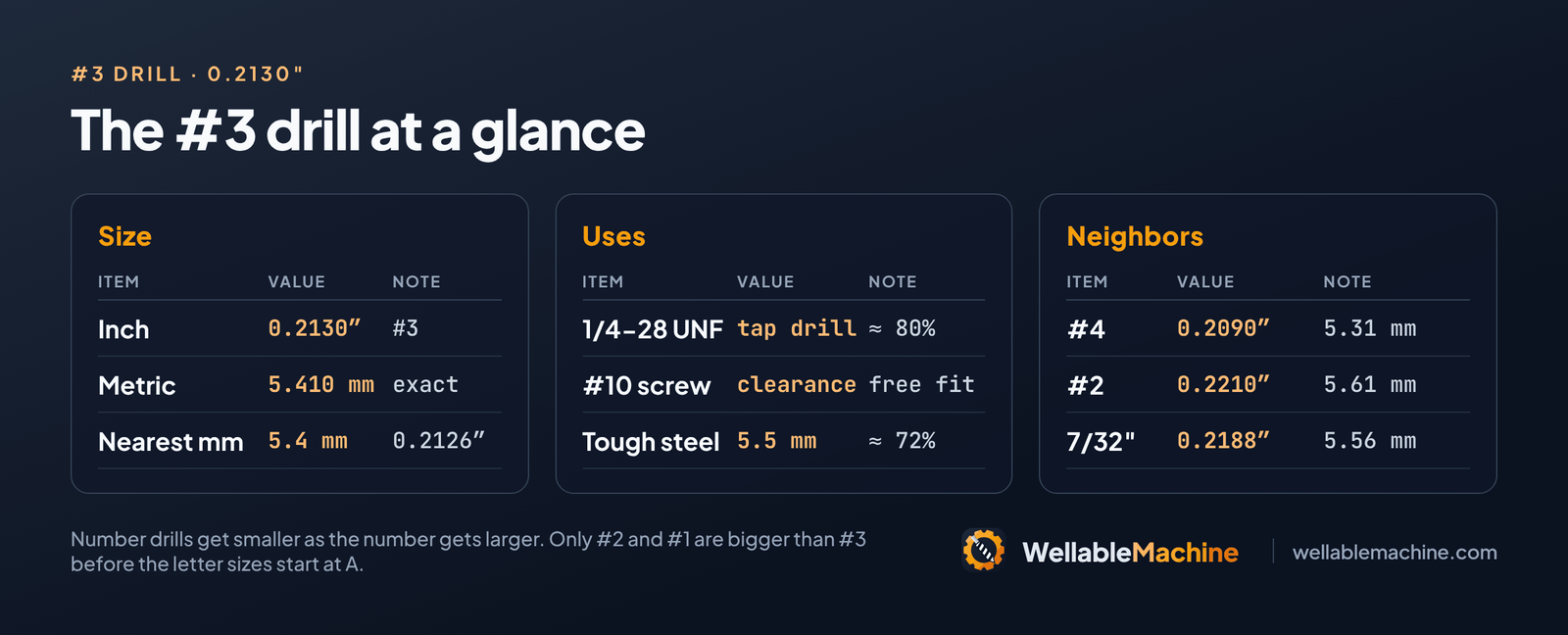
| Item | Value |
|---|---|
| Decimal inch | 0.2130 in |
| Metric | 5.410 mm |
| Closest metric drill | 5.4 mm (0.2126 in), 0.0004 in smaller |
| Fraction just below | 13/64 in (0.2031 in) |
| Fraction just above | 7/32 in (0.2188 in) |
| Number drill below | #4 (0.2090 in) |
| Number drill above | #2 (0.2210 in) |
| Main job | 1/4-28 UNF tap drill (about 80% thread) |
| Second job | Free-fit clearance for #10 (0.190 in) screws |
Number drills shrink as the number grows, so #3 is the third-largest in the series. Only #2 and #1 are bigger; after #1 (0.228 in) the letter series takes over at A (0.234 in). The full list is in our number and letter drill size chart.
Drills Close to a #3
| Drill | Inches | mm | Common job |
|---|---|---|---|
| #7 | 0.2010 | 5.11 | 1/4-20 UNC tap drill |
| 13/64 in | 0.2031 | 5.16 | Loose 1/4-20 tap hole; 10-24 thread insert drill |
| #5 | 0.2055 | 5.22 | Almost exactly 5.2 mm; too tight for 1/4-28 |
| #4 | 0.2090 | 5.31 | Close clearance for M5 screws |
| #3 | 0.2130 | 5.41 | 1/4-28 tap drill; #10 free clearance |
| 5.5 mm | 0.2165 | 5.50 | 1/4-28 in steel and stainless; M5 normal clearance |
| 7/32 in | 0.2188 | 5.56 | Loose 1/4-28 thread, about 64% |
| #2 | 0.2210 | 5.61 | 1/4-28 in tough alloys; 1/4-20 forming taps |
| #1 | 0.2280 | 5.79 | Largest number drill |
The #3 as a 1/4-28 Tap Drill
1/4-28 UNF is the fine-pitch version of the common 1/4-20. You’ll find it on bicycle parts, aircraft and automotive hardware, firearm accessories, optical mounts and other places where a fine adjustment or a strong grip in thin material matters. The thread-percentage formula, 76.98 × TPI × (major diameter − drill), shows what each drill does to the thread:
| Drill | Inches | 1/4-28 thread | When to choose it |
|---|---|---|---|
| #4 | 0.2090 | 88% | Avoid; very hard to tap, no real strength gain |
| #3 | 0.2130 | 80% | Standard: aluminum, brass, plastics, mild steel |
| 5.5 mm | 0.2165 | 72% | Steel and stainless; noticeably easier tapping |
| 7/32 in | 0.2188 | 67% | Tough steels and titanium |
| #2 | 0.2210 | 62% | Very hard materials; short engagement |
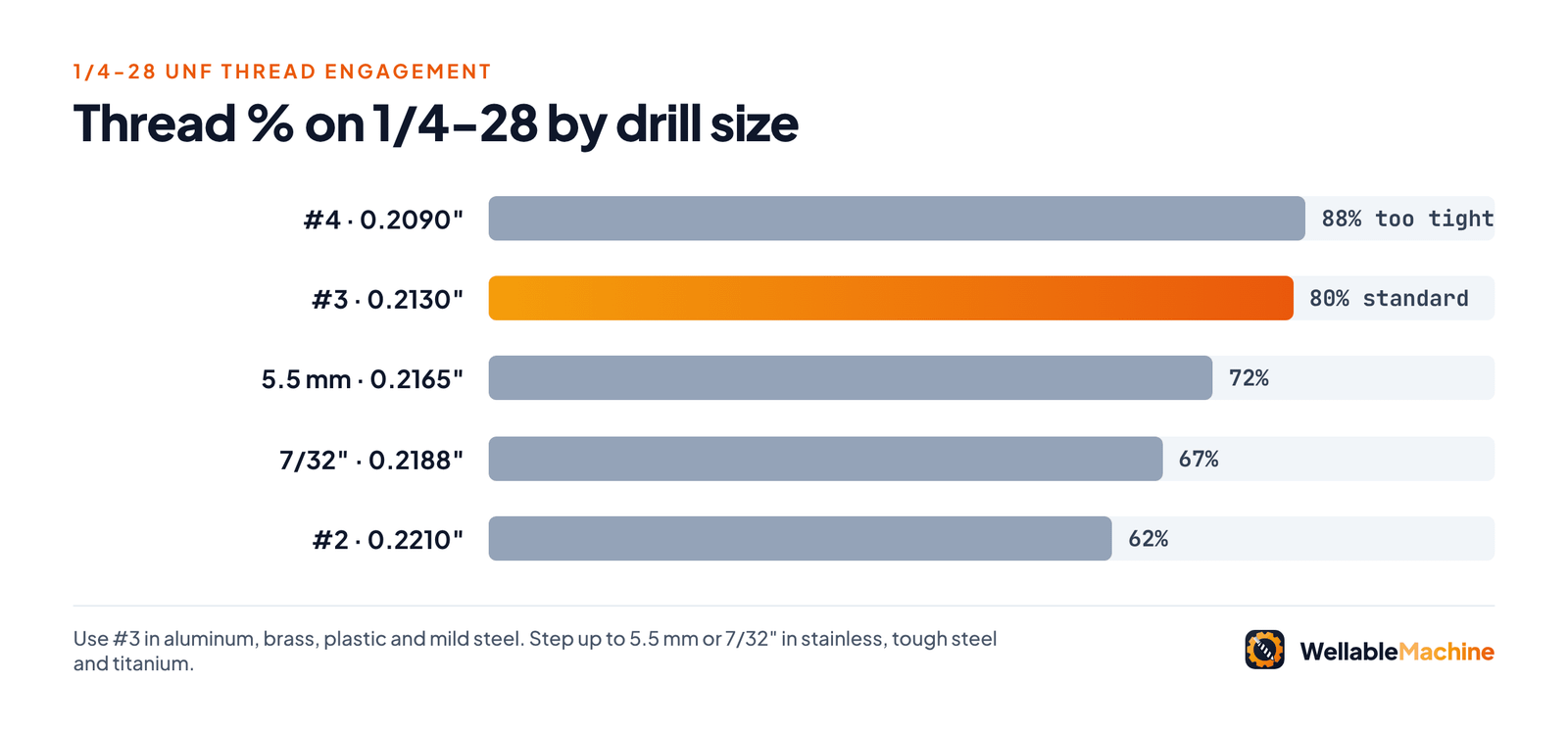
An 80% thread is on the full side. That’s fine in soft metals, but in stainless or alloy steel a 5.5 mm or 7/32 in drill reduces tapping torque a lot while leaving the thread nearly as strong. Fine threads have shallow teeth, so a few percent of engagement makes less difference than you might expect. The full 1/4-28 tap drill size guide covers clearance holes and thread depth.
The #3 as a Clearance Hole
A #10 machine screw is 0.190 in across. Common clearance fits are:
- Close fit: #10 drill (0.1935 in). Precise, but holes must line up well.
- Normal fit: #7 or 13/64 in (about 0.201–0.203 in).
- Free fit: #3 (0.213 in). About 0.023 in of play, so screws drop into holes that are slightly off.
That free fit is handy for sheet-metal panels, enclosure covers and brackets drilled by hand, where hole positions are rarely perfect. In metric work, a #3 is close to the 5.5 mm normal clearance for M5 screws. See the clearance hole size chart for every screw size.
Other Places a #3 Turns Up
- M6 × 0.75 extra-fine threads: these use a 5.25 mm drill; a #4 or #3 is the nearest inch size in tough material.
- Pilot holes for 1/4 in lag screws in softwood: a #3 works where a 13/64 in or 7/32 in bit is recommended for the threaded part. See lag screw pilot hole size.
- Rivets and pins: some 7/32 in (0.219 in) pins and rivets get a #3 hole for a firm push fit, then a reamer if precision matters.
- Enlarging a #7 hole: if a 1/4-20 tap was started in the wrong place, a #3 cleans the hole up for a 1/4-28 or a thread repair.
Substitutes for a #3 Drill
- 5.4 mm: the best substitute by far, within half a thousandth of an inch.
- 5.5 mm: good for 1/4-28 in steel; slightly looser as a clearance hole.
- 7/32 in: fine for clearance; gives a lighter 67% thread on 1/4-28.
- 13/64 in: too small for 1/4-28 (about a 100% thread). Don’t use it as a substitute.
If you only have fractional and metric sets, a 5.4 mm bit bought on its own covers almost every #3 job. Sets with 0.1 mm steps (1–13 mm) include it.
Drilling a Good #3 Hole in Metal
- Center punch the mark, or use a spot drill for accurate positions.
- Pilot with 1/8 in in steel thicker than about 1/8 in. In aluminum and brass you can usually drill the full size directly.
- Use sensible speeds. For a 0.213 in HSS bit: roughly 1,800 RPM in mild steel, 4,000+ RPM in aluminum if your press allows it, and 550–700 RPM in stainless with cutting oil. The drill speed chart lists other sizes.
- Peck deep holes every 1/4 to 3/8 in so chips don’t jam the flutes.
- Deburr with a countersink, especially before tapping.
For tap holes, a drill press keeps the bit square, which matters more with fine threads than with coarse ones. Our guide on how to use a drill press covers setup.
Tapping 1/4-28 After a #3
- Start square. Fine threads cross-thread easily; a tap guide block or the drill press spindle (power off) helps.
- Use tapping fluid. Light oil in aluminum, sulfurized oil in steel.
- Short strokes: half a turn in, a quarter back.
- Blind holes: drill about 5–6 threads (roughly 3/16 in) deeper than the thread you need and finish with a bottoming tap.
- Spiral point taps work well for through holes in a drill press or tapping attachment.
Our how to use a tap and die guide walks through hand tapping in more detail, and how to remove a broken tap helps if one snaps.
Which Type of #3 Bit to Buy
| Bit | Good for | Notes |
|---|---|---|
| HSS jobber, black oxide | Aluminum, brass, mild steel, plastic | Cheap and fine for occasional use |
| Cobalt (M35/M42) | Stainless and alloy steel | Holds its edge when the cut runs hot |
| Screw-machine (stub) length | Accurate tap holes | Shorter flutes, less wander |
| Solid carbide | CNC and hardened steel | Needs a rigid machine; see carbide drill bits |
Measuring a Worn or Unmarked Bit
Measure across the margins near the tip with calipers or a micrometer: a #3 reads 0.213 in or 5.41 mm. Be careful not to mix it up with a #4 (0.209 in) or 5.5 mm (0.2165 in), which are only a few thousandths away. A drill gauge plate with number holes is quicker: the bit should pass through the #3 hole and stop at the #4 hole.
1/4-28 vs 1/4-20: When the Fine Thread Makes Sense
Because the #3 is tied so closely to 1/4-28, it helps to know when you would choose that thread over the far more common 1/4-20. A fine thread has more threads per inch, so each turn moves the screw less and the threads are shallower.
- Thin walls: in sheet or tube around 1/8 in thick, 1/4-28 fits about 3.5 threads into the wall where 1/4-20 fits only 2.5, so it holds better.
- Vibration: fine threads are slightly less likely to loosen, which is why they are common on engines, aircraft and bicycles.
- Fine adjustment: set screws and adjusters move in smaller steps.
- Strength in steel: a 1/4-28 bolt has a slightly larger stress area than 1/4-20, so it is a little stronger in tension.
- Soft materials: 1/4-20 is better in aluminum, plastic and wood, where shallow fine threads strip more easily, and it is far easier to find hardware for.
In short: if the part already calls for 1/4-28, use a #3. If you are designing something new for soft material, 1/4-20 with a #7 drill is usually the better choice.
Speeds for a #3 Drill by Material
| Material | Bit | Approx. RPM | Lubricant |
|---|---|---|---|
| Aluminum | HSS | 3,500–4,500 | Light oil or WD-40 |
| Brass and bronze | HSS | 2,500–3,500 | Dry or light oil |
| Mild steel | HSS or cobalt | 1,600–1,800 | Cutting oil |
| Stainless steel | Cobalt | 550–700 | Sulfurized cutting oil |
| Plastics | HSS | 1,500–2,500 | Dry; peck to avoid melting |
| Hardwood | HSS or brad point | 2,000–3,000 | None |
Keeping 1/4-28 Threads Straight
A crooked tap gives a thread that binds and a bolt that leans. Drill the #3 hole in a drill press if you can, then leave the part clamped and use the press as a guide: put a center in the chuck, rest its point in the tap wrench’s center hole and turn the tap by hand while lowering the quill. Without a press, a simple tapping block (a hardwood or steel block with a square-drilled 1/4 in hole) slides over the tap and holds it upright for the first few turns.
Frequently Asked Questions
6 quick answers from our editors
01What size is a #3 drill bit?
0.2130 in, which is 5.41 mm.
02What is a #3 drill bit used for?
Mainly as the tap drill for 1/4-28 UNF threads, and as a free-fit clearance hole for #10 screws.
03What metric drill equals a #3?
5.4 mm. It is only 0.0004 in smaller than a #3.
04Is a #3 drill bigger than 7/32?
No. 7/32 in is 0.2188 in, about 0.006 in bigger than a #3.
05Can I use 7/32 instead of #3 for 1/4-28?
Yes, especially in steel or stainless. It gives about a 67% thread, which is still strong and much easier to tap.
06Is a #3 drill bigger than a #4?
Yes. #3 is 0.213 in and #4 is 0.209 in. Number drills get smaller as the number increases.
Bottom Line
A #3 drill is 0.213 in (5.41 mm), and a 5.4 mm bit is its practical twin. Use it as the 1/4-28 tap drill in aluminum, brass and mild steel, step up to 5.5 mm or 7/32 in for steel and stainless, and use it as a free-fit clearance hole for #10 screws. For every other thread, see our tap drill size chart.