8 mm Drill Bit in Inches: 0.315″ (Is 5/16 the Same?)
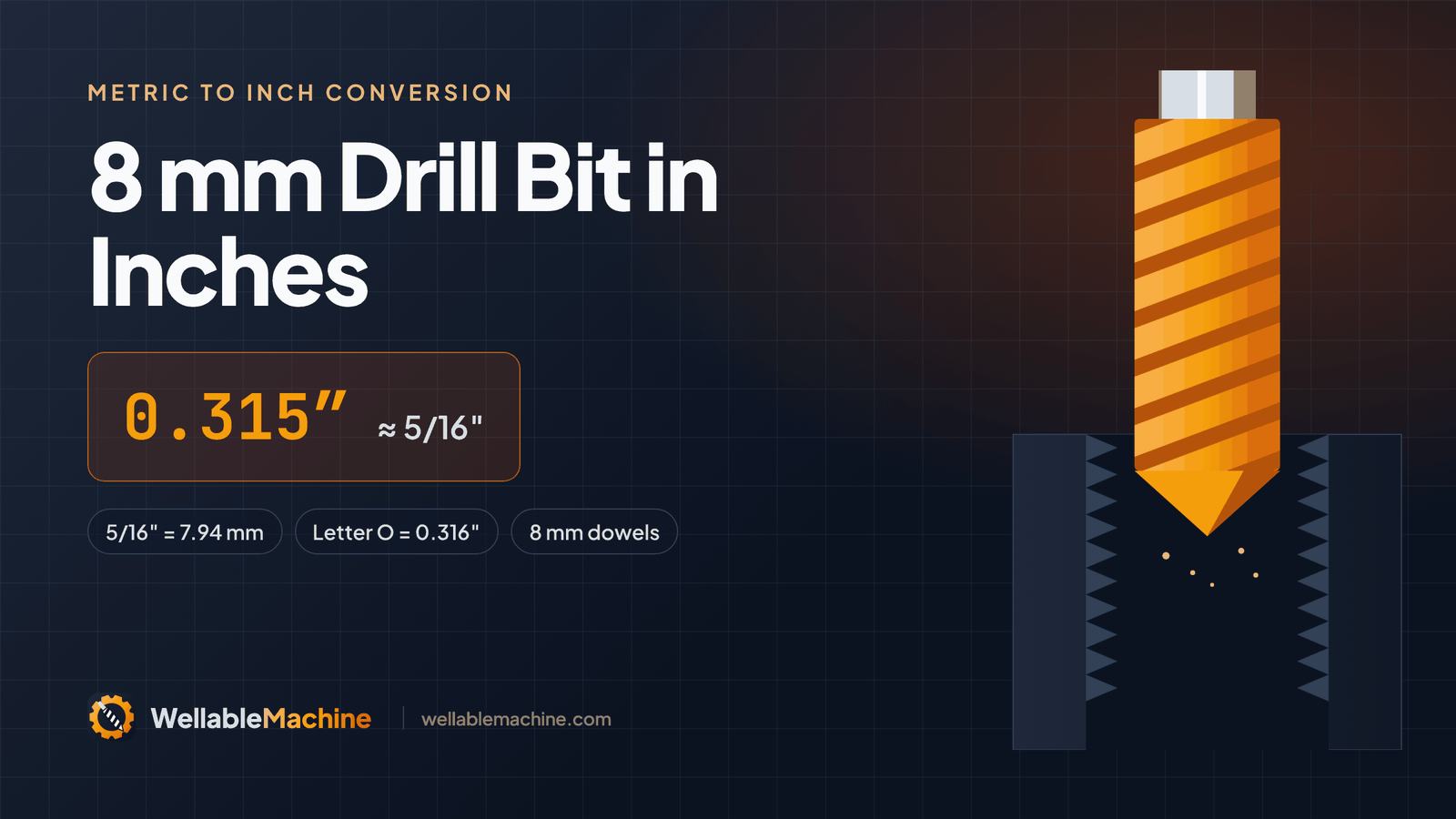
Quick answer: an 8 mm drill bit is 0.315 in (0.31496 in) in diameter. The closest fractional size is 5/16 in (0.3125 in), which is only 0.0025 in (0.06 mm) smaller. The closest letter drill is O (0.316 in), practically identical. For most woodworking and masonry jobs, 5/16 in and 8 mm can be swapped; for tight fits such as dowels and precision holes, use the exact 8 mm size.
8 mm is one of the most common metric drill sizes in the world. It’s the standard size for furniture dowels, wall plugs and many masonry fixings, and it shows up all the time in European instructions. If your bits are in inches, this guide tells you exactly how 8 mm compares, when a 5/16 in bit will do, when it won’t, and what an 8 mm bit is used for.
8 mm Drill Bit at a Glance
| Property | Value |
|---|---|
| Diameter in inches | 0.3150 in (0.31496 in) |
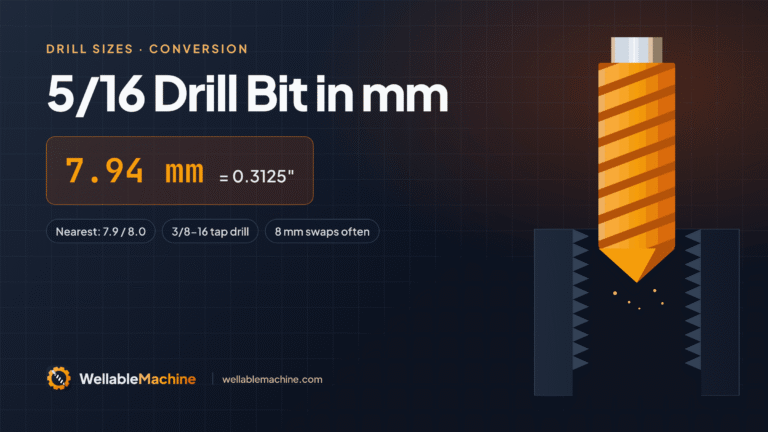
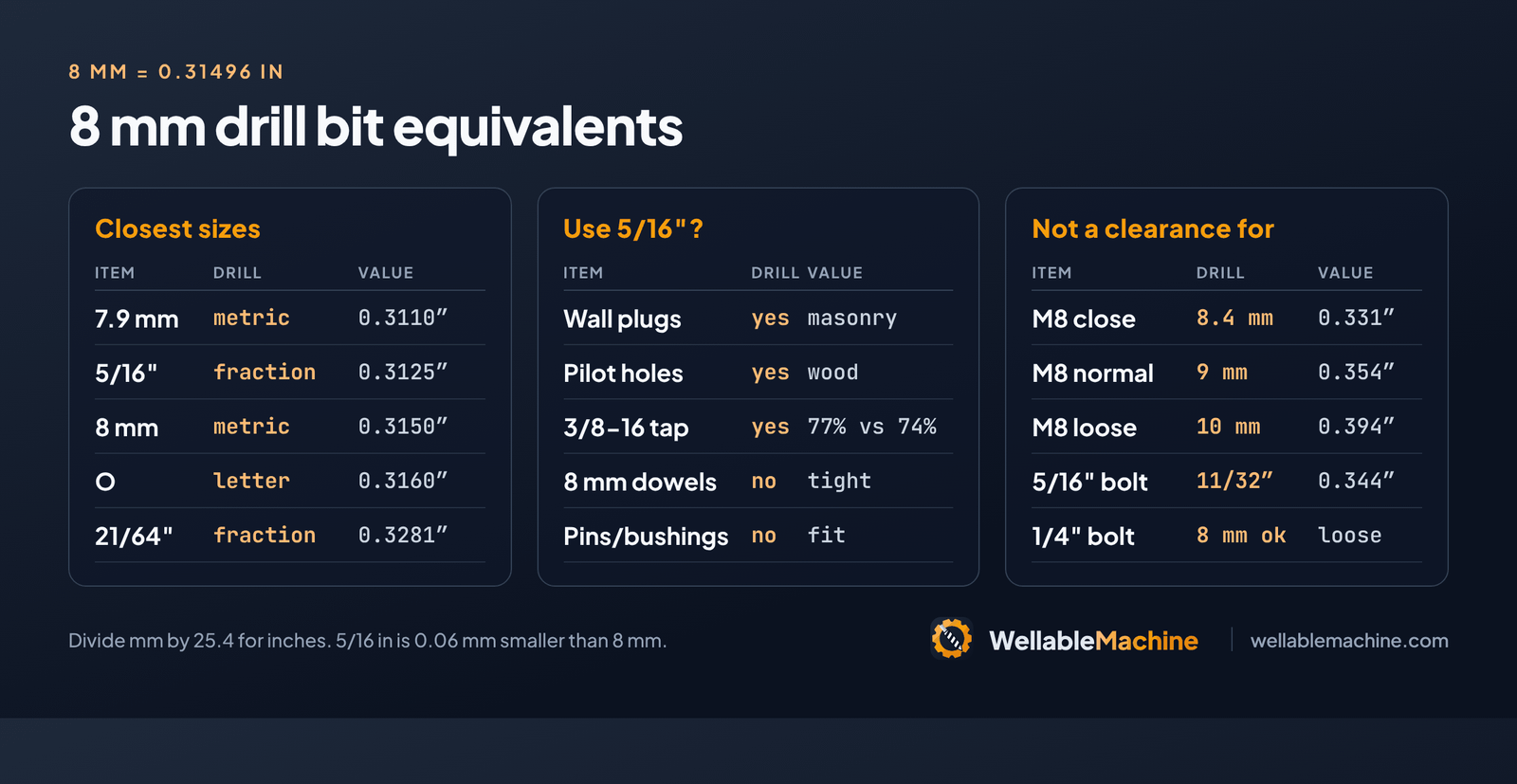
| Closest fractional | 5/16 in = 0.3125 in (7.94 mm), 0.0025 in smaller |
| Next fractional up | 21/64 in = 0.3281 in (8.33 mm), 0.0131 in larger |
| Closest letter drill | O = 0.3160 in (8.03 mm), 0.001 in larger |
| Next metric sizes | 7.9 mm (0.3110 in), 8.1 mm (0.3189 in) |
| Common uses | 8 mm dowels, wall plugs, sleeve anchors, metric tap substitutes |
How to Convert 8 mm to Inches
One inch is defined as exactly 25.4 mm, so you divide millimeters by 25.4: 8 ÷ 25.4 = 0.31496 in. To go the other way, multiply inches by 25.4: 5/16 in = 0.3125 × 25.4 = 7.9375 mm. The exact definition is explained in the inch reference.
To find the nearest fractional drill, multiply the decimal by 64: 0.31496 × 64 = 20.16, so the nearest 64th is 20/64, which reduces to 5/16 in. Since 20.16 is just above 20, 5/16 in is slightly smaller than 8 mm.
Metric Drills Near 8 mm in Inches
| Metric | Inches | Nearest fractional | Nearest letter / number |
|---|---|---|---|
| 6 mm | 0.2362 | 15/64 (0.2344) | B (0.238) |
| 6.5 mm | 0.2559 | 1/4 (0.2500) | F (0.257) |
| 7 mm | 0.2756 | 9/32 (0.2813) | J (0.277) |
| 7.5 mm | 0.2953 | 19/64 (0.2969) | M (0.295) |
| 8 mm | 0.3150 | 5/16 (0.3125) | O (0.316) |
| 8.5 mm | 0.3346 | 21/64 (0.3281) | Q (0.332) |
| 9 mm | 0.3543 | 23/64 (0.3594) | T (0.358) |
| 9.5 mm | 0.3740 | 3/8 (0.3750) | V (0.377) |
| 10 mm | 0.3937 | 25/64 (0.3906) | X (0.397) |
For the full list of fractional sizes, see our fractional drill bit sizes guide, and for letter drills the number and letter drill size chart.
Can You Use 5/16 in Instead of 8 mm?
The difference is 0.06 mm, about the thickness of a sheet of printer paper. Whether that matters depends on the job.
Where 5/16 in works fine
- Wall plugs in masonry: masonry bits cut slightly oversize anyway, and plastic plugs have ribs that grip. A 5/16 in masonry bit is the normal US substitute for 8 mm.
- Clearance and cable holes in wood: nobody will notice 0.06 mm.
- Pilot holes for large screws, lag bolts and threaded inserts in wood.
- Tap drill for 3/8-16: 5/16 in is actually the standard size. 8 mm also works (see below).
Where you need a true 8 mm bit
- 8 mm dowels: a 5/16 in hole is 0.06 mm tight. With glue swelling the dowel, it can be very hard to drive home, and it may split thin parts. Use an 8 mm brad point bit.
- 8 mm pins, shafts and bushings in metal or plastic, where the fit is specified.
- 8 mm sleeve anchors and frame fixings, where the maker specifies the hole and the holding values depend on it.

What Is an 8 mm Drill Bit Used For?
Furniture dowels
8 mm is the most common dowel size in flat-pack and European cabinet furniture, usually 8 × 30 mm or 8 × 35 mm, and it pairs with the 32 mm system used for hinges and shelf holes. For 18–19 mm (3/4 in) boards, an 8 mm dowel is close to the ideal of about 1/3 to 1/2 the board thickness. A sharp 8 mm brad point bit gives accurate, clean dowel holes.
Wall plugs and masonry fixings
8 mm plugs are a standard size for shelves, brackets and TV mounts in brick and block. They usually take a 4.5–6 mm (about #10–#12) screw. 8 mm frame fixings go straight through the part and into the wall, and many 8 mm sleeve anchors take an M6 bolt. Use an 8 mm masonry or SDS-plus bit, and check our wall anchor drill bit size chart for other plug sizes.
Metal work and tapping
8 mm drills are useful in metal shops too:
- 3/8-16 UNC tap drill substitute: 8 mm gives about 74% thread, compared with 77% from the standard 5/16 in. It taps a little more easily. See the 3/8-16 tap drill size guide.
- Pre-drilling for M10: drill 8 mm before opening up to the 8.5 mm tap drill for M10 × 1.5 threads in tough steel.
- Not a clearance hole for M8: an M8 bolt needs at least 8.4 mm (close fit), 9 mm (normal) or 10 mm (loose). An 8 mm hole is the same size as the bolt.
Woodworking hardware
8 mm holes are used for many furniture connector bolts, cross dowels, threaded inserts for M5–M6 bolts (check the insert chart), and as clearance holes for M6 and 1/4 in bolts in wood.
Choosing the Right 8 mm Bit
| Material | Bit type | Tip |
|---|---|---|
| Wood, plywood, MDF | Brad point | Clean edges, accurate start for dowels |
| Mild steel, aluminum | HSS twist (jobber or stub) | Cutting oil in steel, pilot with 3–4 mm |
| Stainless, hard steel | Cobalt (HSS-Co M35/M42) | Slow speed, heavy feed |
| Brick, block, mortar | Carbide masonry bit, hammer mode | Clean dust out before inserting the plug |
| Concrete | SDS-plus bit in a rotary hammer | Much faster than a hammer drill |
| Tile | Diamond or carbide tile bit, no hammer | Switch to a masonry bit after the tile |
8 mm Drill Speeds
Starting speeds for an 8 mm (5/16 in) bit:
- Softwood: about 2,000–2,500 RPM
- Hardwood: about 1,500–2,000 RPM
- Aluminum: about 2,500–3,000 RPM (HSS)
- Mild steel: about 1,000–1,200 RPM
- Stainless steel: about 400–600 RPM with a cobalt bit
- Masonry: use the drill’s hammer mode at medium speed, about 1,000–1,500 RPM
For other sizes and materials, see the drill speed chart.
How to Drill an Accurate 8 mm Hole
- Mark and punch (awl in wood, center punch in metal) so the bit starts on the spot.
- Drill a pilot of 3–4 mm in metal. The chisel edge of an 8 mm drill is wide and wanders without one.
- Set the depth with a stop collar or tape, especially for dowel holes: half the dowel length plus 1–2 mm.
- Keep the bit square with a drill guide, a doweling jig or a drill press.
- Clear chips or dust often in deep holes, and blow or vacuum out masonry holes before fitting plugs.
- Check the size with a test piece: a dowel or pin should go in with firm hand pressure.
How to Check That a Bit Really Is 8 mm
Drill bits lose their size markings quickly, and 5/16 in and 8 mm bits look identical in a drill index. To tell them apart:
- Measure the shank with calipers, not the fluted end. The flutes have a slight back taper, and the margins wear. An 8 mm bit reads about 7.98–8.00 mm (0.314–0.315 in); a 5/16 in bit reads about 7.92–7.94 mm (0.312 in).
- Use a drill gauge. A metal plate with labelled holes is the fastest way to sort a drawer of loose bits.
- Check a test hole with an 8 mm dowel or pin. In metal, a new bit with unequal lips can cut 0.05–0.1 mm oversize, which is more than the whole difference between the two sizes.
8 mm Holes for Inch Hardware
If you’re working in a metric country with inch hardware, or the other way round, these pairings are handy:
- 1/4 in bolts: an 8 mm hole is a loose clearance fit (0.065 in over), fine for brackets and wood.
- 5/16 in bolts: 8 mm is too tight to be a clearance hole. Use 11/32 in or 9 mm.
- 1/4-20 threaded inserts in wood: many need a 3/8 in (9.5 mm) or 10 mm hole, not 8 mm. Check the insert packet.
- #10 and #12 wood screws: fit 8 mm plastic plugs in masonry.
Frequently Asked Questions
7 quick answers from our editors
01What is 8 mm in inches?
0.315 in. It’s just over 5/16 in (0.3125 in).
02Is 5/16 the same as 8 mm?
Almost. 5/16 in is 7.94 mm, 0.06 mm smaller than 8 mm. It works for plugs, pilot holes and clearance, but it’s tight for 8 mm dowels.
03What fraction is closest to 8 mm?
5/16 in. The next size up, 21/64 in, is 8.33 mm.
04What letter drill is 8 mm?
The O drill, at 0.316 in (8.03 mm), is the closest.
05What size screw fits an 8 mm wall plug?
Usually a 4.5–6 mm screw, about #10 to #12 in inch sizes. Check the plug packet.
06Can an 8 mm drill be used for a 3/8-16 tap?
Yes. It gives about 74% thread, close to the standard 5/16 in drill.
07What drill size is an M8 clearance hole?
8.4 mm for a close fit, 9 mm for a normal fit and 10 mm for a loose fit. See the clearance hole size chart.
Bottom Line
An 8 mm drill bit is 0.315 in, just 0.0025 in larger than 5/16 in and almost identical to an O letter drill. Use a 5/16 in bit in its place for wall plugs, pilot holes and tapping 3/8-16 threads. Use a true 8 mm bit for 8 mm dowels, pins, sleeve anchors and anything with a specified fit. And remember that an 8 mm hole is not a clearance hole for an M8 bolt; that needs 8.4 to 10 mm.