M22 Tap Drill Size: 19.5 mm Drill, Fine Thread & Clearance Holes
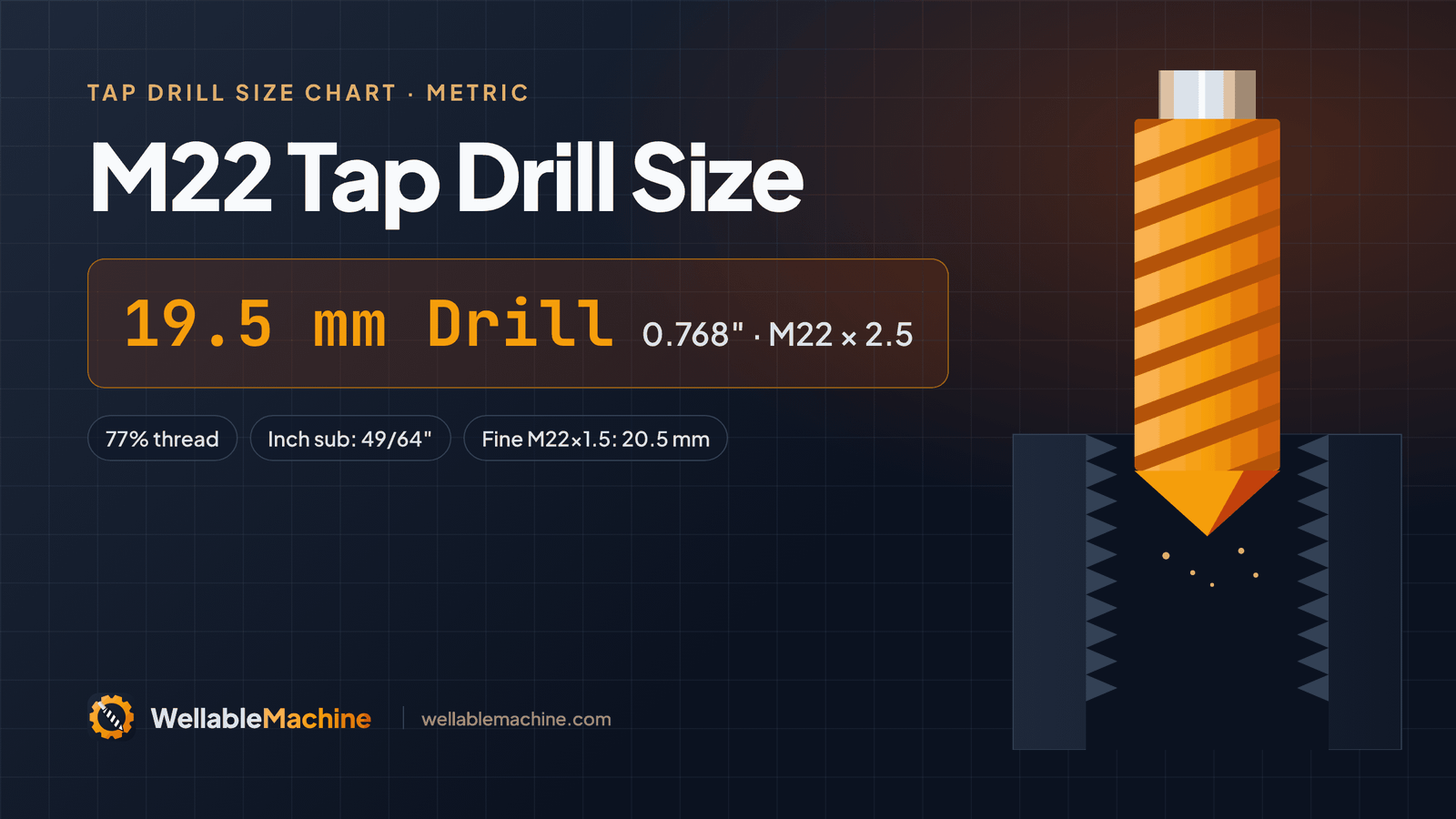
Quick answer: the standard tap drill for an M22 × 2.5 (coarse) thread is 19.5 mm (0.768 in), which gives about a 77% thread. The closest inch drill is 49/64 in. For the fine thread M22 × 1.5, use a 20.5 mm drill.
M22 is a “second choice” size in the ISO metric series, so it is less common than M20 or M24. It still turns up on heavy machinery, structural fixings, pressure vessels and, in its fine pitch, on truck wheel studs and hydraulic fittings. This guide gives the tap drills for both pitches, clearance holes, and practical tips for drilling and tapping a thread this large.
M22 Thread Specifications at a Glance
“M22” means a 22 mm metric thread. With no pitch given, it is the coarse 2.5 mm pitch from the ISO metric screw thread standard. The common fine pitch is 1.5 mm. The quick rule for a metric tap drill is diameter minus pitch: 22 − 2.5 = 19.5 mm.
| Specification | Value |
|---|---|
| Thread series | ISO metric coarse |
| Major diameter | 22.00 mm (0.866 in) |
| Pitch | 2.5 mm (about 10.2 TPI) |
| Minor diameter (external) | 18.93 mm |
| Standard tap drill | 19.5 mm (0.768 in) |
| Inch substitute | 49/64 in (19.45 mm) |
| Fine pitch tap drill | M22 × 1.5: 20.5 mm |
| Medium clearance (ISO 273) | 24 mm |
| Wrench size, hex bolt | 34 mm (ISO) / 32 mm (DIN) |
| Hex key, socket head screw | 17 mm |
M22 Tap Drill Size Chart by Thread Percentage
Pick the drill by how much thread engagement you need. Around 75% is the shop standard for M22; going tighter mostly adds tapping torque and broken taps, while going looser makes hard metals much easier to thread. Each figure below comes from % thread = (D − drill) ÷ (1.299 × pitch) × 100.
| Drill | mm | Inches | Approx. thread | When to use it |
|---|---|---|---|---|
| 19 mm | 19.00 | 0.7480 | 92% | Too tight; tap will stall |
| 19.25 mm | 19.25 | 0.7579 | 85% | Full thread in soft metals |
| 49/64 | 19.45 | 0.7656 | 79% | Inch substitute for 19.5 mm |
| 19.5 mm | 19.50 | 0.7677 | 77% | Standard (pitch rule) |
| 19.75 mm | 19.75 | 0.7776 | 69% | Steel by hand, stainless |
| 20 mm | 20.00 | 0.7874 | 62% | Light duty only |

Which drill should you use? 19.5 mm is the standard drill and right for cast iron, aluminum and machine tapping. For hand tapping steel, 19.75 mm (about 69%) is noticeably easier and still strong. 49/64 in is close enough to 19.5 mm to use if you only have inch drills. Avoid 19 mm.
Clearance Hole Sizes for an M22 Bolt
ISO 273 clearance holes for M22 bolts. For other sizes, see our clearance hole size chart.
| Fit | Drill | Inches | mm | Use it for |
|---|---|---|---|---|
| Fine (close) | 23 mm | 0.906 | 23.0 | Machined, precise alignment |
| Medium (normal) | 24 mm | 0.945 | 24.0 | Most assemblies |
| Coarse (loose) | 26 mm | 1.024 | 26.0 | Fabrication, structural |
M22 vs. M22 × 1.5 vs. 7/8-9
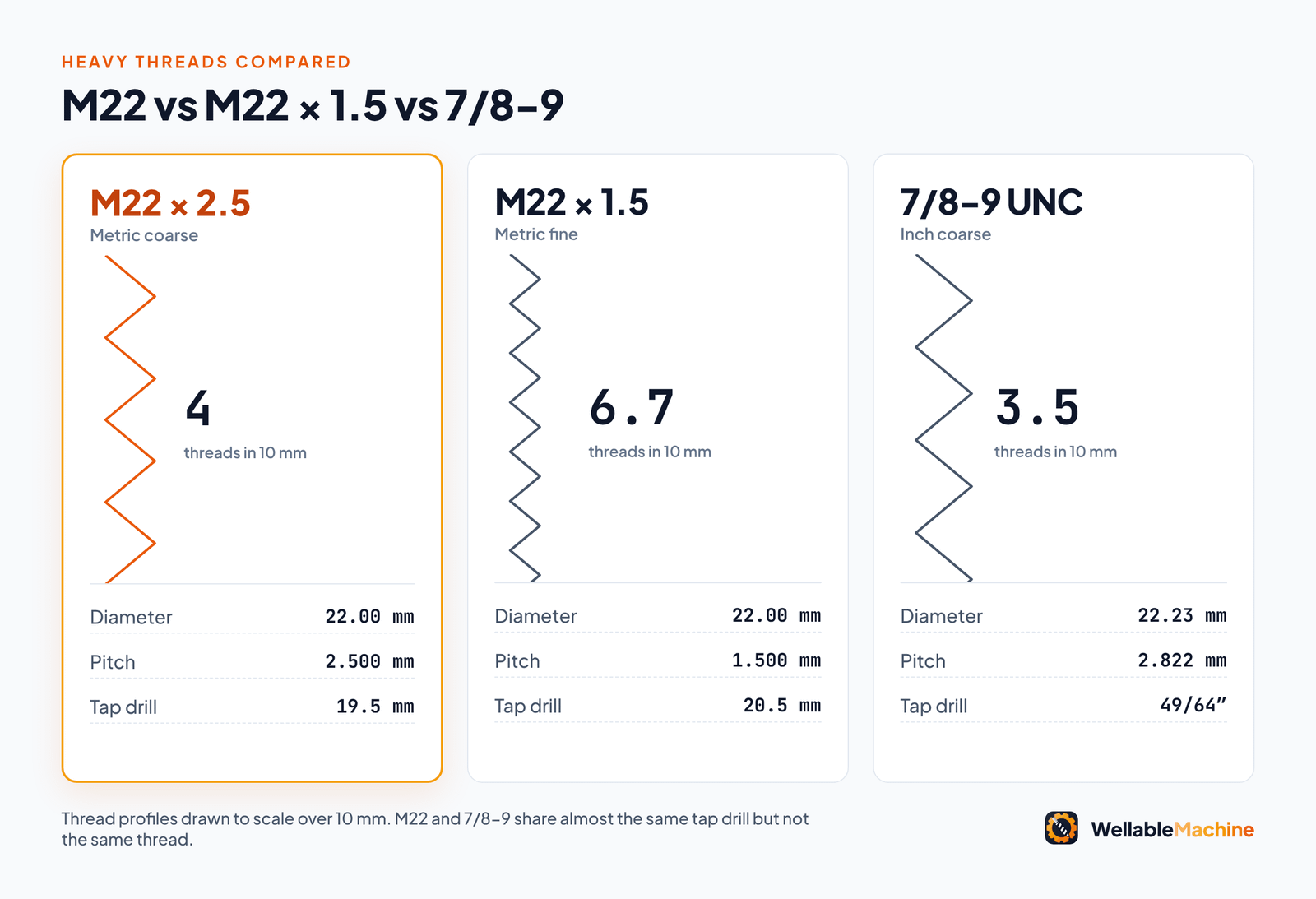
M22 coarse and fine share a diameter. The inch 7/8-9 is only 0.23 mm larger, which is why bolts from mixed machinery get swapped by mistake.
| Thread | Diameter | Pitch | Tap drill | Typical use |
|---|---|---|---|---|
| M22 × 2.5 | 22.00 mm | 2.5 mm | 19.5 mm | Machinery, structural |
| M22 × 1.5 | 22.00 mm | 1.5 mm | 20.5 mm | Truck wheel studs, hydraulics |
| 7/8-9 UNC | 22.23 mm | 2.822 mm (9 TPI) | 49/64 in | Inch structural, flanges |
For the inch size, see the 7/8-9 tap drill size. The neighboring metric sizes are M20 and M24.
Other M22 Hole Sizes You Might Need
- Helicoil / STI insert: about 23 mm drill with the M22 × 2.5 STI tap.
- Counterbore for a socket head cap screw: 35 mm diameter, 22.5 mm deep.
- Fine thread M22 × 1.5: 20.5 mm drill.
- Through-bolt in timber: 24 mm hole with a large washer.
How to Drill and Tap a M22 Hole
- Mark and center punch the hole so the drill starts exactly where you want it.
- Drill with a 19.5 mm bit. In aluminum, run about 500 RPM; in mild steel, about 300 RPM; in stainless, slow down to about 150 RPM with steady pressure and cutting oil. Our guide on how to drill stainless steel explains why stainless needs low speed and constant feed.
- Add a light chamfer just wider than the thread diameter, so the screw starts easily and the top thread stays clean.
- Start the tap straight. Start the tap in the drill press or mill spindle with the power off, or use a tap guide block.
- Keep the chips short: every half turn, back off a little so the chip breaks. Re-oil after every few turns, and back the tap right out if it starts to feel gritty.
- For blind holes, drill at least 7.5 mm (3 pitches) deeper than the full thread you need, and finish with a bottoming tap.
If a large tap jams, back it out rather than forcing it; see how to remove a broken tap if it breaks. For drilling speeds, see our drill speed chart.
Tapping M22 in Different Materials
Soft metals forgive mistakes; tough ones do not. Use this table to adjust your drill, fluid and approach for the material in front of you.
| Material | Recommended drill | Tapping fluid | Tips |
|---|---|---|---|
| Aluminum | 19.5 mm | Light oil or WD-40 | 19.5 mm; light oil |
| Mild steel | 19.5 mm | Sulfurized cutting oil | Reverse often to break the chip |
| Stainless (304/316) | 19.75 mm | Heavy tapping paste | Cobalt tap; tapping paste |
| Brass | 19.5 mm | Dry or light oil | Cuts cleanly; tap can grab at the end |
| Cast iron | 19.5 mm | Dry or kerosene | Easy to tap; clear powder often |
How Deep Should a M22 Thread Be?
A common rule is to engage at least one screw diameter in steel and more in softer metals. Past that, extra length adds work but very little holding power:
- Steel: 1 × diameter, 22 mm.
- Cast iron: 1.5 × diameter, 33 mm.
- Aluminum: 2 × diameter, 44 mm, or use an insert.
Where Is M22 Used?
M22 is used on heavy machinery and machine bases, structural and foundation bolts, pressure equipment, and (as M22 × 1.5) on truck and bus wheel studs and metric hydraulic fittings.
M22 × 1.5 Fine Thread
The fine pitch M22 × 1.5 is used where a coarse thread would be too deep for the wall, and on parts that need a strong, vibration-resistant thread:
- Truck and bus wheel studs: M22 × 1.5 is a standard wheel stud thread on many heavy commercial vehicles. Never re-tap these; replace damaged studs and nuts.
- Hydraulic and pneumatic fittings: M22 × 1.5 ports and adapters are common on metric hydraulic equipment.
- Sensor and plug bosses on engines and gearboxes.
Tap drill for M22 × 1.5 is 20.5 mm (about 77% thread). Use 20.6 mm or 13/16 in (20.64 mm) for easier tapping.
Drilling a 19.5 mm Hole
Use a drill press or magnetic drill and step up in sizes: a pilot of 6–8 mm, then about 12 mm, then 19.5 mm. A reduced-shank bit lets a 13 mm chuck hold it. Run around 250 RPM in mild steel and 125 RPM in stainless, with cutting oil, and clamp the work firmly. For holes in plate or beams, an annular cutter is faster and leaves a cleaner hole. Our drill speed chart gives speeds for other materials.
Common M22 Tapping Problems (and How to Fix Them)
- Bolt jams after a turn: check whether it is M22 × 1.5 or a 7/8-9 inch bolt.
- Tap very hard to turn: open the hole to 19.75 mm for hand tapping in steel.
- Thread crooked: use a spindle or guide to start the tap.
- Hard to find an M22 bolt: M22 is a second-choice size; check the drawing before substituting M20 or M24.
Frequently Asked Questions
6 quick answers from our editors
01What size drill for an M22 tap?
19.5 mm for M22 × 2.5 coarse thread, about 77% thread.
02What drill for M22 x 1.5?
20.5 mm.
03What is the inch equivalent of the M22 tap drill?
49/64 in (19.45 mm).
04What clearance hole for M22?
23 mm close, 24 mm normal or 26 mm loose.
05What wrench size is an M22 bolt?
34 mm for ISO hex heads, 32 mm for older DIN heads.
06Is M22 a common bolt size?
Less common than M20 and M24. It is a second-choice ISO size, but it is still used on heavy equipment.
Bottom Line
For M22 × 2.5, drill 19.5 mm (or 49/64 in); for M22 × 1.5, drill 20.5 mm. Clearance is 24 mm for a normal fit. Drill in steps, start the tap square and use plenty of oil. For every size, see our tap drill size chart.