How to Drill Glass Without Cracking It

Quick answer: to drill glass, use a diamond core bit (or a carbide spear-point bit for small holes), run the drill slowly (about 400–800 RPM for a 1/4 in hole, slower for bigger ones) with no hammer action, keep the spot wet with water the whole time, and use only light pressure. Start the bit at an angle or through a guide so it doesn’t skate, and ease off as you break through. Tempered (safety) glass cannot be drilled: it will shatter.
Glass is hard but brittle. A normal twist bit can’t cut it, and heat or too much pressure cracks it. With the right bit, water and patience, though, you can drill clean holes in bottles, jars, shelves, tabletops and mirrors with an ordinary cordless drill. This guide shows how, and how to avoid the cracks and chips that spoil most first attempts.
First: Can This Glass Be Drilled?
Check before you start, because one type of glass will explode the moment the bit breaks its surface.
- Annealed (regular) glass: picture frames, most bottles and jars, old windows, many shelves. Drillable.
- Tempered glass: shower doors, oven doors, car side windows, glass tabletops and many modern shelves. Not drillable. Tempered glass is under internal stress and shatters into small cubes if you drill or cut it. It is often marked with a small etched logo in one corner.
- Laminated glass: two sheets bonded with a plastic layer (car windshields, some balustrades). Very hard to drill cleanly; best left to a glazier.
- Mirrors: usually annealed glass with a painted silver backing. Drillable from the glass side.
If you need a hole in tempered glass, order a new piece with the hole made before tempering.
Choosing a Bit
| Bit | Hole sizes | Pros | Cons |
|---|---|---|---|
| Diamond core bit (hollow) | 1/4 in to 2 in+ | Fastest, cleanest holes; long life with water | Hard to start without a guide |
| Carbide spear-point (glass and tile) bit | 1/8 to 1/2 in | Cheap; starts easily | Slow; wears quickly; more chipping |
| Solid diamond-tipped bit | Under 1/4 in | Good for small holes in bottles and beads | Small sizes only |
| Standard twist bit | – | – | Will not cut glass |
For holes over about 1/2 in, a diamond core bit is the only sensible choice. Many are sold as tile bits; the same bits drill porcelain and ceramic, as explained in our guide on how to drill through tile.

What You Need
- A drill with variable speed and the hammer function turned off. A drill press is ideal for small pieces.
- A diamond core bit or spear-point bit of the right size.
- Water: a spray bottle, a sponge, or a dam of plumber’s putty filled with water.
- Masking or painter’s tape, a marker, and a drilling guide or a scrap of wood with a hole in it.
- Safety glasses and gloves. Glass edges are sharp, and a cracked piece can split suddenly.
How to Drill Glass Step by Step
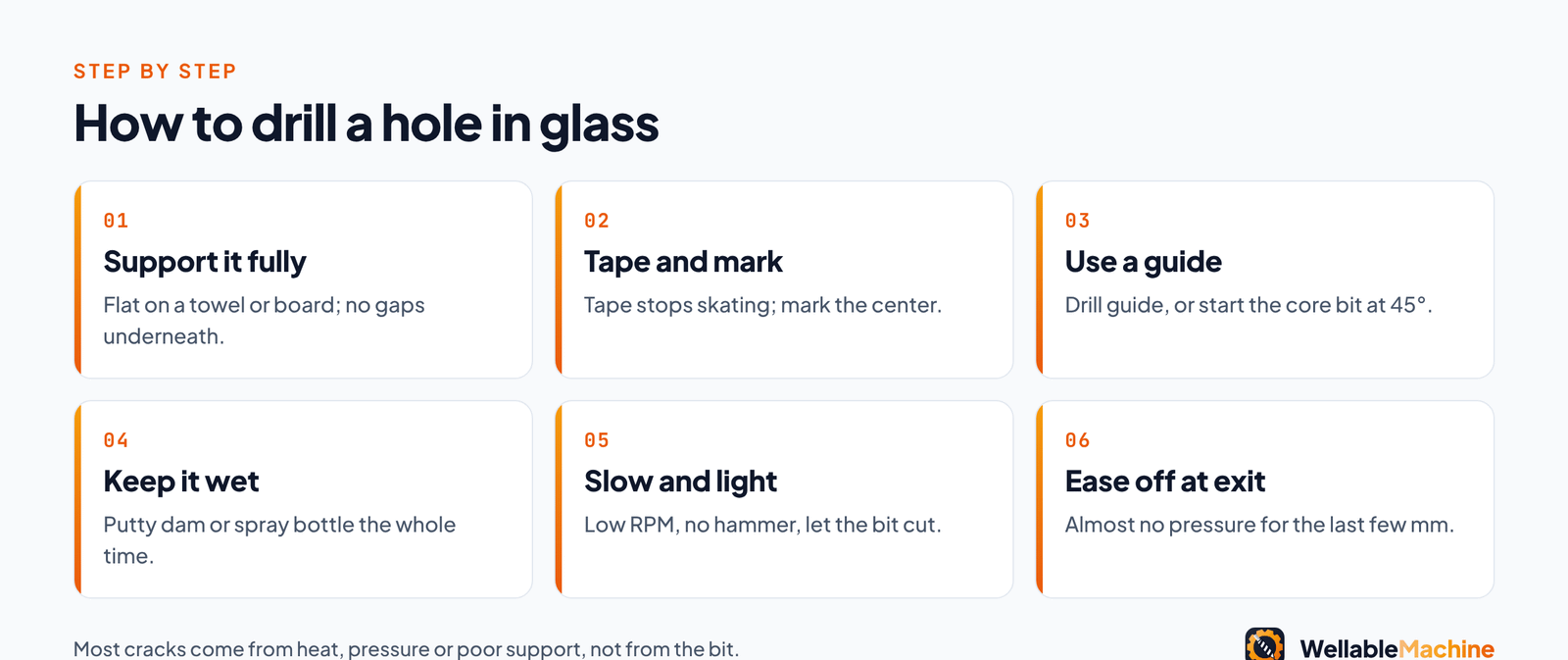
- Support the glass. Lay sheet glass flat on a towel or a sheet of plywood so it is fully supported. Bottles and jars can rest in a towel nest or be wedged in a box.
- Mark the hole. Put tape over the spot and mark the center. Keep holes at least 3/4 in (or twice the glass thickness) from any edge.
- Set up a guide. Clamp a scrap board with a hole of the same size, or use a suction-cup drill guide. Without one, start a core bit tilted at about 45° so only one edge touches, then slowly bring it upright once a small crescent is cut.
- Add water. Make a ring of plumber’s putty around the mark and fill it with water, or have a helper spray continuously. A dry diamond bit burns out in seconds, and heat cracks the glass.
- Drill slowly with light pressure. Let the bit do the work. A gentle circular rocking motion with a core bit helps clear the slurry. Pull out now and then to let water flow in.
- Ease off near the end. When you are almost through, reduce pressure to a minimum. For a cleaner exit on thick glass, drill halfway, turn the piece over and finish from the other side.
- Clean and smooth. Remove the tape and slurry, and smooth any sharp edge with fine wet-and-dry paper or a diamond file.
Speeds for Drilling Glass
Too much speed creates heat; too little wastes time. These are good starting points with a diamond core bit and water:
| Hole size | Approx. speed |
|---|---|
| 1/4 in (6 mm) | 600–800 RPM |
| 1/2 in (12 mm) | 400–600 RPM |
| 1 in (25 mm) | 300–400 RPM |
| 2 in (50 mm) | 200–300 RPM |
Carbide spear-point bits should run slower still. Our drill speed chart covers other materials, and the hole saw size chart lists standard sizes if you need a hole for a fitting.
Drilling Bottles and Jars
Bottles are popular for lamps and planters. Lay the bottle on its side in a towel so it can’t roll, and drill through the side or the base with a diamond core bit and water. The curved surface makes the bit skate, so a guide or the 45° starting trick is essential. Many bottles have thicker glass near the base; drill a little higher if the base is uneven. Drain holes for planters work well at 1/4–1/2 in.
Drilling Mirrors
Drill from the glass side, never through the backing first. Protect the back with tape so the silver coating doesn’t flake around the exit. Use extra water and very light pressure for the last few millimeters, because mirror backings chip easily. Mount drilled mirrors with rubber or nylon washers so the screw never touches the glass, and don’t overtighten.
Why Glass Cracks While Drilling
- Heat: not enough water, or too fast a speed. Keep the hole flooded.
- Pressure: pushing hard bends the glass and starts a crack. Let the bit cut.
- Poor support: a gap under the glass lets it flex. Support the whole sheet.
- Hammer mode: always switch it off.
- Too close to an edge: keep at least twice the glass thickness away.
- Tempered glass: it can’t be drilled at all.
Plastic glazing is a different story: acrylic and polycarbonate need sharp plastic bits instead. See how to drill acrylic. To keep any hole perpendicular, the tricks in how to drill a straight hole apply here too, and our overview of types of drill bits explains how diamond and carbide bits differ from twist bits.
Large Holes for Sinks, Fittings and Lamps
Holes of 1 in and more, for vessel sink drains, aquarium bulkheads or lamp fittings, need a large diamond core bit and extra care. Run slowly (200–300 RPM for a 2 in bit), keep the cut flooded, and don’t let the bit sit still in one spot. For thick glass, drill about halfway, turn the piece over and finish from the other side, lining up with a pilot hole or by marking both faces carefully. This keeps both faces free of chips. Aquariums are a special case: the glass in many tanks is tempered on the bottom or sides, and a crack in a filled tank can be dangerous, so confirm the glass type with the maker first.
Glass Tile and Mosaics
Glass tiles drill the same way as sheet glass, but they are often fixed to a wall already. Use a diamond core bit with water from a spray bottle, start at an angle or through a guide, and drill the tile only; then switch to a masonry bit for the wall behind it, as described in how to drill through tile. Keep holes away from the tile edges, and drill through the middle of a tile rather than a grout line when hanging heavy items.
Finishing the Hole
A freshly drilled hole has a sharp rim and sometimes tiny chips. Wrap fine wet-and-dry paper (400–600 grit) around a dowel and work it around the hole with water, or use a small tapered diamond file. A slight bevel on both edges makes the hole stronger and safer to handle, and it stops screws and fittings from putting pressure on a sharp edge. Use rubber grommets or nylon washers between glass and any metal fixing.
Frequently Asked Questions
7 quick answers from our editors
01Can you drill glass with a regular drill?
Yes, any variable-speed drill works if you use a diamond or carbide glass bit, keep it wet and turn off the hammer setting.
02What is the best bit for drilling glass?
A diamond core bit for holes 1/4 in and larger. For very small holes, a solid diamond-tipped or carbide spear-point bit.
03Why do you need water to drill glass?
Water cools the bit and the glass, and it carries away the glass dust. Without it, the bit overheats and the glass can crack.
04Can you drill tempered glass?
No. Tempered glass shatters if it is drilled or cut. Holes must be made before it is tempered.
05How long does it take to drill a hole in glass?
A 1/4 in hole in 1/4 in glass usually takes one to three minutes with a diamond bit. Larger holes and thicker glass take longer.
06How far from the edge can I drill glass?
At least twice the glass thickness, and 3/4 in or more is safer.
07What speed should I drill glass at?
Slow: about 600–800 RPM for a 1/4 in hole, 400–600 RPM for 1/2 in and 200–300 RPM for 2 in.
Bottom Line
Drilling glass is about patience, not power. Make sure the glass is not tempered, use a diamond core bit, keep the hole flooded with water, run at low speed with light pressure and ease off at breakthrough. Support the glass fully, start through a guide and keep holes away from the edges, and you will get clean holes in bottles, mirrors and shelves without cracks.