Bolt Size Chart: Inch and Metric Sizes, Threads and Wrench Sizes

Quick answer: a bolt size is written as diameter, thread pitch and length. In inch sizes, a 1/2-13 × 2 bolt is 1/2 in across the threads, has 13 threads per inch and is 2 in long, and it takes a 3/4 in wrench. In metric, an M10 × 1.5 × 40 bolt is 10 mm across, has 1.5 mm between threads, is 40 mm long and takes a 16 mm wrench (17 mm on older DIN bolts). The charts below list every common size with its threads, wrench size and tap drill.
Bolts are sold in two systems that look alike but never interchange, and each system has coarse and fine threads, several strength grades and more than one wrench size for the same bolt. This guide puts the numbers in one place: inch and metric bolt charts, how to measure a bolt you already have, what the head markings mean, and how to choose the right length.
Inch Bolt Size Chart (1/4 in to 1 in)
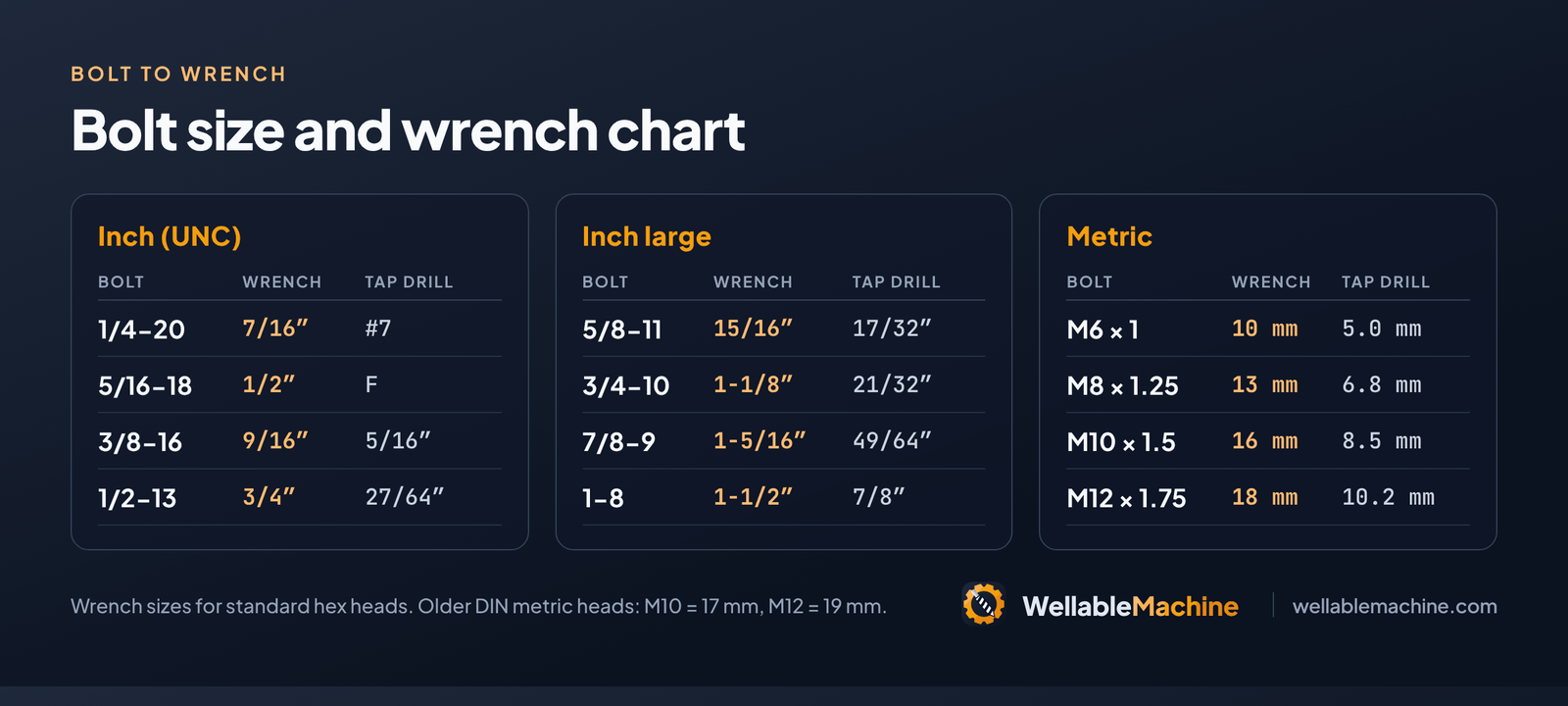
Inch bolts follow the Unified Thread Standard. Each diameter has a coarse thread (UNC), used for most general work, and a fine thread (UNF), used on vehicles and machinery.
| Bolt size | Diameter (mm) | Coarse (UNC) | Fine (UNF) | Hex head wrench | Coarse tap drill |
|---|---|---|---|---|---|
| 1/4 in | 6.35 | 1/4-20 | 1/4-28 | 7/16 in | #7 |
| 5/16 in | 7.94 | 5/16-18 | 5/16-24 | 1/2 in | F |
| 3/8 in | 9.53 | 3/8-16 | 3/8-24 | 9/16 in | 5/16 in |
| 7/16 in | 11.11 | 7/16-14 | 7/16-20 | 5/8 in | U |
| 1/2 in | 12.70 | 1/2-13 | 1/2-20 | 3/4 in | 27/64 in |
| 9/16 in | 14.29 | 9/16-12 | 9/16-18 | 13/16 in | 31/64 in |
| 5/8 in | 15.88 | 5/8-11 | 5/8-18 | 15/16 in | 17/32 in |
| 3/4 in | 19.05 | 3/4-10 | 3/4-16 | 1-1/8 in | 21/32 in |
| 7/8 in | 22.23 | 7/8-9 | 7/8-14 | 1-5/16 in | 49/64 in |
| 1 in | 25.40 | 1-8 | 1-12 | 1-1/2 in | 7/8 in |
Heavy hex bolts and structural bolts use a head one size larger: for example, a 1/2 in heavy hex bolt takes a 7/8 in wrench. Below 1/4 in, fasteners are sized by number (#4, #6, #8, #10) and are usually called screws; see the screw size chart.
Metric Bolt Size Chart (M5 to M24)
Metric bolts follow the ISO metric thread standard. If no pitch is given, the coarse pitch is meant. Wrench sizes changed for four sizes when ISO replaced the older DIN standard, so you may meet both.
| Bolt size | Coarse pitch | Common fine pitch | Wrench (ISO) | Wrench (old DIN) | Coarse tap drill |
|---|---|---|---|---|---|
| M5 | 0.8 mm | 0.5 mm | 8 mm | 8 mm | 4.2 mm |
| M6 | 1.0 mm | 0.75 mm | 10 mm | 10 mm | 5.0 mm |
| M8 | 1.25 mm | 1.0 mm | 13 mm | 13 mm | 6.8 mm |
| M10 | 1.5 mm | 1.25 mm | 16 mm | 17 mm | 8.5 mm |
| M12 | 1.75 mm | 1.25 / 1.5 mm | 18 mm | 19 mm | 10.2 mm |
| M14 | 2.0 mm | 1.5 mm | 21 mm | 22 mm | 12.0 mm |
| M16 | 2.0 mm | 1.5 mm | 24 mm | 24 mm | 14.0 mm |
| M20 | 2.5 mm | 1.5 mm | 30 mm | 30 mm | 17.5 mm |
| M22 | 2.5 mm | 1.5 mm | 34 mm | 32 mm | 19.5 mm |
| M24 | 3.0 mm | 2.0 mm | 36 mm | 36 mm | 21.0 mm |
Tap drill guides for the most common sizes: M6, M8, M10 and M12. For every thread, see the tap drill size chart.
How to Read a Bolt Size
- Inch: 3/8-16 × 1-1/2 means 3/8 in diameter, 16 threads per inch, 1-1/2 in long.
- Metric: M8 × 1.25 × 30 means 8 mm diameter, 1.25 mm pitch, 30 mm long. Often written just M8 × 30 when the thread is coarse.
- Grade or class usually follows: Grade 5 or 8.8. More on this below.
Diameter is always the outside of the thread (the major diameter), not the shank of a reduced-shank bolt and not the head.
How to Measure a Bolt
- Diameter: measure across the threads with calipers. A reading of about 0.37 in is a 3/8 in bolt; about 7.9 mm is an M8. Threads are slightly undersize, so round up to the nearest standard size.
- Pitch: use a thread pitch gauge. If you don’t have one, count threads over 1 in (TPI) or measure the distance across 10 threads and divide by 10 (metric pitch).
- Length: measure from under the head to the tip for hex, socket and pan heads. For flat (countersunk) heads, measure the overall length including the head.
If an inch and a metric size are close, such as 5/16 in and M8, the pitch decides it: 18 or 24 TPI means inch; 1.25 or 1.0 mm means metric. Never force a nut that stops after a turn or two.
Bolt Grades and Strength
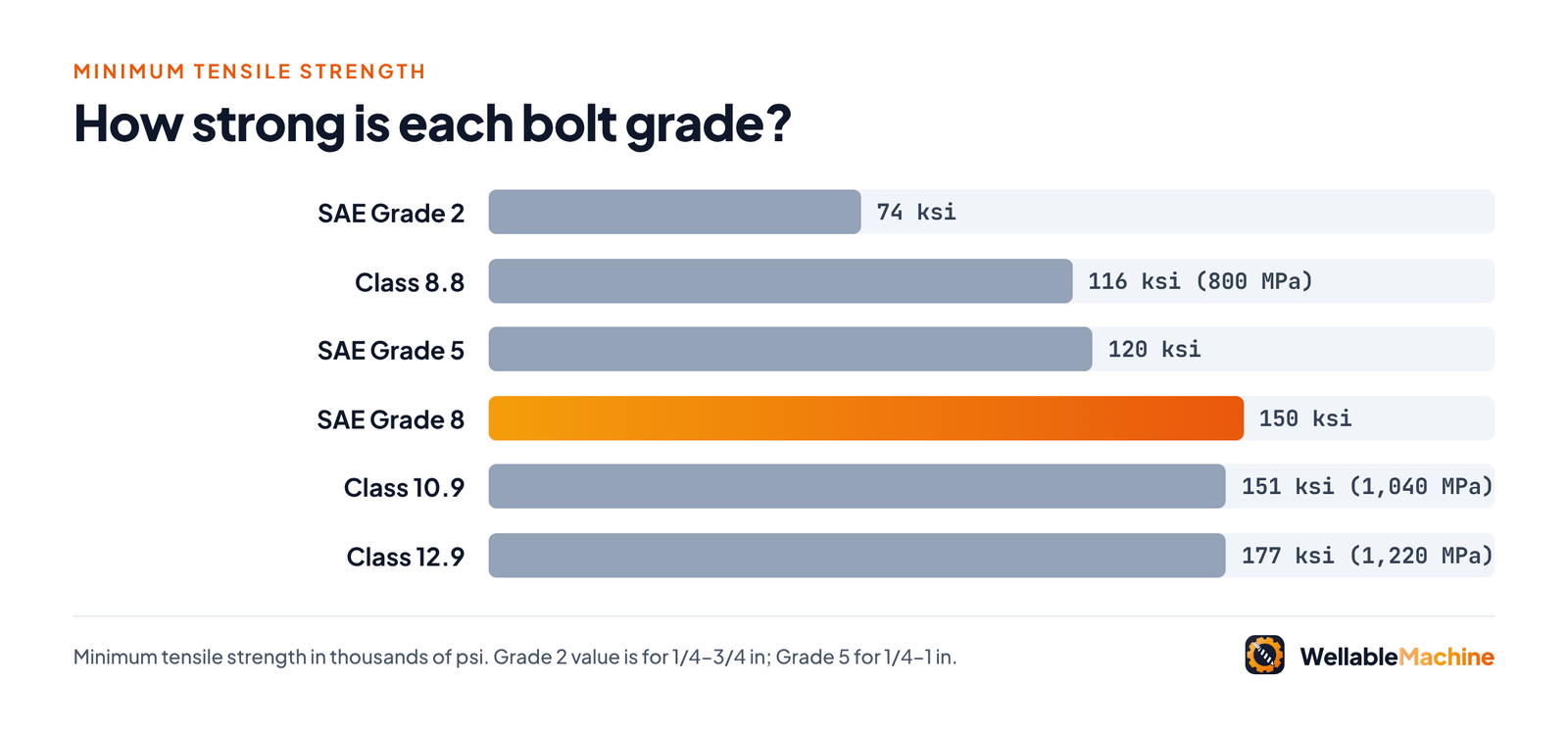
The head marking tells you how strong the bolt is. Inch bolts use radial lines; metric bolts carry a number.
| Marking | Grade / class | Min. tensile strength | Typical use |
|---|---|---|---|
| No marks | SAE Grade 2 | 74,000 psi (1/4–3/4 in) | Light duty, household |
| 3 radial lines | SAE Grade 5 | 120,000 psi (1/4–1 in) | Automotive, machinery |
| 6 radial lines | SAE Grade 8 | 150,000 psi | Suspension, heavy equipment |
| 8.8 | Property class 8.8 | 800 MPa (about 116,000 psi) | General metric, similar to Grade 5 |
| 10.9 | Property class 10.9 | 1,040 MPa (about 151,000 psi) | Automotive, similar to Grade 8 |
| 12.9 | Property class 12.9 | 1,220 MPa (about 177,000 psi) | Socket head cap screws, tooling |
Stainless steel bolts are marked A2 (304) or A4 (316) and are roughly as strong as Grade 2 to 8.8, depending on the class; they are chosen for corrosion resistance, not strength. Always replace a bolt with one of the same grade or higher, especially on brakes, suspension and steering.
Choosing the Right Bolt Length
- With a nut: the bolt should pass through the nut by at least two full threads.
- Into a tapped hole: engage at least 1 diameter in steel, 1.5 in cast iron and 2 in aluminum. Our tap drill guides list engagement lengths for each size.
- Through-holes: drill the hole slightly larger than the bolt. The clearance hole size chart gives close and free fits for every size.
- Washers: add a hardened washer under the turning part on soft materials or slotted holes.
Common Bolt Head Types
- Hex head (hex cap screw): the general-purpose bolt, turned with a wrench or socket.
- Socket head cap screw: a round head with a hex key socket, used in machines where there is no room for a wrench. Usually class 12.9 or alloy steel.
- Carriage bolt: domed head with a square neck that locks into wood, so it can’t turn.
- Flange bolt: a hex head with a built-in washer; common on vehicles.
- Lag bolt (lag screw): a heavy wood screw with a hex head; needs a pilot hole. See the pilot hole size chart.
If a bolt has snapped off in a hole, our guide on how to remove a broken bolt explains the options from penetrating oil to extractors.
Inch and Metric Look-Alikes
These pairs are close enough in diameter to fool the eye, and they cause most stripped threads on mixed equipment:
| Inch bolt | Diameter | Metric look-alike | Diameter | How to tell |
|---|---|---|---|---|
| 1/4-20 | 6.35 mm | M6 × 1.0 | 6.00 mm | 20 TPI = 1.27 mm pitch |
| 5/16-18 | 7.94 mm | M8 × 1.25 | 8.00 mm | 18 TPI = 1.41 mm pitch |
| 3/8-16 | 9.53 mm | M10 × 1.5 | 10.00 mm | 16 TPI = 1.59 mm pitch |
| 1/2-13 | 12.70 mm | M12 × 1.75 | 12.00 mm | 13 TPI = 1.95 mm pitch |
A thread pitch gauge settles it in seconds. A wrench that fits loosely is another clue: a 13 mm wrench is slightly loose on a 1/2 in head, while a 1/2 in wrench won’t fit a 13 mm head at all.
Matching Nuts and Washers
A nut must match the bolt’s diameter and pitch exactly, and it should be at least the same grade: a Grade 8 bolt needs a Grade 8 (or Grade C) nut, and a class 10.9 bolt a class 10 nut. Flat washers are sized by the bolt they fit, not by their own hole: a “1/2 in washer” has a hole of about 17/32 in. Use hardened washers under high-strength bolts, and fender washers (with a large outside diameter) on wood and thin sheet.
Frequently Asked Questions
7 quick answers from our editors
01What size wrench fits a 1/2 in bolt?
A 3/4 in wrench for a standard hex head, or 7/8 in for a heavy hex bolt.
02What wrench size is an M10 bolt?
16 mm for ISO bolts and 17 mm for older DIN bolts. Many cars use 15 mm heads on M10 flange bolts, so check before you buy.
03Is 5/16 in the same as M8?
No. 5/16 in is 7.94 mm and M8 is 8 mm, so they look identical, but the pitches are different and the threads will not mate.
04What does 3/8-16 mean?
A 3/8 in diameter bolt with 16 threads per inch, the coarse thread for that size.
05Which is stronger, Grade 8 or 10.9?
They are about the same. Grade 8 has a minimum tensile strength of 150,000 psi and class 10.9 about 151,000 psi.
06How do I know if a bolt is metric?
Look for a number such as 8.8 or 10.9 on the head, and check the pitch with a gauge. Inch bolts have radial lines or no marks.
07What size is an M12 bolt in inches?
About 0.472 in, slightly smaller than 1/2 in (0.500 in). The threads are different, so they are not interchangeable.
Bottom Line
Every bolt is described by diameter, pitch and length. Use the inch chart for 1/4 to 1 in bolts (UNC for general work, UNF for vehicles) and the metric chart for M5 to M24, remembering that M10, M12, M14 and M22 heads changed size between DIN and ISO. Measure with calipers and a pitch gauge before buying, match or exceed the original grade, and drill clearance and tap holes from the charts linked above.