M12 Tap Drill Size: 10.2 mm Drill Chart for M12 x 1.75 Threads

Quick answer: the standard tap drill for an M12 × 1.75 thread is a 10.2 mm drill (0.402 in), giving about a 79% thread. With inch drills, use 13/32 in (0.406 in). Because M12 taps take a lot of torque, many people drill 10.4 or 10.5 mm for hand tapping steel or stainless.
M12 is a heavy-duty metric bolt used in machinery, vehicles, steel structures and lifting gear. This guide gives you the M12 drill chart, the drills for M12 fine pitches, clearance and counterbore sizes, Helicoil sizes and practical tips for tapping a large thread by hand.
M12 Thread Specifications at a Glance
“M12” is an ISO metric thread with a 12 mm diameter and a coarse pitch of 1.75 mm. Fine pitches of 1.5 mm and 1.25 mm are also common. See the ISO metric screw thread reference.
| Specification | Value |
|---|---|
| Thread series | ISO metric coarse (M) |
| Major diameter | 12.00 mm (0.472 in) |
| Pitch | 1.75 mm (about 14.5 TPI) |
| Basic minor diameter (internal) | 10.106 mm |
| Tap drill, ~77% thread | 10.2 mm (0.402 in) |
| Inch substitute | 13/32 in (0.406 in) |
| Fine pitches | M12 × 1.5 → 10.5 mm; M12 × 1.25 → 10.8 mm |
| Clearance hole, normal fit | 13.5 mm |
| Hex head wrench size | 18 mm (ISO) or 19 mm (DIN) |
M12 Tap Drill Size Chart by Thread Percentage
Thread percentage tells you how much of a full thread the tap actually cuts. A smaller hole gives a fuller thread but needs much more torque, and anything above about 75% adds almost no real strength. That’s why machinists use about 75% in soft metals and drop to 60–70% in hard ones. The values below use % thread = (D − drill) ÷ (1.299 × pitch) × 100.
| Drill | mm | Inches | Approx. thread | When to use it |
|---|---|---|---|---|
| 10.0 mm | 10.00 | 0.3937 | 88% | Too tight; very hard to tap |
| 10.2 mm | 10.20 | 0.4016 | 79% | Standard choice for most materials |
| 10.3 mm | 10.30 | 0.4055 | 75% | Slightly easier in steel |
| 13/32 | 10.32 | 0.4062 | 74% | Inch substitute |
| 10.4 mm | 10.40 | 0.4094 | 70% | Steel, hand tapping |
| 10.5 mm | 10.50 | 0.4134 | 66% | Stainless steel |
| 27/64 | 10.72 | 0.4219 | 56% | Inch option for stainless |
| 10.8 mm | 10.80 | 0.4252 | 53% | Hard alloys only |
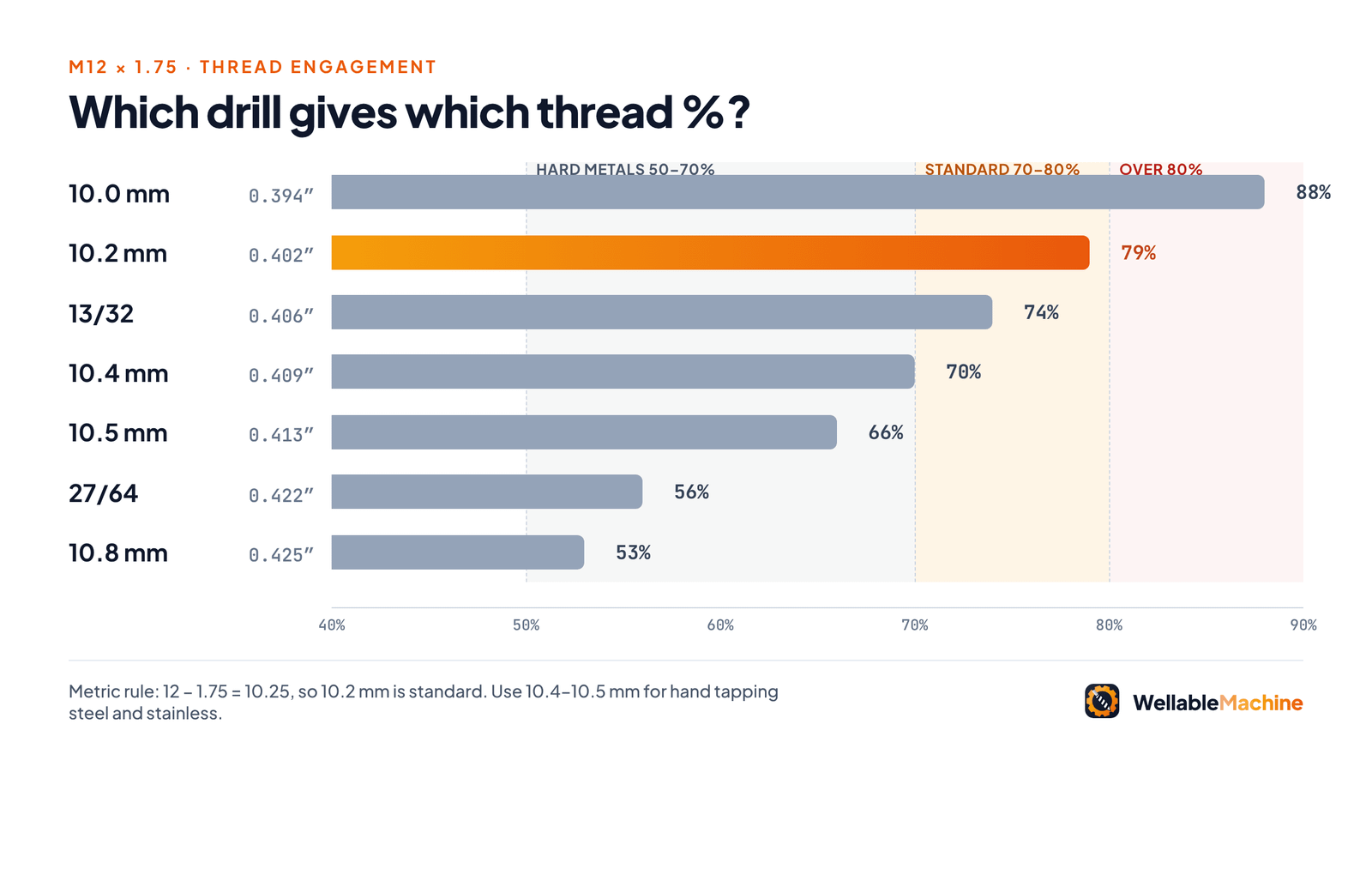
Which drill should you use? Use 10.2 mm for machine tapping and soft materials. For hand tapping mild steel, 10.3 or 10.4 mm lowers the torque a lot. In stainless, 10.5 mm or 27/64 in is the realistic choice. A 66% thread on an M12 bolt is still stronger than the bolt in almost every joint.
M12 Fine Thread Drill Sizes
| Thread | Tap drill | Typical use |
|---|---|---|
| M12 × 1.75 | 10.2 mm | General coarse thread |
| M12 × 1.5 | 10.5 mm | Wheel studs and lug nuts on many cars |
| M12 × 1.25 | 10.8 mm | Some Japanese wheel studs, fine adjustment |
Clearance Hole Sizes for an M12 Bolt
ISO 273 clearance holes for M12:
| Fit | Drill | Inches | mm | Use it for |
|---|---|---|---|---|
| Close (fine) | 13 mm | 0.512 | 13.00 | Precise location |
| Normal (medium) | 13.5 mm | 0.531 | 13.50 | Most assemblies |
| Loose (coarse) | 14.5 mm | 0.571 | 14.50 | Structural steel, frames |
M12 vs. M12 × 1.5 vs. 1/2-13
M12 coarse and fine share a diameter. The inch 1/2-13 is close in size but larger with a coarser pitch.
| Thread | Diameter | Pitch | Tap drill | Typical use |
|---|---|---|---|---|
| M12 × 1.75 | 12.00 mm | 1.75 mm | 10.2 mm | Machinery, structures |
| M12 × 1.5 | 12.00 mm | 1.5 mm | 10.5 mm | Wheel studs, automotive |
| 1/2-13 UNC | 12.70 mm | 1.954 mm | 27/64 in | US machinery |
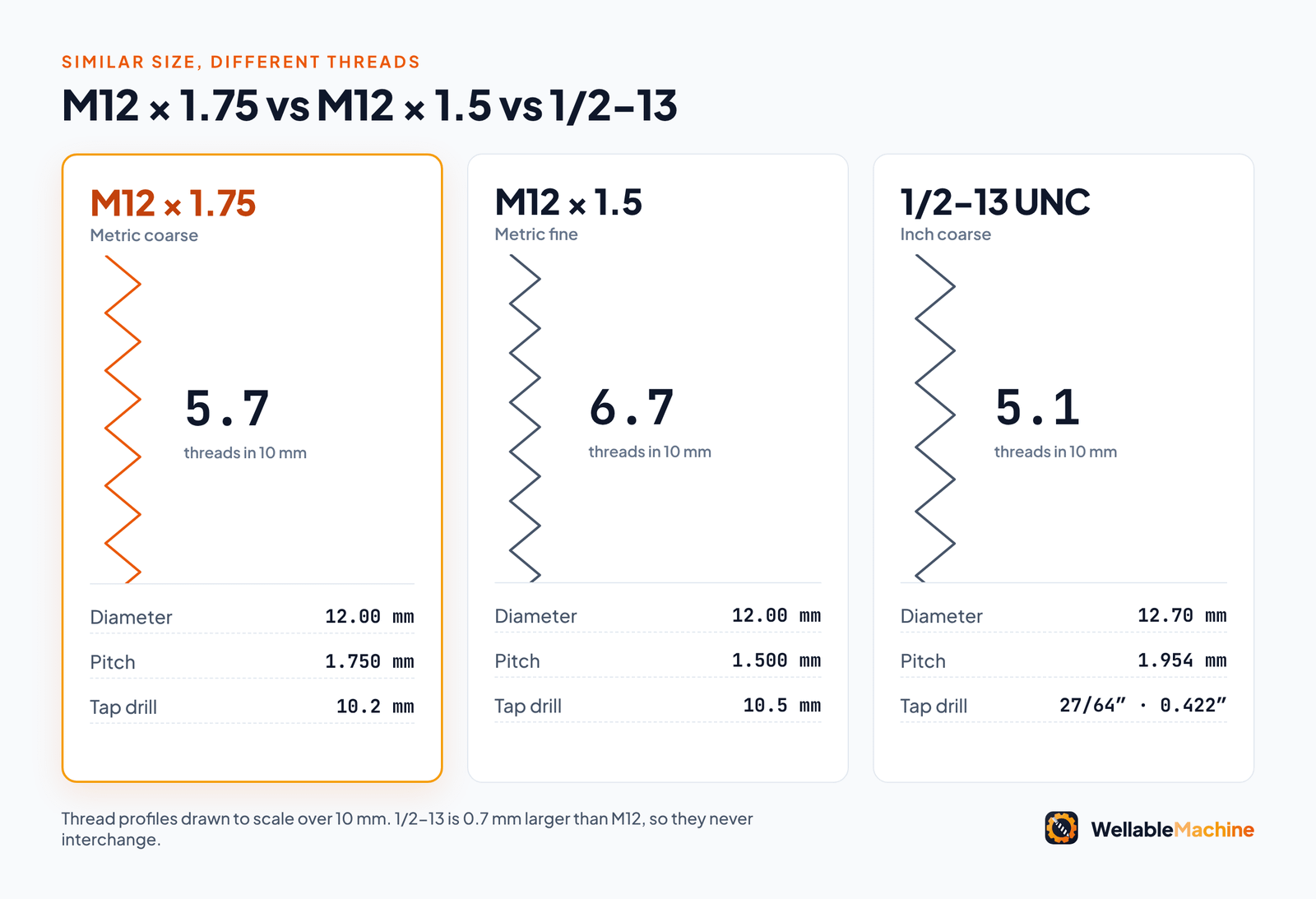
See the 1/2-13 tap drill size guide for the inch equivalent.
Other M12 Hole Sizes You Might Need
- Forming (roll) tap: about 11.2 mm.
- Helicoil / wire thread insert: drill 12.5 mm and use the M12 STI tap.
- Counterbore for an M12 socket head cap screw: 20 mm diameter, about 13 mm deep.
How to Drill and Tap a M12 Hole
- Mark and center punch the hole so the drill starts exactly where you want it.
- Drill with a 10.2 mm bit. In aluminum, run about 950 RPM; in mild steel, about 550 RPM; in stainless, slow down to about 300 RPM with steady pressure and cutting oil. Our guide on how to drill stainless steel explains why stainless needs low speed and constant feed.
- Chamfer the top of the hole with a countersink so the tap starts square and the first thread doesn’t lift.
- Start the tap straight. Use a guide block or start the tap in a drill press. With a large tap, a long two-handle wrench gives smooth, even force.
- Cut and break the chip: half a turn forward, a quarter turn back, with tapping fluid. Light oil suits aluminum; sulfurized cutting oil suits steel.
- For blind holes, drill at least 6 mm deeper than the full thread you need, and finish with a bottoming tap.

For large holes in stainless, read how to drill stainless steel. For smaller metric sizes, see the M10 tap drill size.
Which M12 Tap Should You Use?
At M12, a taper tap followed by a plug tap is the easiest way to hand tap steel. In production, spiral point and spiral flute taps in a tapping head save a lot of effort.
| Tap type | Best for | Notes |
|---|---|---|
| Taper tap | Starting threads by hand in hard material | Long chamfer; the easiest to start straight |
| Plug tap | Through-holes and most blind holes | The everyday hand tap |
| Bottoming tap | Full threads to the bottom of blind holes | Use only after a plug or taper tap |
| Spiral point (gun) tap | Through-holes, power tapping | Pushes chips ahead; strong core, fewer breaks |
| Spiral flute tap | Blind holes, power tapping | Lifts chips up and out of the hole |
| Forming (roll) tap | Aluminum, brass, mild steel | No chips; needs a larger 11.2 mm hole |
Tapping M12 in Different Materials
The 10.2 mm drill is right for most materials, but each metal behaves differently under the tap. This table sums up what works.
| Material | Recommended drill | Tapping fluid | Tips |
|---|---|---|---|
| Aluminum | 10.2 mm | Light oil or WD-40 | Large chips; back out every turn |
| Mild steel | 10.2 mm | Sulfurized cutting oil | Standard plug tap works well |
| Stainless (304/316) | 10.5 mm | Heavy tapping paste | Cobalt tap, two-handle wrench |
| Brass and bronze | 10.2 mm | Light oil or dry | Cuts cleanly; avoid high-rake taps |
| Cast iron | 10.2 mm | Dry or air blast | Blow out powder before assembly |
How Deep Should a M12 Thread Be?
Thread engagement matters more than thread percentage. The first few threads carry most of the load, so going much deeper adds effort without adding strength. Use these lengths as a starting point:
- Steel: 1 × diameter = 12 mm.
- Cast iron: 1.5 × diameter = 18 mm.
- Aluminum: 2 × diameter = 24 mm, or a Helicoil.
Where Is M12 Used?
M12 bolts are used for machine bases and motor mounts, vehicle suspension and engine mounts, wheel studs (in the 1.5 mm fine pitch), steel beam connections, scaffolding and eye bolts for lifting. It is the metric counterpart of the 1/2 in bolt.
Common M12 Tapping Problems (and How to Fix Them)
- Tap very hard to turn: drill 10.4–10.5 mm and use a taper tap first.
- Thread is crooked: use a guide block.
- Bolt binds: may be a fine pitch (1.5 or 1.25 mm); check before forcing.
- Stripped thread in aluminum: fit an M12 Helicoil.
Frequently Asked Questions
6 quick answers from our editors
01What size drill bit for an M12 tap?
A 10.2 mm drill. It gives about a 79% thread.
02What inch drill can I use for M12?
13/32 in (0.406 in).
03What size drill for M12 × 1.5?
10.5 mm.
04What size drill for M12 × 1.25?
10.8 mm.
05What size clearance hole for M12?
13.5 mm for a normal fit, 13 mm close and 14.5 mm loose.
06What size Helicoil drill for M12?
12.5 mm, then the M12 STI tap.
Bottom Line
For an M12 × 1.75 thread, drill 10.2 mm (or 13/32 in). Use 10.4–10.5 mm for hand tapping steel and stainless, 10.5 mm for M12 × 1.5 and 10.8 mm for M12 × 1.25. Drill 13.5 mm for clearance. For other sizes, see our tap drill size chart.