Helicoil Tap Drill Size Chart (STI Drill Sizes, Inch and Metric)
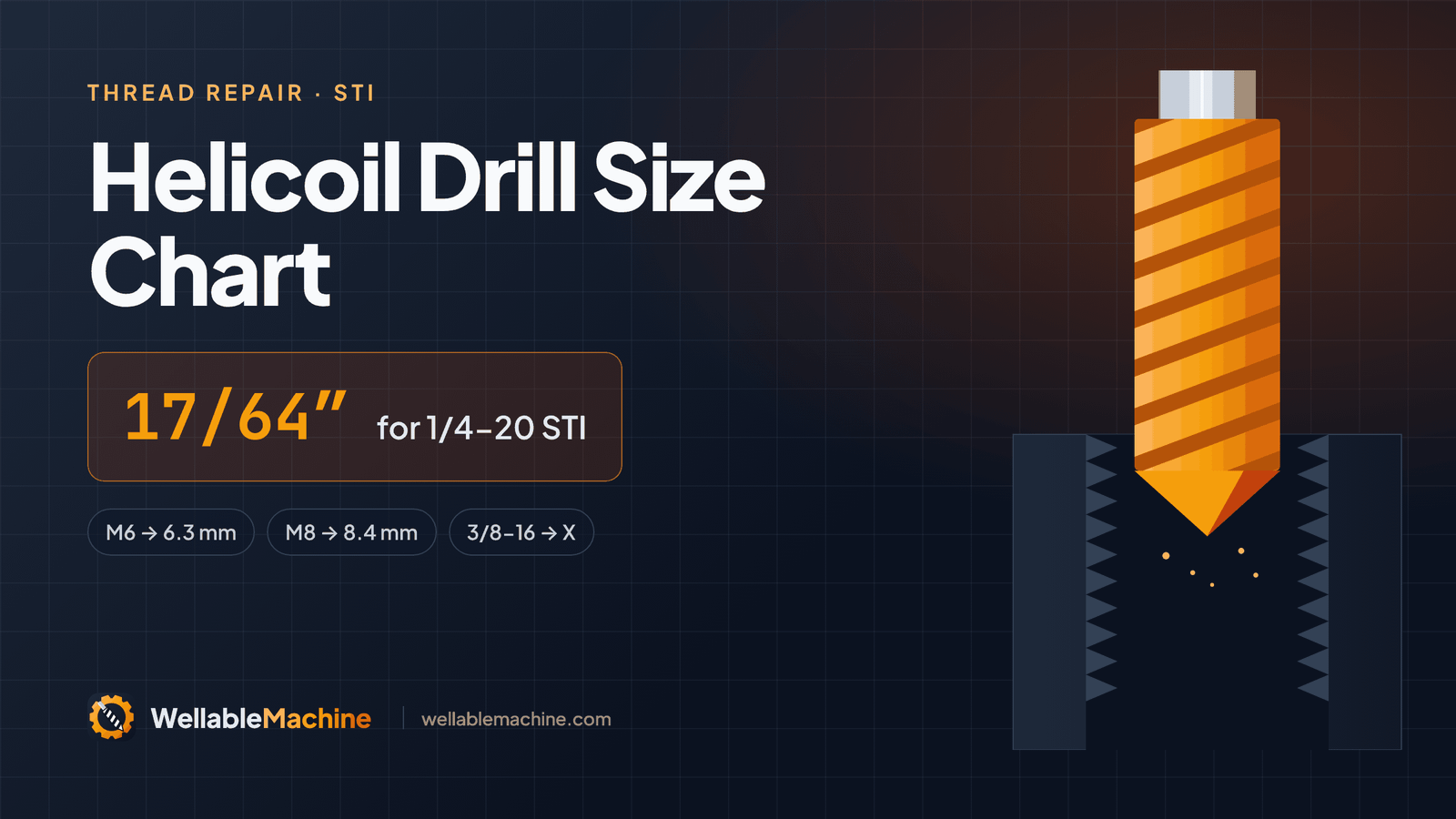
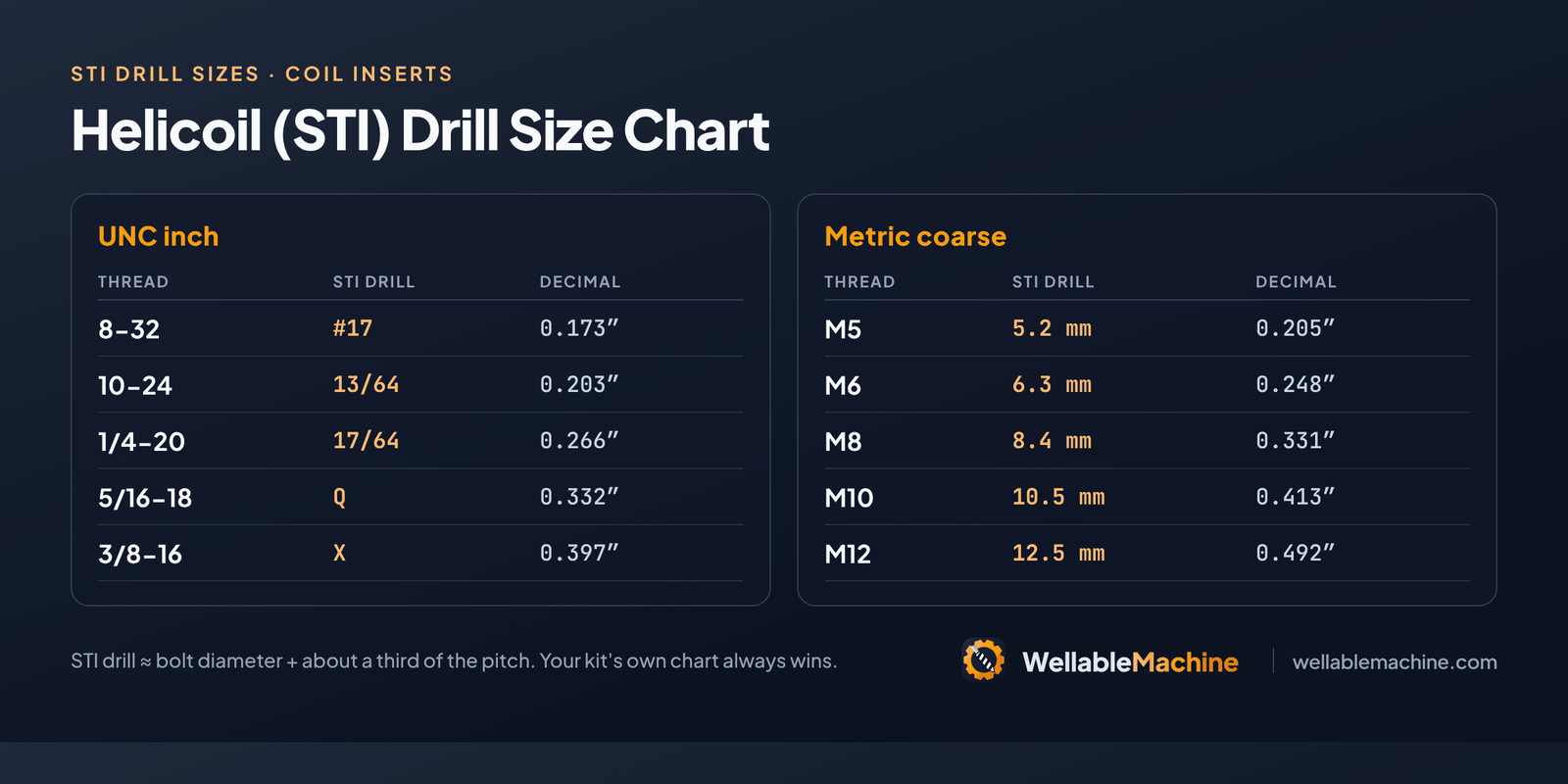
Quick answer: a Helicoil (STI, or screw thread insert) hole is drilled larger than a normal tap drill, because the STI tap cuts a thread big enough to hold the coil. The most common sizes are 17/64 in for 1/4-20, Q (0.332 in) for 5/16-18, X (0.397 in) for 3/8-16, 13/64 in for 10-24, 6.3 mm for M6, 8.4 mm for M8 and 10.5 mm for M10. A good rule: the STI drill is close to the bolt’s own diameter plus about a third of the pitch. Always check the chart that comes with your kit, because it overrides any generic table.
This page is a reference chart for drilling STI holes, covering coarse, fine and metric threads. It explains why the sizes are what they are and how deep to drill. The installation itself, from tapping to setting the coil and breaking the tang, is covered step by step in our guide on how to install a Helicoil.
Helicoil Drill Size Chart: UNC (Coarse) Threads
| Thread | STI drill | Decimal | Standard tap drill (for comparison) |
|---|---|---|---|
| 4-40 | #31 | 0.1200 in | #43 (0.089 in) |
| 6-32 | #26 | 0.1470 in | #36 (0.1065 in) |
| 8-32 | #17 or 11/64 | 0.1730 / 0.1719 in | #29 (0.136 in) |
| 10-24 | 13/64 | 0.2031 in | #25 (0.1495 in) |
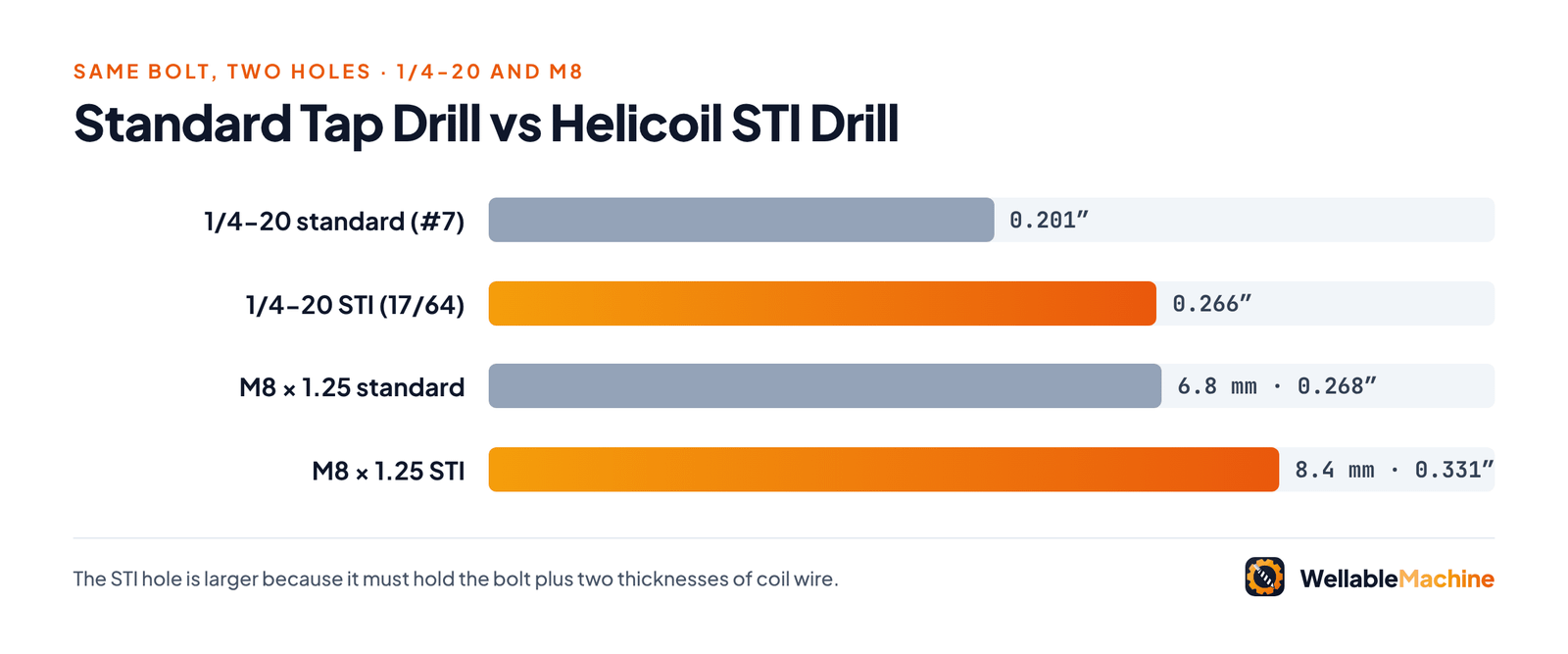
| 1/4-20 | 17/64 | 0.2656 in | #7 (0.201 in) |
| 5/16-18 | Q | 0.3320 in | F (0.257 in) |
| 3/8-16 | X | 0.3970 in | 5/16 (0.3125 in) |
| 7/16-14 | 29/64 | 0.4531 in | U (0.368 in) |
| 1/2-13 | 17/32 | 0.5313 in | 27/64 (0.4219 in) |
Helicoil Drill Sizes: UNF (Fine) Threads
| Thread | STI drill | Decimal |
|---|---|---|
| 10-32 | #7 | 0.2010 in |
| 1/4-28 | H | 0.2660 in |
| 5/16-24 | Q | 0.3320 in |
| 3/8-24 | W | 0.3860 in |
| 7/16-20 | 29/64 | 0.4531 in |
| 1/2-20 | 33/64 | 0.5156 in |
Helicoil Drill Sizes: Metric Threads
| Thread | STI drill | Inch equivalent | Standard tap drill |
|---|---|---|---|
| M3 × 0.5 | 3.2 mm | 0.126 in | 2.5 mm |
| M4 × 0.7 | 4.2 mm | 0.165 in | 3.3 mm |
| M5 × 0.8 | 5.2 mm | 0.205 in | 4.2 mm |
| M6 × 1.0 | 6.3 mm | 0.248 in | 5.0 mm |
| M8 × 1.25 | 8.4 mm | 0.331 in | 6.8 mm |
| M8 × 1.0 | 8.3 mm | 0.327 in | 7.0 mm |
| M10 × 1.5 | 10.5 mm | 0.413 in | 8.5 mm |
| M10 × 1.25 | 10.4 mm | 0.409 in | 8.8 mm |
| M12 × 1.75 | 12.5 mm | 0.492 in | 10.2 mm |
| M12 × 1.5 | 12.5 mm | 0.492 in | 10.5 mm |
| M14 × 2.0 | 14.5 mm | 0.571 in | 12.0 mm |
| M16 × 2.0 | 16.5 mm | 0.650 in | 14.0 mm |
These are the sizes most kit makers list. A few brands specify a slightly different drill (for example 8.3 mm instead of 8.4 mm for M8), usually to suit their own tap. When your kit includes a drill, use it.
Why STI Holes Are Bigger
A coil insert is a spring of diamond-shaped stainless wire. Its outside fits a special thread cut in the part, and its inside forms a standard thread for the original bolt. So the hole has to be big enough for the bolt plus two thicknesses of wire. The STI tap cuts that larger thread. It has the same pitch as the bolt, but its diameter is increased by roughly 1.3 times the thread height on each side.
That gives a handy check. The STI drill comes out at about nominal diameter + 0.3 to 0.4 × pitch:
- 1/4-20: 0.250 + 0.35 × 0.050 = 0.2675 in → 17/64 in (0.2656 in)
- 3/8-16: 0.375 + 0.35 × 0.0625 = 0.397 in → letter X (0.397 in)
- M8 × 1.25: 8.0 + 0.35 × 1.25 = 8.44 mm → 8.4 mm
Use the rule to spot a typo in a chart or to judge whether a drill you have is close enough. Use the kit’s chart for the real job.
How Deep to Drill for a Helicoil
Inserts are sold by length as a multiple of the bolt diameter: 1D, 1.5D, 2D, 2.5D and 3D. For a 1/4-20 insert, 1.5D is 0.375 in long. The hole must be deep enough for the insert to sit just below the surface and for the tap’s chamfer to cut full thread to the bottom of the insert.
| Hole type | Minimum drill depth | Minimum full STI thread |
|---|---|---|
| Through-hole | Through the part | Full length of the part |
| Blind, plug or spiral-flute STI tap | Insert length + about 1/2 pitch (set below surface) + 3 to 4 pitches (tap chamfer) | Insert length + 1/2 pitch |
| Blind, bottoming STI tap | Insert length + 1/2 pitch + 1 to 2 pitches | Insert length + 1/2 pitch |
As a worked example, take a 1.5D insert for 1/4-20 (0.375 in) in a blind hole tapped with a plug tap. Drill at least 0.375 + 0.025 + 0.200 = about 0.60 in deep. When you’re repairing a stripped hole, first drill out the old thread and any debris to that depth.
Choosing the Insert Length
- Steel and cast iron: 1D to 1.5D is usually enough.
- Aluminum: 1.5D to 2D. This is the most common repair, in engine and gearbox castings.
- Magnesium and soft castings: 2D or longer.
- Thin parts: use the longest insert that fits the wall. A short insert in a thin wall can still out-hold the original thread.
Drilling the STI Hole Well
- Drill straight. An angled STI hole means an angled bolt. On a repair, a drill guide or a drill press keeps the new hole on the axis of the old one. Our guide on drilling a straight hole covers jigs and guides.
- Start from the old hole. On repairs, the stripped thread guides the drill, so step up from a smaller drill if the old thread is badly torn.
- Use the right speed and fluid. Aluminum castings drill quickly with a little oil or WD-40. In steel, use cutting oil and a slower speed. See how to drill aluminum.
- Countersink lightly. Many kits call for a 120° countersink (some use 90°) just larger than the STI thread, so the first coil starts cleanly and the top thread doesn’t lift.
- Clear the chips. Blow out the hole before tapping and again before installing. Chips trapped under the insert stop it from going to depth.
Checking the STI Thread
In production and critical repairs, STI threads are checked with an STI GO/NO-GO plug gauge before the insert goes in. The GO end should screw in full depth, and the NO-GO end shouldn’t go in more than about three turns. In home workshops, a careful test with the insert on its installing tool is the practical check. If the coil goes in loose and wobbly, the hole is oversize. If it binds hard after a turn or two, the STI thread is too shallow or full of chips.
Common Drilling Problems
- Insert spins or pulls out: the hole was drilled oversize, or with a regular oversize tap instead of an STI tap. Use the next size up or a solid insert.
- Insert won’t go in: the STI thread is too shallow, or the hole isn’t deep enough. Check the depth and re-run the tap.
- Bolt goes in crooked: the hole was drilled off-axis. Use a guide on repairs.
- Breakthrough on a casting: check wall thickness before drilling the larger STI hole. A plug may be needed to seal coolant or oil passages.
- Wrong drill in the kit box: kits mix inch and metric bits. Check the size printed on the drill against the chart.
For other ways to fix damaged threads, see how to remove a broken bolt and the standard tap drill size chart. For background on coil and solid inserts, see the threaded insert article; insert makers’ technical guides give full STI dimensions and tolerances.
Converting Inch STI Drills to Metric Bits
If you only have metric bits for an inch STI repair, these are close: 17/64 in (6.75 mm), Q (8.4 mm), X (10.1 mm), 13/64 in (5.2 mm) and 17/32 in (13.5 mm). The differences are under 0.05 mm, small enough for most repairs in aluminum and steel. Going the other way, the metric STI drill for M6 (6.3 mm) is close to a letter D (6.25 mm), and the M8 drill (8.4 mm) is close to a letter Q (8.43 mm). Check carefully, because an oversize STI hole leaves the coil loose.
Helicoil vs Oversize Tapping: Hole Sizes Compared
Some people repair a stripped hole by tapping the next size up instead of fitting an insert. Compare the holes: a stripped 1/4-20 can be re-tapped 5/16-18 from an F drill (0.257 in), or fitted with an insert from a 17/64 in drill (0.2656 in). The insert hole is barely larger, but the insert lets you keep the original 1/4-20 bolt, which matters when the mating part, a cover or a standard fastener, can’t change. Inserts also give a stronger, wear-resistant thread in aluminum.
Frequently Asked Questions
7 quick answers from our editors
01What size drill for a 1/4-20 Helicoil?
17/64 in (0.2656 in).
02What size drill for a 3/8-16 Helicoil?
Letter X (0.397 in).
03What size drill for an M8 Helicoil?
8.4 mm for M8 × 1.25, or 8.3 mm for M8 × 1.0.
04What size drill for a 5/16-18 Helicoil?
Letter Q (0.332 in).
05Can I use a regular tap for a Helicoil?
No. You need an STI tap of the same nominal size and pitch. A regular oversize tap has the wrong pitch diameter for the coil.
06Is the STI drill the same for all brands?
Mostly, but some kits differ by a tenth of a millimeter. Use the drill in the kit or the size printed in its instructions.
07How deep should I drill for a Helicoil?
For a blind hole, at least the insert length, plus half a pitch, plus 3 to 4 pitches for the tap chamfer.
Bottom Line
STI holes are drilled bigger than normal tap holes: about the bolt diameter plus a third of the pitch. That works out to 17/64 in for 1/4-20, Q for 5/16-18, X for 3/8-16, and 6.3, 8.4 and 10.5 mm for M6, M8 and M10. Drill straight and deep enough for the insert length, countersink lightly, use the matching STI tap, and trust your kit’s chart over any generic table.