Brad Point Drill Bits: What They Are and How to Use Them

Quick answer: a brad point bit is a twist drill made for wood. It has a sharp center spur that stops the bit from wandering and two outer spurs that slice the wood fibers at the edge of the hole before the lips lift the waste out. The result is an accurately placed hole with clean, splinter-free edges. Use brad point bits for dowels, shelf pins, hardware and any visible hole in wood, plywood or MDF, in sizes from about 1/8 in to 1/2 in (3–12 mm). Don’t use them on metal or masonry.
If you’ve ever drilled a hole in oak with a regular twist bit and watched it skate off the mark, then tear a ring of splinters on the way in, a brad point bit is the fix. This guide explains how they work, how they compare with twist, Forstner and spade bits, which sizes to buy, the right speeds, and how to keep them sharp.
Anatomy of a Brad Point Bit
- Center spur (brad): a sharp, pyramid-shaped point that goes into the wood first. Put it in a punched or awl mark and the bit starts exactly where you want it, even on a curved or angled surface.
- Outer spurs (lips or nickers): two thin points at the rim that score the outline of the hole. Because the fibers are cut before they’re lifted, the edge of the hole stays crisp.
- Cutting lips: nearly flat edges between the spurs that shave the wood out of the hole, a bit like a chisel.
- Flutes: usually wider and more open than on a metal bit, to clear the larger wood chips.
- Shank: round, sometimes with flats, or 1/4 in hex on quick-change sets. Large sizes may have a reduced shank.
A metal-cutting twist drill has a 118° or 135° cone point with no spur. In wood, that cone has nothing to hold it on line, and its lips lift the fibers before cutting them. The brad point design fixes both problems. The drill bit reference shows the main point styles side by side. You’ll find more on how drill points differ in our guide to types of drill bits.
Brad Point vs Twist, Forstner and Spade Bits
| Bit | Best for | Hole quality | Sizes | Limits |
|---|---|---|---|---|
| Brad point | Accurate holes in wood: dowels, shelf pins, hardware | Clean edges, accurate start | 1/8–1/2 in (3–12 mm) | Wood and wood products only |
| Twist (HSS) | General drilling in metal, plastic and wood | Fair in wood; tends to wander and splinter | Very wide range | Not ideal for visible wood holes |
| Forstner | Flat-bottomed holes, overlapping holes, hinge cups | Excellent, flat bottom | 1/4–2-1/8 in+ | Slow; best in a drill press |
| Spade (paddle) | Fast rough holes for wiring and plumbing | Rough, splinters on exit | 1/4–1-1/2 in | Not for finish work |
| Auger | Deep holes through beams and posts | Good, fast | 1/4–1-1/4 in | Aggressive; needs a powerful drill |
Brad point bits and Forstner bits overlap in the 1/4–1/2 in range. Pick a brad point for through-holes and deep dowel holes, and a Forstner when you need a flat bottom or a hole that breaks out at the edge of the board. Our Forstner bits guide covers the other side of that choice.
Which Brad Point Sizes Do You Need?
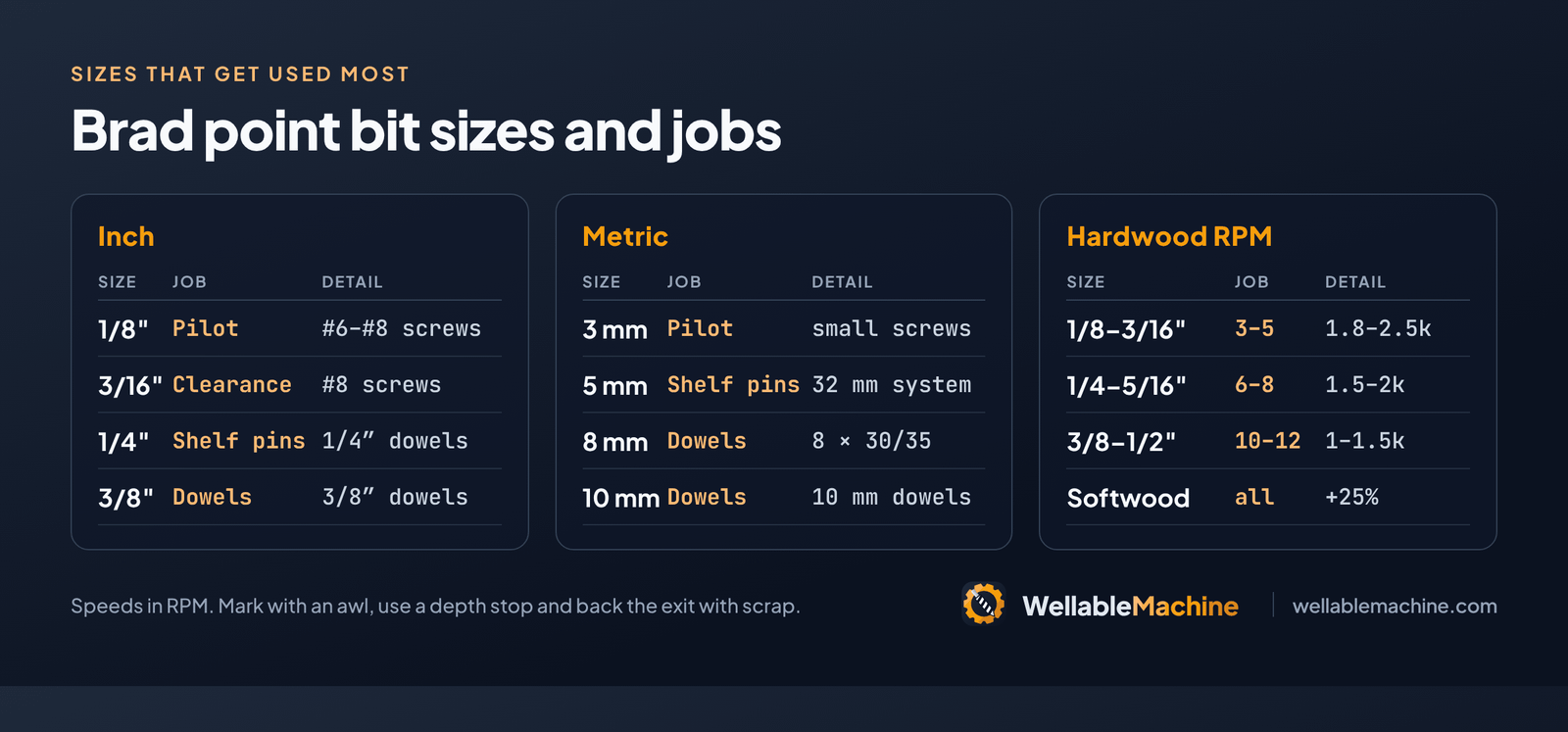
Most sets come in 7 to 8 pieces from 1/8 in to 1/2 in, or 3 mm to 10 mm in metric. These are the sizes that get used the most:
| Size | Common job |
|---|---|
| 1/8 in / 3 mm | Pilot holes for #6–#8 wood screws in hardwood |
| 5/32 in / 4 mm | Clearance for #6 screws, pilot for larger screws |
| 3/16 in / 5 mm | Clearance for #8 screws; 5 mm shelf pins (European cabinets) |
| 1/4 in / 6 mm | 1/4 in shelf pins, 1/4 in and 6 mm dowels, hardware bolts |
| 5/16 in / 8 mm | 5/16 in and 8 mm dowels (the most common furniture dowel) |
| 3/8 in / 10 mm | 3/8 in and 10 mm dowels, 1/4 in threaded inserts, bolt holes |
| 1/2 in / 12 mm | 1/2 in dowels, plugs, carriage bolt clearance |
If you use European hardware, buy a metric set (5, 6, 8 and 10 mm especially). A 5/16 in bit is 7.94 mm, a little tight for an 8 mm dowel, and a 1/4 in bit (6.35 mm) is loose for a 6 mm dowel. For screw sizes, our pilot hole size chart has the full list for hardwood and softwood.
Brad Point Drill Speeds
Brad point bits like moderate speeds. Too slow and the spurs tear instead of slicing; too fast and the bit burns, especially in cherry, maple and MDF.
| Bit size | Softwood | Hardwood | MDF / plywood |
|---|---|---|---|
| 1/8–3/16 in (3–5 mm) | 2,500–3,000 RPM | 1,800–2,500 RPM | 2,000–2,500 RPM |
| 1/4–5/16 in (6–8 mm) | 2,000–2,500 RPM | 1,500–2,000 RPM | 1,500–2,000 RPM |
| 3/8–1/2 in (10–12 mm) | 1,500–2,000 RPM | 1,000–1,500 RPM | 1,000–1,500 RPM |
Most cordless drills top out around 1,500–2,000 RPM in high gear, which is fine for every size above. On a drill press, see the drill speed chart for belt settings.
How to Drill a Clean Hole With a Brad Point Bit

- Mark with an awl. A small dimple gives the center spur a home. A pencil cross alone isn’t enough on hard woods.
- Set the depth. Use a stop collar, a drill press depth stop or a strip of tape on the bit. Remember the center spur goes deeper than the rim; measure depth to the outer spurs.
- Start slowly until the outer spurs have scored a full circle, then bring the drill up to speed.
- Keep it square. A drill guide, a drill press or a doweling jig keeps dowel and shelf pin holes perpendicular. Our guide on drilling a straight hole has more tricks.
- Clear chips every 1/2 to 3/4 in of depth in deep holes, so the flutes don’t pack and burn.
- Back the exit. Clamp a scrap board under the work so the spurs cut a clean exit. Or drill until the center spur just pokes through, flip the board, and finish from the other side.
Where Brad Point Bits Shine
Dowel joints
Dowels need holes that are the right size, on the mark and square to the face. A brad point bit in a doweling jig does all three. Drill a test hole in scrap and check the fit: a dowel should go in with firm hand pressure.
Shelf pin holes
Rows of 5 mm or 1/4 in holes at 32 mm or 1 in spacing must line up perfectly, and the edges are visible. A brad point bit in a shelf pin jig, with a stop collar, gives clean, matching holes every time.
Hardware and knobs
Cabinet knob and pull holes are on show. A 3/16 in or 5 mm brad point bit drilled from the front with a backer board inside the door gives a clean hole on both faces.
Plywood and veneered panels
The outer spurs cut through the face veneer cleanly instead of lifting it, which is why brad point bits are the standard for melamine, prefinished plywood and veneered panels.
Choosing a Good Set
- Ground, not stamped: quality bits have precisely ground spurs and lips. Cheap bits sometimes have a center spur that’s off center, which makes an oversize, wobbly hole.
- HSS or carbon steel: HSS holds an edge longer and handles heat better. Carbon steel bits are cheap but dull quickly.
- Carbide-tipped: worth it for MDF, particleboard and melamine, which are full of glue and dull steel fast.
- Metric and inch: buy the system your hardware uses, or both.
- Long-series bits: 6 in and 12 in brad points are useful for deep dowel holes and drilling through thick posts.
Sharpening Brad Point Bits
Brad point bits can be touched up by hand with a small fine file or a diamond needle file:
- Center spur: file each face lightly, keeping it centered.
- Outer spurs: file only the inside face. Filing the outside reduces the bit’s diameter and the holes come out undersize.
- Lips: file the top of each lip lightly, keeping the same angle, so both lips stay the same height.
Go easy; a few strokes on each surface is usually enough. Badly worn or chipped bits are better replaced. Twist drills are sharpened differently; our guide on how to sharpen drill bits covers those.
Common Problems
- Burn marks: speed too high, feed too slow, or a dull bit. Lower the speed, feed steadily and clear chips.
- Tear-out on exit: no backer board, or pushing hard at breakthrough. Back the work and ease off at the end.
- Hole off the mark: no awl dimple, or the drill was tilted at the start. Start slowly with the spur in the dimple.
- Oversize holes: a bent bit, an off-center spur or a loose chuck. Check the bit by rolling it on a flat surface.
- Bit won’t cut: the outer spurs are dull or chipped, often from hitting a nail or screw.
Frequently Asked Questions
6 quick answers from our editors
01Can you use brad point bits on metal?
No. The spurs will chip or dull almost at once. Use HSS or cobalt twist drills for metal.
02Are brad point bits better than twist bits for wood?
Yes, for accurate and clean holes. Twist bits are fine for rough or hidden holes.
03Can I use brad point bits in a hand drill?
Yes. They work well in cordless drills, as long as you start slowly and keep the drill square.
04Do brad point bits work in plastic?
They can in soft plastics such as HDPE, but for acrylic use a bit ground for plastic to avoid cracking.
05What is the difference between brad point and dowel bits?
They’re usually the same thing. “Dowel bit” is just another name for a brad point bit sold in dowel sizes.
06What size brad point bit for shelf pins?
5 mm for European 5 mm pins and 1/4 in for 1/4 in pins. Measure your pins first.
Bottom Line
A brad point bit is the best twist-style bit for wood: the center spur places the hole exactly and the outer spurs give clean edges. Keep a set from 1/8 to 1/2 in (or 3 to 12 mm) for dowels, shelf pins, hardware and visible holes. Mark with an awl, start slowly, use a depth stop and a backer board, and sharpen only the inside of the outer spurs. For flat-bottomed or large holes, switch to a Forstner bit.