1-8 Tap Drill Size: 7/8″ Drill, Clearance Holes & Flange Studs
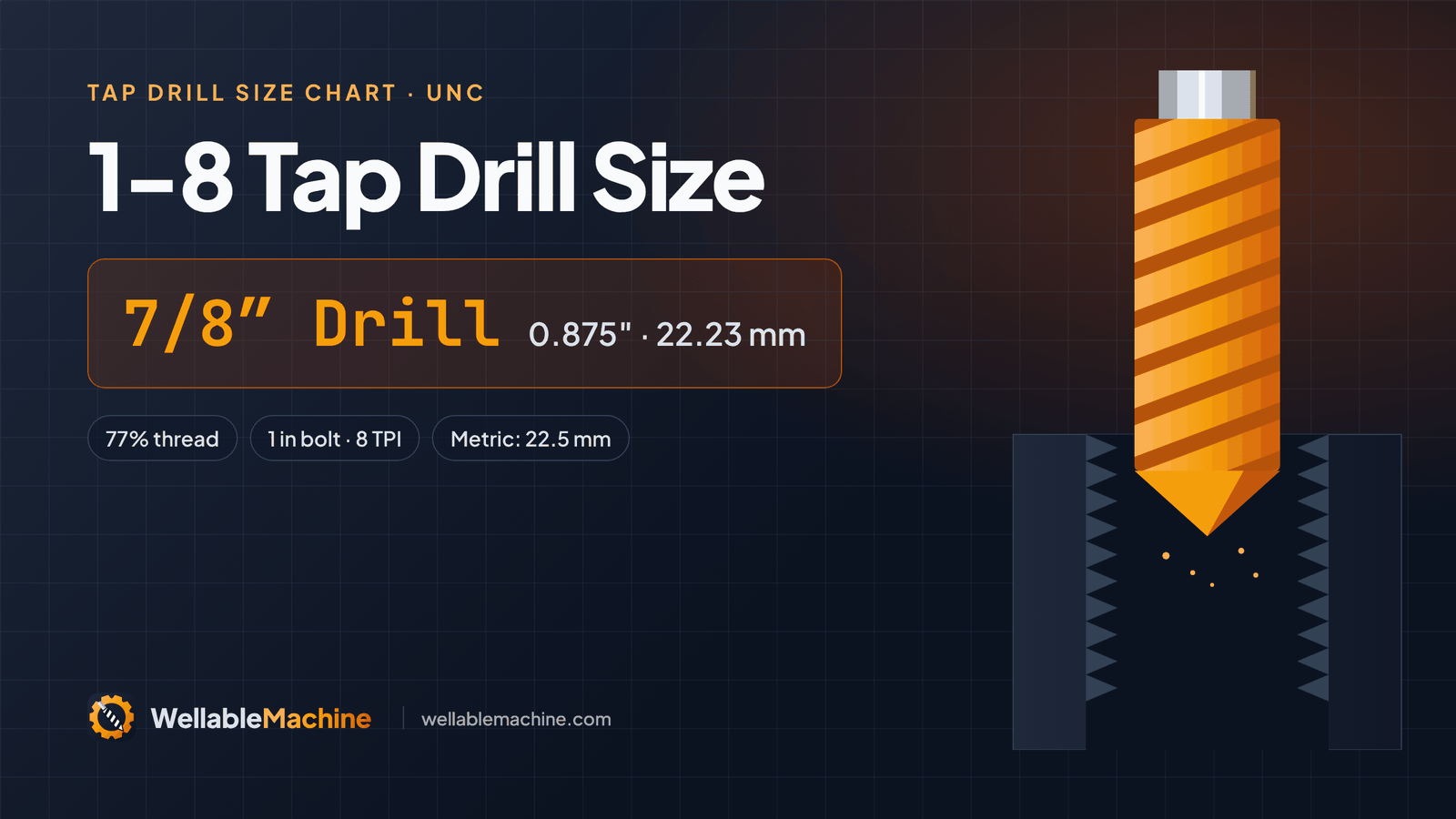
Quick answer: the standard tap drill for a 1-8 UNC thread is a 7/8 in drill (0.875 in / 22.23 mm), which gives about a 77% thread. The nearest metric drill is 22.5 mm (about 70%). When hand tapping steel or stainless, a 57/64 in drill gives about 67% thread and is much easier to turn.
1-8 is the coarse thread for a 1 in bolt, and it is about as big as most shops ever tap by hand. You will find it on pipe flange stud bolts, anchor rods, heavy machinery, cranes and presses. At this size the challenges change: you need a drill press or magnetic drill that can swing a 7/8 in bit, a tap wrench with real leverage, and a plan for chips. This guide covers the drill, clearance holes, flange bolting and practical tips for tapping 1 in threads.
1-8 Thread Specifications at a Glance
“1-8” is a 1 in (1.000 in) diameter thread with 8 threads per inch, the coarse (UNC) pitch for this size in the Unified Thread Standard. The fine thread is 1-12 UNF, and 1-14 UNS is also common in some industries.
| Specification | Value |
|---|---|
| Thread series | UNC (Unified National Coarse) |
| Major diameter | 1.000 in (25.40 mm) |
| Threads per inch | 8 |
| Pitch | 0.125 in (3.175 mm) |
| Basic minor diameter | 0.8647 in (21.96 mm) |
| Standard tap drill | 7/8 = 0.8750 in (22.23 mm) |
| Easy-tapping drill | 57/64 = 0.8906 in (22.62 mm) |
| Close-fit clearance | 1-1/32 = 1.0312 in (26.19 mm) |
| Free-fit clearance | 1-1/16 = 1.0625 in (26.99 mm) |
| Wrench size, heavy hex nut | 1-5/8 in |
1-8 Tap Drill Size Chart by Thread Percentage
Thread percentage tells you how much of a full thread the tap actually cuts. A smaller hole gives a fuller thread but needs much more torque, and anything above about 75% adds almost no real strength. That’s why machinists use about 75% in soft metals and drop to 60–70% in hard ones. The values below use % thread = 76.98 × TPI × (major diameter − drill diameter).
| Drill | Inches | mm | Approx. thread | When to use it |
|---|---|---|---|---|
| 55/64 | 0.8594 | 21.83 | 87% | Very full thread; machine only |
| 22.0 mm | 0.8661 | 22.00 | 82% | Metric option for soft metals |
| 7/8 | 0.8750 | 22.22 | 77% | Standard choice for most materials |
| 22.5 mm | 0.8858 | 22.50 | 70% | Metric for hand tapping |
| 57/64 | 0.8906 | 22.62 | 67% | Steel and stainless by hand |
| 29/32 | 0.9062 | 23.02 | 58% | Light loads only |
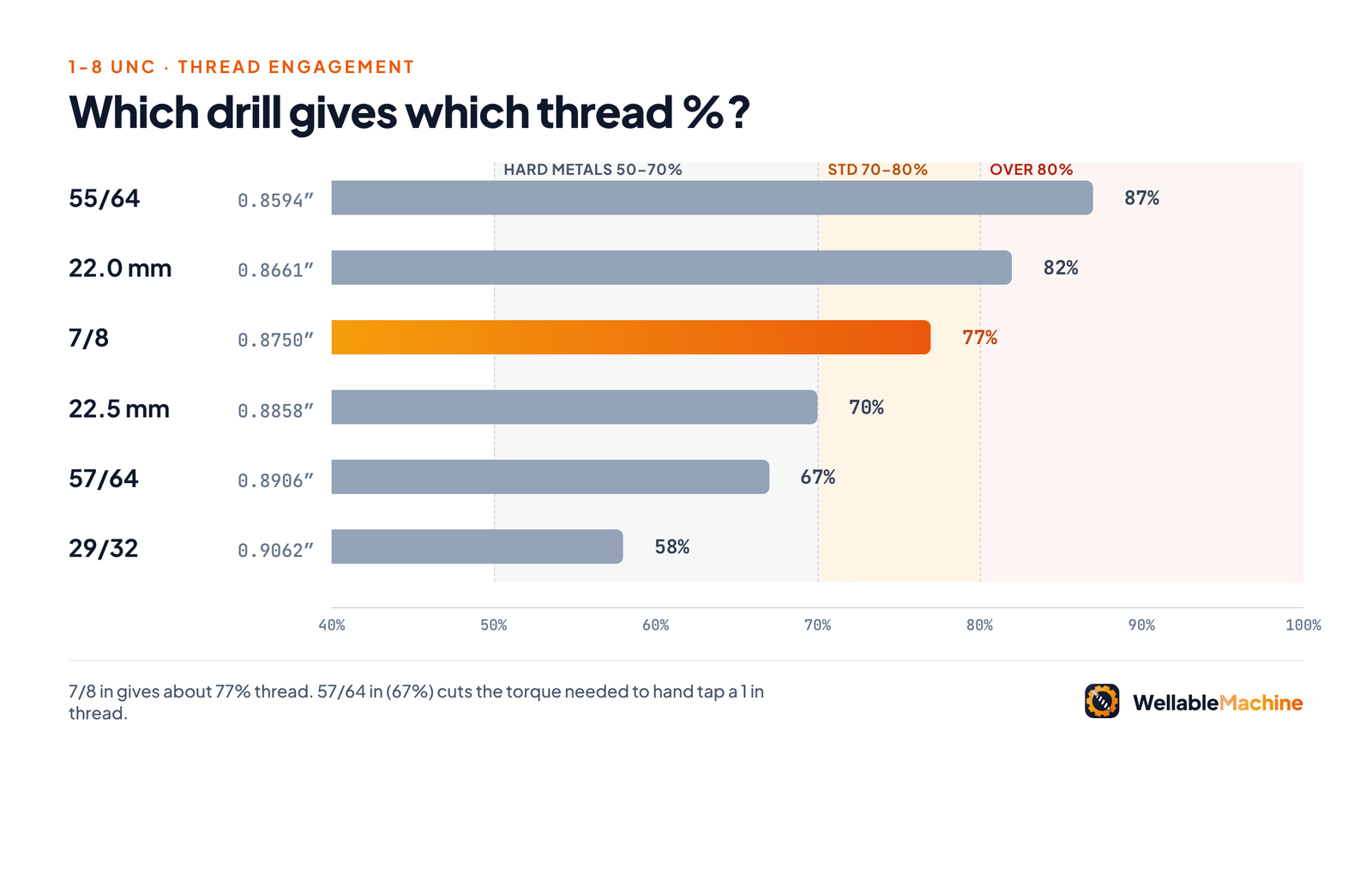
Which drill should you use? Use 7/8 in in cast iron, aluminum and any machine-tapped hole. For hand tapping mild steel, 57/64 in leaves about 67% thread, which is still stronger than the bolt with 1.5 diameters of engagement, and saves a lot of effort. In stainless, 57/64 in or 29/32 in is practical. Avoid 55/64 in unless the tapping is done by machine.
1-8 Stud Bolts on Pipe Flanges
ASME B16.5 pipe flanges use stud bolts with UNC threads up to 1 in, so 1-8 UNC studs are common on Class 150 and Class 300 flanges in the 8 to 12 in pipe range (check the flange table for the exact size and count). Points that matter in the field:
- Stud bolts are threaded full length with two heavy hex nuts. Nut wrench size is 1-5/8 in.
- Bolt holes in the flange are typically 1/8 in larger than the stud, so 1-1/8 in for a 1 in stud.
- Tighten in a star pattern in several passes to the specified torque, so the gasket compresses evenly.
- Use the right grade: B7 studs with 2H nuts are the usual carbon steel combination.
You rarely tap 1-8 holes in flanges themselves, but you will chase damaged stud threads with a 1-8 die nut.
Drilling a 7/8 in Hole for Tapping
A 7/8 in drill in steel needs low speed (about 260 RPM in mild steel, 130 RPM in stainless) and a lot of thrust, more than a hand drill can safely give. Use a drill press, radial drill or magnetic drill. Step up through a 3/8 in and 5/8 in pilot so the chisel edge of the big drill doesn’t have to work alone. A 7/8 in drill usually has a reduced shank (often 1/2 in) to fit common chucks. Alternatively, an annular cutter on a mag drill cuts a 7/8 in hole quickly with far less power. Our drill speed chart explains the speeds.
Clearance Hole Sizes for a 1 in Bolt
Clearance holes are the same for 1-8 and 1-12 bolts. For steel connections, standard holes are 1-1/16 in. See our clearance hole size chart for other sizes.
| Fit | Drill | Inches | mm | Use it for |
|---|---|---|---|---|
| Close fit | 1-1/32 | 1.0312 | 26.19 | Machined parts |
| Free fit | 1-1/16 | 1.0625 | 26.99 | Steel connections |
| Flange bolt hole | 1-1/8 | 1.1250 | 28.58 | ASME flanges |
1-8 vs. 1-12 vs. M24
M24 is the nearest metric size and has almost the same pitch, so an M24 nut can start on a 1-8 bolt and then bind. Don’t mix them.
| Thread | Diameter | Pitch | Tap drill | Typical use |
|---|---|---|---|---|
| 1-8 UNC | 1.000 in (25.40 mm) | 8 TPI (3.175 mm) | 7/8 in | Flanges, anchor rods, machinery |
| 1-12 UNF | 1.000 in (25.40 mm) | 12 TPI (2.117 mm) | 59/64 in | Automotive, aircraft |
| M24 × 3 | 24.00 mm | 3.0 mm | 21 mm | Metric structural |
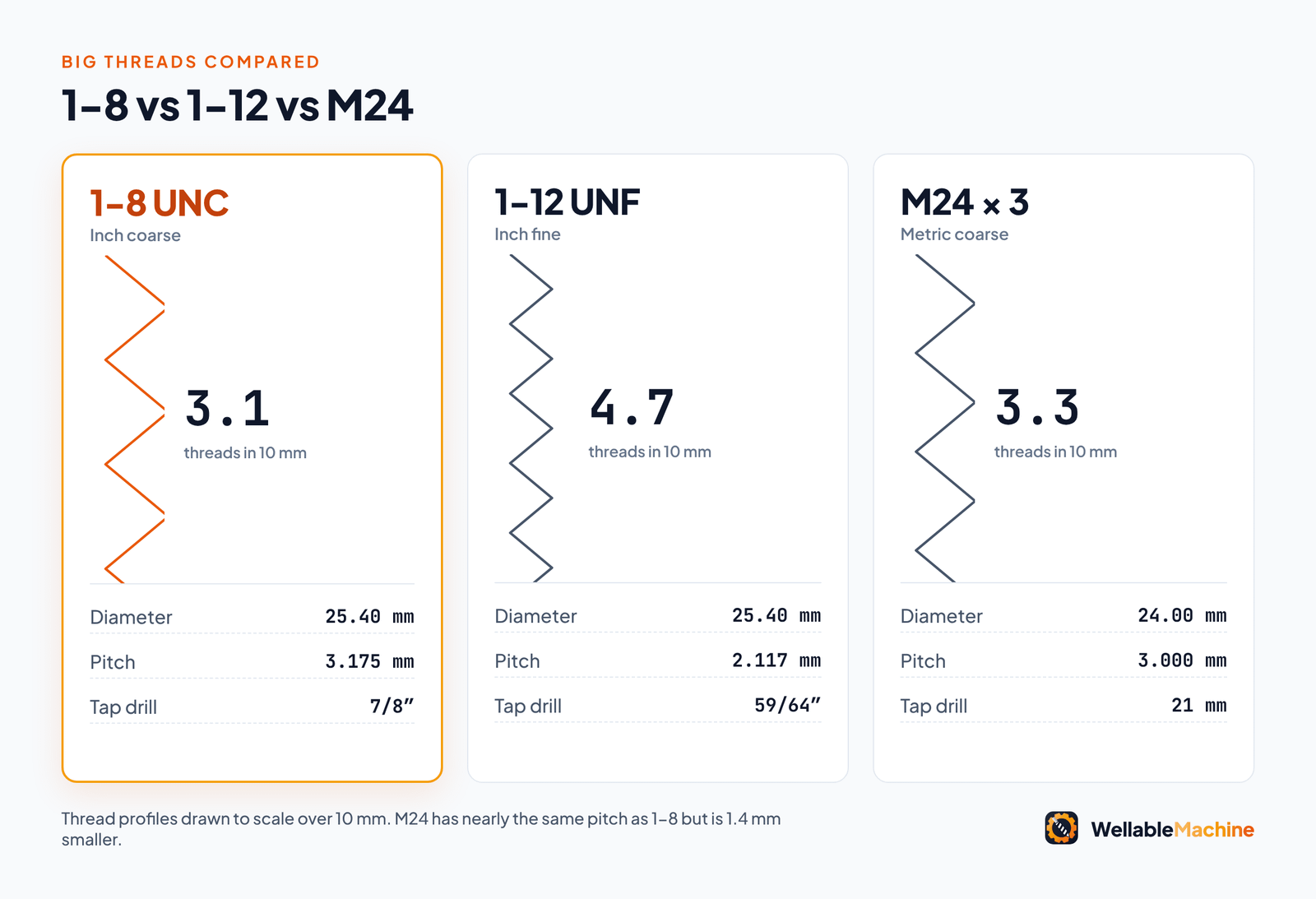
For the metric equivalent, see the M24 tap drill size. For the next size down, see 3/4-10.
Other 1-8 Hole Sizes You Might Need
- Forming (roll) tap: not usually practical at this size.
- Helicoil / STI insert: about a 1-1/16 in drill, then the 1-8 STI tap.
- Counterbore for a socket head cap screw: 1-5/8 in diameter, 1 in deep.
- Tap drill for 1-12 UNF: 59/64 in (0.9219 in).
How to Drill and Tap a 1-8 Hole
- Mark and center punch the hole so the drill starts exactly where you want it.
- Drill with a 7/8 bit. In aluminum, run about 450 RPM; in mild steel, about 250 RPM; in stainless, slow down to about 150 RPM with steady pressure and cutting oil. Our guide on how to drill stainless steel explains why stainless needs low speed and constant feed.
- Chamfer the top of the hole with a countersink so the tap starts square and the first thread doesn’t lift.
- Start the tap straight. Use a taper tap and a tap wrench at least 24 in long. Check square with a try square after the first two turns.
- Cut and break the chip: half a turn forward, a quarter turn back, with tapping fluid. Light oil suits aluminum; sulfurized cutting oil suits steel.
- For blind holes, drill at least 3/8 in (3 pitches) deeper than the full thread you need, and finish with a bottoming tap.
Threads this size are often cut on a lathe or with a thread mill instead of a tap. If you are cutting external threads by hand, see how to use a tap and die.
Which 1-8 Tap Should You Use?
At 1 in, hand taps are heavy and expensive. Buy a taper and a plug tap; for production, spiral point taps in a tapping head or thread milling are faster.
| Tap type | Best for | Notes |
|---|---|---|
| Taper tap | Starting threads by hand in hard material | Long chamfer; the easiest to start straight |
| Plug tap | Through-holes and most blind holes | The everyday hand tap |
| Bottoming tap | Full threads to the bottom of blind holes | Use only after a plug or taper tap |
| Spiral point (gun) tap | Through-holes, power tapping | Pushes chips ahead; strong core, fewer breaks |
| Spiral flute tap | Blind holes, power tapping | Lifts chips up and out of the hole |
| Forming (roll) tap | Aluminum, brass, mild steel | No chips; needs a larger not practical hole |
Tapping 1-8 in Different Materials
The 7/8 drill is right for most materials, but each metal behaves differently under the tap. This table sums up what works.
| Material | Recommended drill | Tapping fluid | Tips |
|---|---|---|---|
| Aluminum | 7/8 | Light oil or WD-40 | Light oil; chips are long |
| Mild steel | 7/8 | Sulfurized cutting oil | Reverse often to break the chip |
| Stainless (304/316) | 57/64 | Heavy tapping paste | Cobalt tap; low speed; heavy paste |
| Brass | 7/8 | Dry or light oil | Cuts cleanly; tap can grab at the end |
| Cast iron | 7/8 | Dry or air | Common for machine bases |
How Deep Should a 1-8 Thread Be?
Thread engagement matters more than thread percentage. The first few threads carry most of the load, so going much deeper adds effort without adding strength. Use these lengths as a starting point:
- Steel: 1–1.5 × diameter, 1–1-1/2 in.
- Cast iron: 1.5 × diameter, 1-1/2 in.
- Aluminum: 2 × diameter, 2 in, or use inserts.
Where Is 1-8 Used?
1-8 UNC is used on pipe flange stud bolts, anchor rods and base plates, heavy machinery, cranes and hoists, presses, large valves and structural connections.
Common 1-8 Tapping Problems (and How to Fix Them)
- Tap won’t turn: open the hole to 57/64 in and use more leverage.
- Nut binds on the bolt: it may be M24. Check the pitch.
- Hole oversize: large drills cut oversize if not thinned; pilot first.
- Chips jam the tap: reverse every half turn and clear with oil.
Frequently Asked Questions
6 quick answers from our editors
01What size drill for a 1-8 tap?
A 7/8 in drill (0.875 in), which gives about 77% thread.
02What metric drill for 1-8?
22.5 mm, about 70% thread.
03What size wrench for a 1 in bolt?
1-1/2 in for a standard hex head; 1-5/8 in for a heavy hex nut.
04What clearance hole for a 1 in bolt?
1-1/32 in close or 1-1/16 in free.
05Can I tap 1-8 by hand?
Yes, with a long tap wrench, a taper tap and lots of oil. A 57/64 in hole makes it much easier.
06What is the drill for 1-12?
59/64 in.
Bottom Line
For 1-8 UNC, drill 7/8 in on a drill press or mag drill, or 57/64 in when hand tapping steel. Clearance is 1-1/16 in. Pilot first, run slowly and use plenty of oil. For every size, see our tap drill size chart and fractional drill bit sizes.