M20 Tap Drill Size: 17.5 mm Drill, Fine Pitch & Clearance

Quick answer: an M20 × 2.5 (coarse) thread needs a 17.5 mm drill (0.689 in), giving about a 77% thread. The inch equivalent is 11/16 in (0.6875 in). For the fine M20 × 1.5, drill 18.5 mm. In stainless or when tapping steel by hand, 18.0 mm makes the job far easier.
M20 is heavy-duty territory: machine feet, structural connections, anchor bolts and lifting eye bolts. At this size the drill is too big for most hand drills and the tap needs serious leverage, so planning the job matters as much as picking the right drill. This guide covers the drill sizes, how to make the big hole, and the extra care lifting points need.
M20 Thread Specifications at a Glance
“M20” is an ISO metric thread with a 20 mm diameter and a 2.5 mm coarse pitch. Fine pitches of 1.5 mm and 2.0 mm also exist. See the ISO metric screw thread reference for the full list.
| Specification | Value |
|---|---|
| Thread series | ISO metric coarse (M) |
| Major diameter | 20.00 mm (0.787 in) |
| Coarse pitch | 2.5 mm (10.2 TPI) |
| Basic minor diameter (internal) | 17.294 mm |
| Tap drill, coarse | 17.5 mm (0.689 in) |
| Tap drill, M20 × 1.5 | 18.5 mm |
| Inch substitute | 11/16 in = 0.6875 in |
| Clearance hole, normal fit | 22.0 mm |
| Hex key, socket head screw | 17 mm |
M20 Tap Drill Size Chart by Thread Percentage
Every drill in the table below leaves a different amount of metal for the tap to cut. Tests have shown that a 60% thread is only a few percent weaker than a 75% one, yet it takes far less effort to tap, so there is no prize for the tightest hole. Percentages are worked out with % thread = (D − drill) ÷ (1.299 × pitch) × 100.
| Drill | mm | Inches | Approx. thread | When to use it |
|---|---|---|---|---|
| 17.0 mm | 17.00 | 0.6693 | 92% | Far too tight |
| 11/16 | 17.46 | 0.6875 | 78% | Inch drill; full thread |
| 17.5 mm | 17.50 | 0.6890 | 77% | Standard choice for most materials |
| 17.75 mm | 17.75 | 0.6988 | 69% | Steel by hand |
| 45/64 | 17.86 | 0.7031 | 66% | Inch option for steel |
| 18.0 mm | 18.00 | 0.7087 | 62% | Stainless and tough steel |
| 23/32 | 18.26 | 0.7188 | 54% | Too loose for load-bearing threads |

Which drill should you use? Use 17.5 mm (or 11/16 in) in cast iron, aluminum and brass. In mild steel tapped by hand, 17.75 mm or 45/64 in brings the thread to 66–69% and noticeably reduces effort. In stainless, use 18.0 mm. The 23/32 in drill is too big for anything that carries real load.
Clearance Hole Sizes for an M20 Bolt
ISO 273 clearance holes for M20 bolts:
| Fit | Drill | Inches | mm | Use it for |
|---|---|---|---|---|
| Close (fine) | 21.0 mm | 0.827 | 21.00 | Machined parts |
| Normal (medium) | 22.0 mm | 0.866 | 22.00 | Most assemblies |
| Loose (coarse) | 24.0 mm | 0.945 | 24.00 | Structural steel, base plates |
How to Drill a 17.5 mm Hole
Most cordless drills top out at a 13 mm (1/2 in) chuck, so an M20 tap hole needs a plan:
- Use a drill press or magnetic drill. A 17.5 mm reduced-shank (Silver & Deming style) drill fits a 13 mm chuck, but it needs a rigid machine and a low speed: about 200 RPM in mild steel and 100 RPM in stainless.
- Step up. Drill a 6 mm pilot, then 12 mm, then 17.5 mm. Each step takes a smaller chip, so the big drill cuts round and doesn’t grab.
- Annular cutter for plate: on a mag drill, an 18 mm annular cutter is faster, but check its actual size against the tap drill.
- Clamp the work. A 17.5 mm drill can spin an unclamped part with real force.
M20 Lifting Eye Bolts: Thread Depth and Seating
M20 is a common size for lifting eye bolts on motors, gearboxes and machine frames. When you tap a hole for one:
- Engage enough thread. Aim for at least 1.5 × diameter (30 mm) in steel and more in cast iron or aluminum, and follow the eye bolt maker’s guidance.
- Seat the shoulder flat. Spot-face or counterbore the surface so the eye bolt shoulder sits fully down. A shoulder that doesn’t seat greatly reduces the safe angled load.
- Use a full-strength thread. Stick with 17.5 mm in soft materials, and don’t lift from a repaired or partial thread unless the repair is rated for it.
- Respect the rating. Eye bolt load limits drop sharply with sling angle; check the maker’s chart.
Tapping M20 by Hand or by Machine
By hand, an M20 tap needs a wrench at least 500 mm (20 in) long and two sessions: a taper tap to cut most of the thread and a plug tap to finish it. Expect it to take several minutes per hole in steel. On a drill press, a tapping head with a clutch does the job in seconds and keeps the tap perfectly square. For a few holes, hand tapping is fine; for a batch of machine feet or base plates, a tapping head or a radial drill pays for itself quickly.
M20 × 2.5 vs. M20 × 1.5 vs. 3/4-10
M20 and 3/4-10 are the classic metric/inch mix-up on imported machinery: the pitch is nearly identical, so a 3/4 bolt will thread into an M20 hole and feel fine until it strips under load.
| Thread | Diameter | Pitch | Tap drill | Typical use |
|---|---|---|---|---|
| M20 × 2.5 | 20.00 mm | 2.5 mm | 17.5 mm | Machinery, structures, eye bolts |
| M20 × 1.5 | 20.00 mm | 1.5 mm | 18.5 mm | Hydraulic and automotive parts |
| 3/4-10 UNC | 19.05 mm | 2.54 mm (10 TPI) | 21/32 in | US structural, anchor bolts |
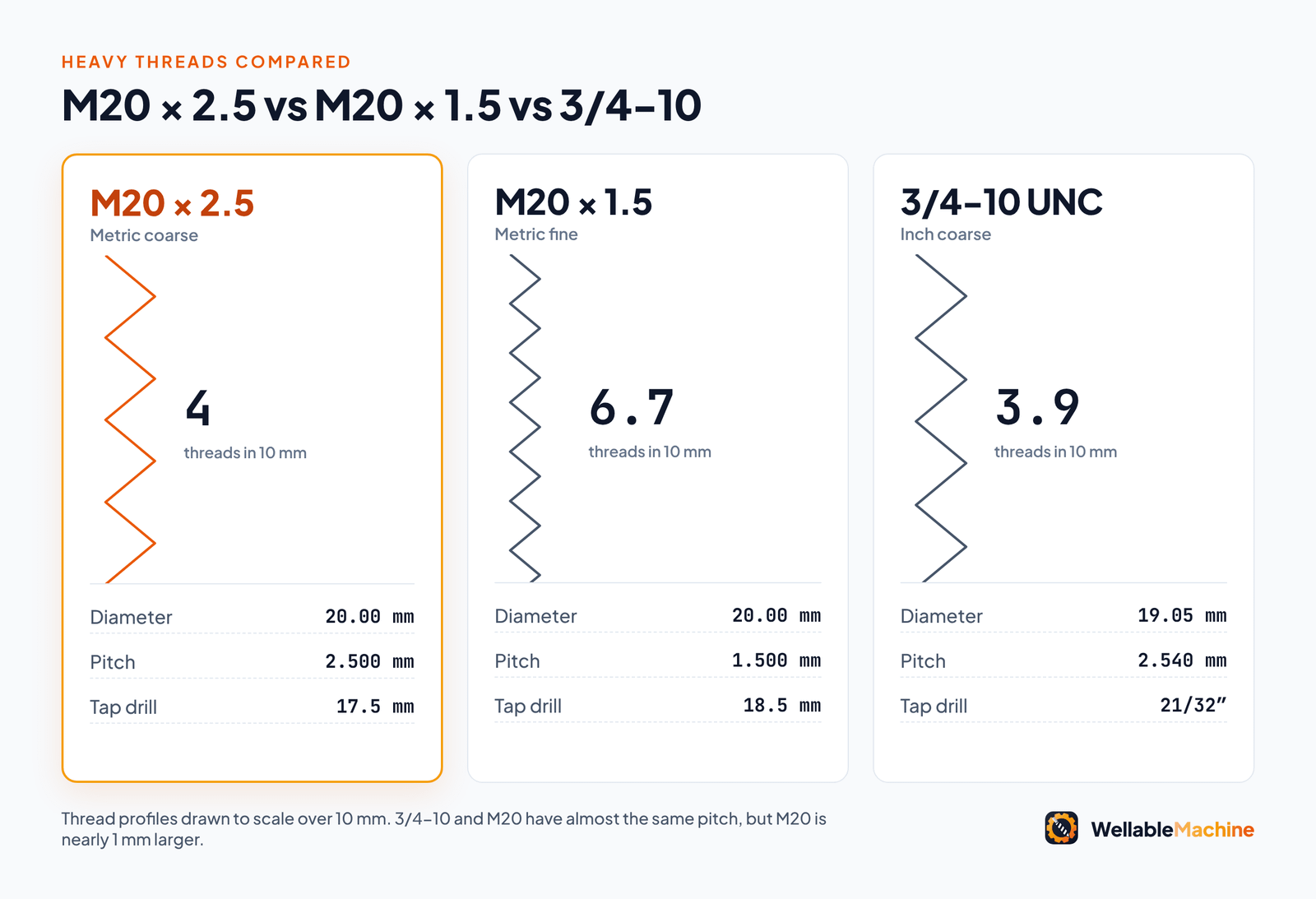
Measure the bolt with calipers: 20 mm means metric, 19 mm means 3/4 in. For the next size down, see the M16 tap drill size guide.
Other M20 Hole Sizes You Might Need
- Forming (roll) tap: about 18.8 mm. Check the tap maker’s chart.
- Heli-Coil / STI insert: about 20.75 mm drill, then the M20 × 2.5 STI tap.
- Counterbore for a socket head cap screw: 33 mm diameter, 21 mm deep.
How to Drill and Tap a M20 Hole
- Mark and center punch the hole so the drill starts exactly where you want it.
- Drill with a 17.5 mm bit. In aluminum, run about 550 RPM; in mild steel, about 350 RPM; in stainless, slow down to about 150 RPM with steady pressure and cutting oil. Our guide on how to drill stainless steel explains why stainless needs low speed and constant feed.
- Break the sharp edge with a countersink. A small chamfer guides the tap in and keeps a raised burr from forming around the hole.
- Start the tap straight. Use a long two-handle wrench and a guide, or start the tap in the drill press with the spindle locked as a center. Big taps are heavy and want to tilt.
- Work in short strokes. Turn forward until you feel resistance build, then reverse slightly to snap the chip. Keep the flutes wet with tapping fluid the whole time.
- For blind holes, drill at least 7.5 mm (3 pitches) deeper than the full thread you need, and finish with a bottoming tap.

For drilling the big hole in stainless, our guide on how to drill stainless steel covers speed and feed. If your drills cut oversize, see how to sharpen drill bits.
Tapping M20 in Different Materials
The hole size rarely changes from one metal to another, but the fluid, tap and technique do. Here is a quick guide for M20 work.
| Material | Recommended drill | Tapping fluid | Tips |
|---|---|---|---|
| Aluminum | 17.5 mm | Light oil or WD-40 | Light oil; long engagement |
| Mild steel | 17.5 mm | Sulfurized cutting oil | Back out often to clear long chips |
| Stainless (304/316) | 18.0 mm | Heavy tapping paste | Cobalt tap; tap in stages |
| Cast iron | 17.5 mm | Dry or air blast | Chips are powder; blow the hole clean |
| Cast iron machine bases | 17.5 mm | Dry or air blast | Spot-face for eye bolt shoulders |
How Deep Should a M20 Thread Be?
How much thread you need depends on what the hole is made of. Softer materials need longer engagement so the internal thread doesn’t strip before the screw breaks:
- Steel: 1 × diameter, 20 mm; 1.5 × for lifting points.
- Cast iron: 1.5 × diameter, 30 mm.
- Aluminum: 2 × diameter, 40 mm, or an insert.
Where Is M20 Used?
M20 is used on machine feet and leveling pads, structural steel connections, anchor bolts in concrete, lifting eye bolts on motors and gearboxes, heavy-duty vises, press frames and large hydraulic components.
Common M20 Tapping Problems (and How to Fix Them)
- Bolt goes in but feels loose: it may be 3/4-10 in an M20 hole. Measure it.
- Tap won’t turn: open to 18.0 mm in steel and use a longer wrench.
- Hole oval or oversize: step-drill and clamp the part rigidly.
- Eye bolt shoulder not seating: spot-face the surface.
Frequently Asked Questions
7 quick answers from our editors
01What size drill bit for an M20 tap?
17.5 mm for M20 × 2.5. It gives about a 77% thread.
02What drill for M20 x 1.5?
18.5 mm.
03What inch drill for M20?
11/16 in, which is within 0.03 mm of 17.5 mm.
04What clearance hole for M20?
21 mm fine, 22 mm medium or 24 mm coarse.
05Can I drill 17.5 mm with a cordless drill?
Only with a reduced-shank bit and great care. A drill press or mag drill is much safer.
06What size hex key fits an M20 socket head screw?
17 mm.
07Can I use a 3/4 bolt in an M20 hole?
No. The pitch is close, but the 3/4 in bolt is about 1 mm smaller and the thread can strip under load.
Bottom Line
For coarse M20 × 2.5, drill 17.5 mm (or 11/16 in), and use 18.0 mm in stainless or for easier hand tapping. M20 × 1.5 needs 18.5 mm. Clearance is 22 mm for a normal fit. Step-drill the hole on a rigid machine, and give lifting points full engagement and a flat seat. For every size, see our tap drill size chart.