Number & Letter Drill Size Chart (#80 to Z, Inch & mm)
Quick answer: number drills run from #80 (0.0135 in / 0.343 mm) up to #1 (0.228 in / 5.79 mm), and letter drills continue from A (0.234 in / 5.94 mm) up to Z (0.413 in / 10.49 mm). For number drills, a higher number means a smaller drill. For letter drills, sizes get bigger from A to Z. The full chart with decimal inches and millimeters is below.
Number and letter drills fill the gaps between fractional sizes, which is why tap drill charts and engineering drawings use them so often. This page gives you the complete chart, explains how the system works, shows the most-used sizes and their jobs, and lists the closest fractional and metric substitutes.
How Number and Letter Drill Sizes Work
In North America, twist drills come in four series:
- Fractional: 1/64 in to 1/2 in and up, in 1/64 in steps.
- Number (wire gauge): #80 to #1, from 0.0135 in to 0.228 in.
- Letter: A to Z, from 0.234 in to 0.413 in.
- Metric: usually 0.1 mm steps up to about 13 mm.
Number sizes came from the old Stubs steel wire gauge, where a higher gauge number meant thinner wire. That’s why the numbers run backward. Letter sizes were added later to cover the range between #1 and 1/2 in. Together, the three inch series give a drill roughly every 0.001–0.005 in in the small sizes, which is far finer than fractional sizes alone. The standards and history are summarized in this drill bit sizes reference.
Number Drill Sizes #1 to #30 (Most Used)
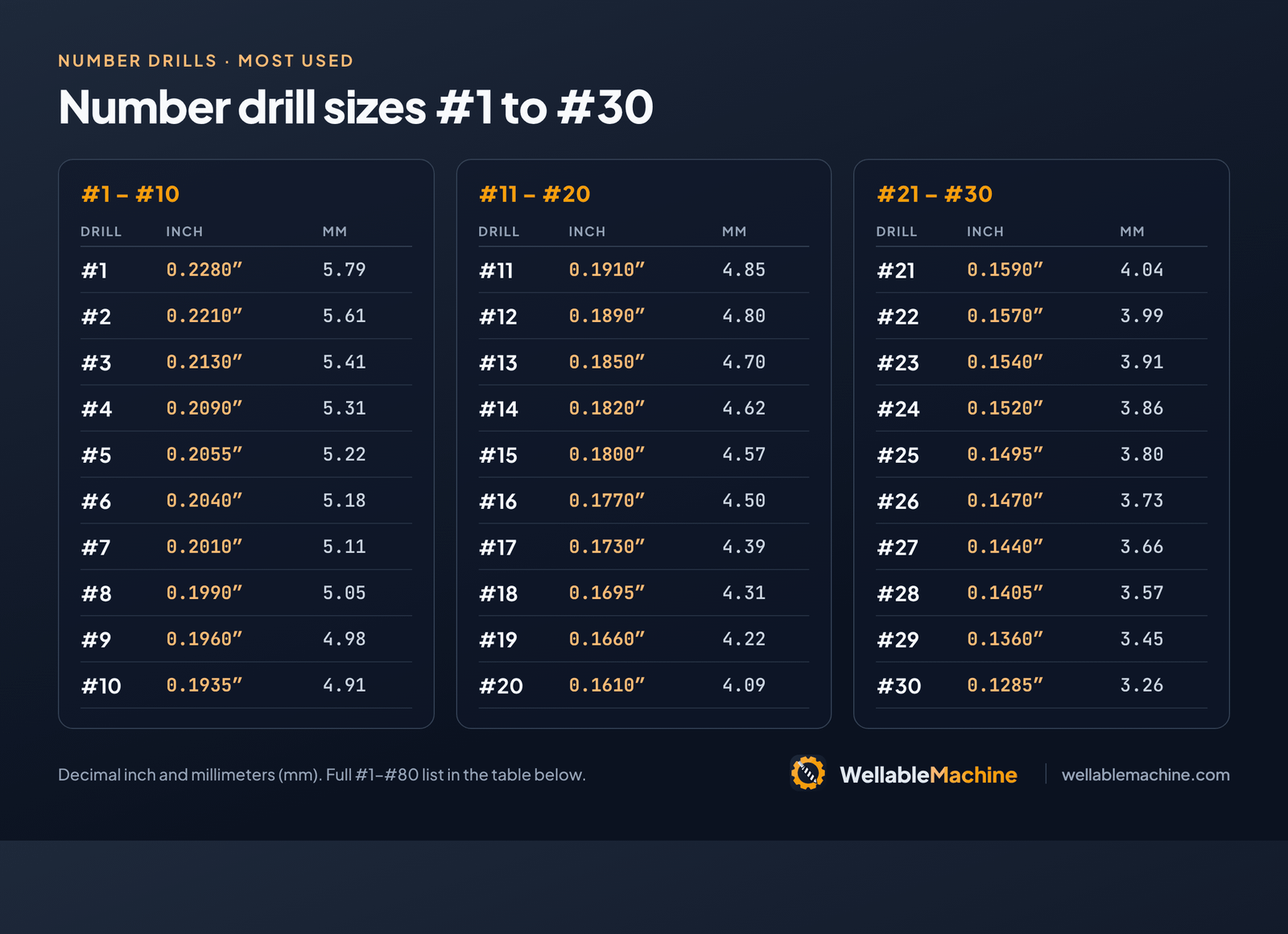
The #1–#30 range covers most tap drills and clearance holes for #4 through 1/4 in screws. Here they are on one card you can save or print:
Letter Drill Sizes A to Z
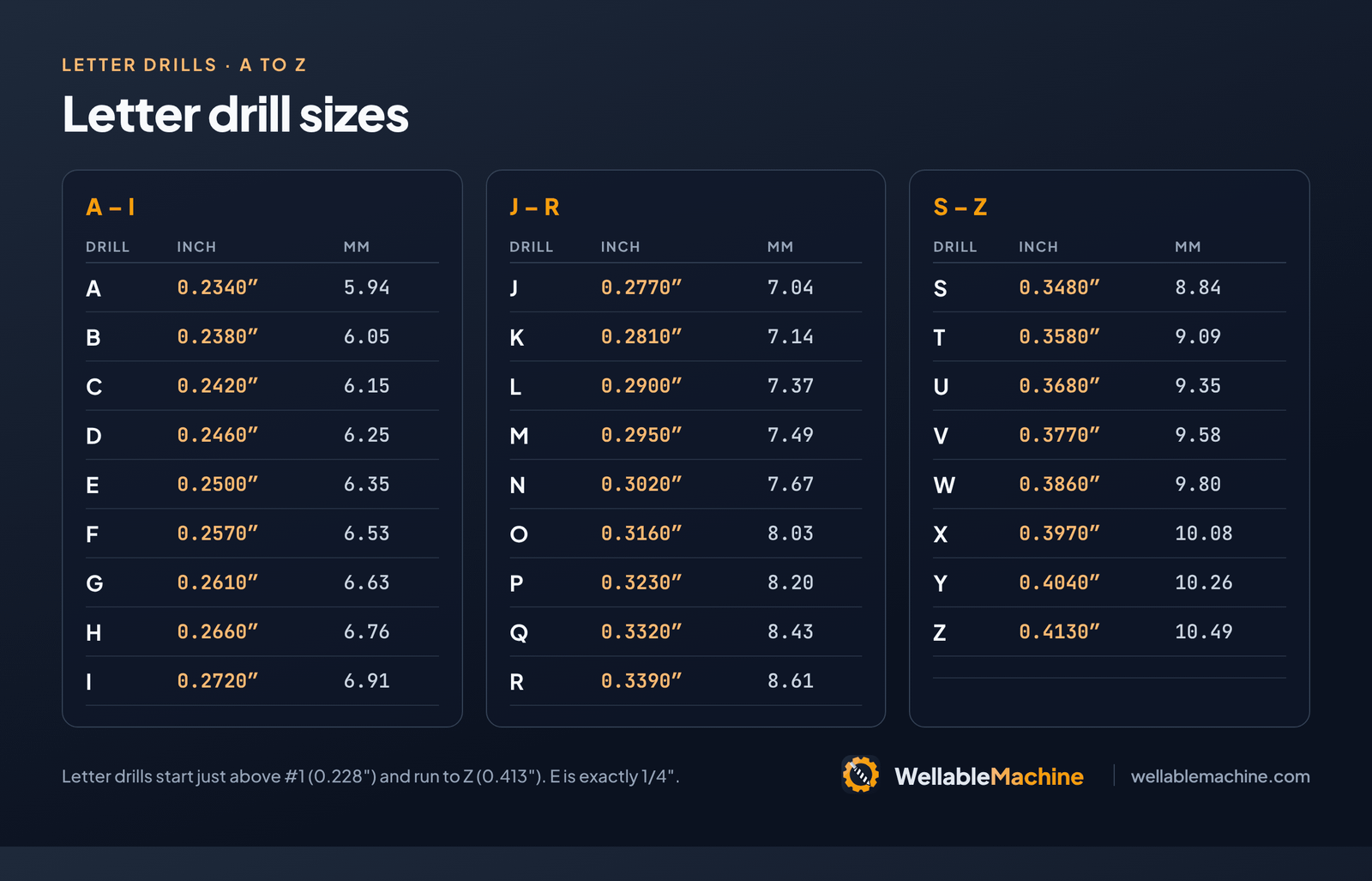
Letter drills cover tap drills for 5/16 in and 3/8 in threads, pipe threads and many clearance holes. Note that E is exactly 1/4 in, a handy reference point.
| Drill | Inches | mm | Drill | Inches | mm |
|---|---|---|---|---|---|
| A | 0.2340 | 5.94 | N | 0.3020 | 7.67 |
| B | 0.2380 | 6.05 | O | 0.3160 | 8.03 |
| C | 0.2420 | 6.15 | P | 0.3230 | 8.20 |
| D | 0.2460 | 6.25 | Q | 0.3320 | 8.43 |
| E | 0.2500 | 6.35 | R | 0.3390 | 8.61 |
| F | 0.2570 | 6.53 | S | 0.3480 | 8.84 |
| G | 0.2610 | 6.63 | T | 0.3580 | 9.09 |
| H | 0.2660 | 6.76 | U | 0.3680 | 9.35 |
| I | 0.2720 | 6.91 | V | 0.3770 | 9.58 |
| J | 0.2770 | 7.04 | W | 0.3860 | 9.80 |
| K | 0.2810 | 7.14 | X | 0.3970 | 10.08 |
| L | 0.2900 | 7.37 | Y | 0.4040 | 10.26 |
| M | 0.2950 | 7.49 | Z | 0.4130 | 10.49 |
Complete Number Drill Size Chart (#1 to #80)
Here is every number drill with its decimal inch and millimeter size. Sizes are rounded to four decimal places in inches and two in millimeters.
| Drill | Inches | mm | Drill | Inches | mm |
|---|---|---|---|---|---|
| #1 | 0.2280 | 5.79 | #41 | 0.0960 | 2.44 |
| #2 | 0.2210 | 5.61 | #42 | 0.0935 | 2.37 |
| #3 | 0.2130 | 5.41 | #43 | 0.0890 | 2.26 |
| #4 | 0.2090 | 5.31 | #44 | 0.0860 | 2.18 |
| #5 | 0.2055 | 5.22 | #45 | 0.0820 | 2.08 |
| #6 | 0.2040 | 5.18 | #46 | 0.0810 | 2.06 |
| #7 | 0.2010 | 5.11 | #47 | 0.0785 | 1.99 |
| #8 | 0.1990 | 5.05 | #48 | 0.0760 | 1.93 |
| #9 | 0.1960 | 4.98 | #49 | 0.0730 | 1.85 |
| #10 | 0.1935 | 4.91 | #50 | 0.0700 | 1.78 |
| #11 | 0.1910 | 4.85 | #51 | 0.0670 | 1.70 |
| #12 | 0.1890 | 4.80 | #52 | 0.0635 | 1.61 |
| #13 | 0.1850 | 4.70 | #53 | 0.0595 | 1.51 |
| #14 | 0.1820 | 4.62 | #54 | 0.0550 | 1.40 |
| #15 | 0.1800 | 4.57 | #55 | 0.0520 | 1.32 |
| #16 | 0.1770 | 4.50 | #56 | 0.0465 | 1.18 |
| #17 | 0.1730 | 4.39 | #57 | 0.0430 | 1.09 |
| #18 | 0.1695 | 4.31 | #58 | 0.0420 | 1.07 |
| #19 | 0.1660 | 4.22 | #59 | 0.0410 | 1.04 |
| #20 | 0.1610 | 4.09 | #60 | 0.0400 | 1.02 |
| #21 | 0.1590 | 4.04 | #61 | 0.0390 | 0.99 |
| #22 | 0.1570 | 3.99 | #62 | 0.0380 | 0.97 |
| #23 | 0.1540 | 3.91 | #63 | 0.0370 | 0.94 |
| #24 | 0.1520 | 3.86 | #64 | 0.0360 | 0.91 |
| #25 | 0.1495 | 3.80 | #65 | 0.0350 | 0.89 |
| #26 | 0.1470 | 3.73 | #66 | 0.0330 | 0.84 |
| #27 | 0.1440 | 3.66 | #67 | 0.0320 | 0.81 |
| #28 | 0.1405 | 3.57 | #68 | 0.0310 | 0.79 |
| #29 | 0.1360 | 3.45 | #69 | 0.0292 | 0.74 |
| #30 | 0.1285 | 3.26 | #70 | 0.0280 | 0.71 |
| #31 | 0.1200 | 3.05 | #71 | 0.0260 | 0.66 |
| #32 | 0.1160 | 2.95 | #72 | 0.0250 | 0.64 |
| #33 | 0.1130 | 2.87 | #73 | 0.0240 | 0.61 |
| #34 | 0.1110 | 2.82 | #74 | 0.0225 | 0.57 |
| #35 | 0.1100 | 2.79 | #75 | 0.0210 | 0.53 |
| #36 | 0.1065 | 2.71 | #76 | 0.0200 | 0.51 |
| #37 | 0.1040 | 2.64 | #77 | 0.0180 | 0.46 |
| #38 | 0.1015 | 2.58 | #78 | 0.0160 | 0.41 |
| #39 | 0.0995 | 2.53 | #79 | 0.0145 | 0.37 |
| #40 | 0.0980 | 2.49 | #80 | 0.0135 | 0.34 |
Most-Used Number and Letter Drills and What They’re For
| Drill | Inches | Common job |
|---|---|---|
| #43 | 0.0890 | Tap drill for 4-40 |
| #36 | 0.1065 | Tap drill for 6-32 (guide) |
| #29 | 0.1360 | Tap drill for 8-32 and 8-36 (guide) |
| #25 | 0.1495 | Tap drill for 10-24; free-fit hole for #6 |
| #21 | 0.1590 | Tap drill for 10-32 (guide) |
| #16 | 0.1770 | Free-fit clearance for #8 screws |
| #7 | 0.2010 | Tap drill for 1/4-20 (guide) |
| #3 | 0.2130 | Tap drill for 1/4-28 |
| F | 0.2570 | Tap drill for 5/16-18 (guide) |
| I | 0.2720 | Tap drill for 5/16-24 |
| Q | 0.3320 | Tap drill for 3/8-24; free-fit for 5/16 bolts |
| R | 0.3390 | Tap drill for 1/8 NPT (guide) |
| U | 0.3680 | Tap drill for 7/16-14 |
| X | 0.3970 | Free-fit clearance for 3/8 bolts |
For every thread size, see our tap drill size chart.
Closest Fractional and Metric Substitutes
If your set doesn’t include number or letter drills, these common sizes come closest. Differences under about 0.002 in rarely matter for tapping or clearance.
| Number / letter | Inches | Closest fractional | Closest metric |
|---|---|---|---|
| #43 | 0.0890 | 3/32 (0.0938) | 2.25 mm (0.0886) |
| #36 | 0.1065 | 7/64 (0.1094) | 2.7 mm (0.1063) |
| #29 | 0.1360 | 9/64 (0.1406) | 3.45 mm (0.1358) |
| #25 | 0.1495 | 5/32 (0.1563) | 3.8 mm (0.1496) |
| #21 | 0.1590 | 5/32 (0.1563) | 4.0 mm (0.1575) |
| #7 | 0.2010 | 13/64 (0.2031) | 5.1 mm (0.2008) |
| #3 | 0.2130 | 7/32 (0.2188) | 5.4 mm (0.2126) |
| F | 0.2570 | 1/4 (0.2500) | 6.5 mm (0.2559) |
| I | 0.2720 | 17/64 (0.2656) | 6.9 mm (0.2717) |
| Q | 0.3320 | 21/64 (0.3281) | 8.4 mm (0.3307) |
| R | 0.3390 | 11/32 (0.3438) | 8.6 mm (0.3386) |
| U | 0.3680 | 23/64 (0.3594) | 9.3 mm (0.3661) |
Watch out with fractional substitutes for tap drills: a slightly smaller drill makes tapping much harder. For example, 1/4 in instead of F for 5/16-18 gives an 87% thread, which risks breaking the tap. When in doubt, go slightly larger, not smaller.
Should You Buy a Number or Letter Drill Set?
- Number set #1–#60: the most useful for metalworkers. It covers every small tap drill and clearance hole.
- Number set #61–#80: tiny drills for model making, jewelry, electronics and clock work. Use them in a pin vise or a sensitive drill press.
- Letter set A–Z: needed for 5/16 in and 3/8 in tap drills and pipe threads.
- 115-piece set: fractional + number + letter. The best value if you tap holes often.
For steel and stainless steel, choose cobalt drills. See our pick of the best drill bits for stainless steel.
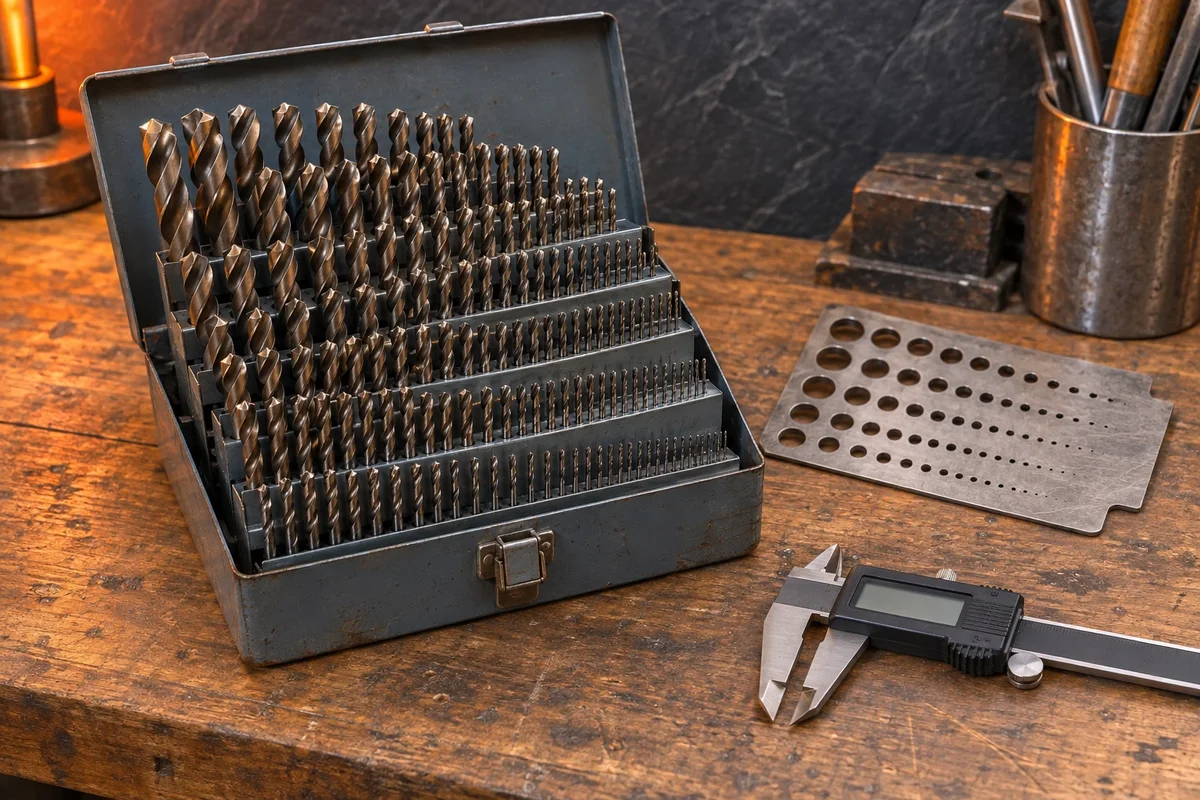
How to Identify an Unmarked Drill Bit
- Measure across the margins (the narrow lands next to the flutes) with a caliper or micrometer. Don’t measure the shank on small drills; some are slightly undersize there.
- Compare to the chart above. Most sizes are at least 0.001 in apart.
- Use a drill gauge plate for quick checks. Push the drill into labeled holes until it fits snugly.
- Label it. Put it back in an indexed case or mark the shank with a paint pen.
Tips for Using Small Number Drills
- Run them fast. A #50 drill (0.070 in) can run 5,000+ RPM in aluminum. Small drills cut poorly at slow speed.
- Peck often. Pull the drill out every 2–3 diameters to clear chips.
- Use a stub-length drill where possible. Short drills don’t wander or break as easily.
- Don’t sharpen tiny drills. Below about 1/8 in, replacing is usually cheaper and more accurate. For larger drills, see how to sharpen drill bits.
How to Convert a Number or Letter Drill to mm
Every drill size in the inch system can be converted with one simple formula: millimeters = inches × 25.4. For example, a #21 drill is 0.159 in, and 0.159 × 25.4 = 4.04 mm. A letter Q is 0.332 in, which is 8.43 mm. To go the other way, divide millimeters by 25.4.
When you buy a substitute metric drill, round to the nearest 0.1 mm and remember the rule for tap holes: if you have to choose, pick the slightly larger drill. A thread that’s a few percent shallower is still strong, but a hole that’s too small can snap the tap.
Frequently Asked Questions
7 quick answers from our editors
01What is the largest number drill size?
#1, at 0.228 in (5.79 mm).
02What is the smallest number drill size?
#80, at 0.0135 in (0.343 mm). Some charts list even smaller sizes down to #97, but these are rare.
03Why do number drill sizes go backward?
They come from the old Stubs wire gauge, where a higher number meant thinner wire. So a #60 drill is much smaller than a #6.
04Which letter drill is 1/4 inch?
E is exactly 0.250 in (1/4 in).
05What size is a Z drill?
Z is 0.413 in (10.49 mm), the largest letter drill.
06What size is an F drill bit?
F is 0.257 in (6.53 mm). It’s the standard tap drill for 5/16-18.
07What size is a #7 drill bit?
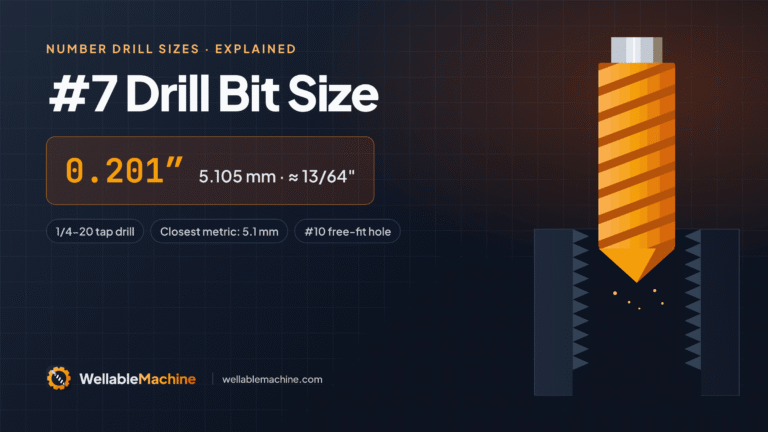
0.201 in (5.105 mm), the tap drill for 1/4-20. See our #7 drill bit size guide.
Bottom Line
Number drills run from #80 (0.0135 in) to #1 (0.228 in), getting larger as the number drops, and letter drills continue from A (0.234 in) to Z (0.413 in). They exist to fill the gaps between fractional sizes, which is why tap drill charts use them. Keep this chart handy, measure unmarked bits across the margins, and when substituting a fractional or metric drill for a tap hole, go slightly larger rather than smaller. To match drills to threads, use our tap drill size chart.