Shelf Pin Hole Size: 5 mm or 1/4 in, Depth, Spacing and How to Drill
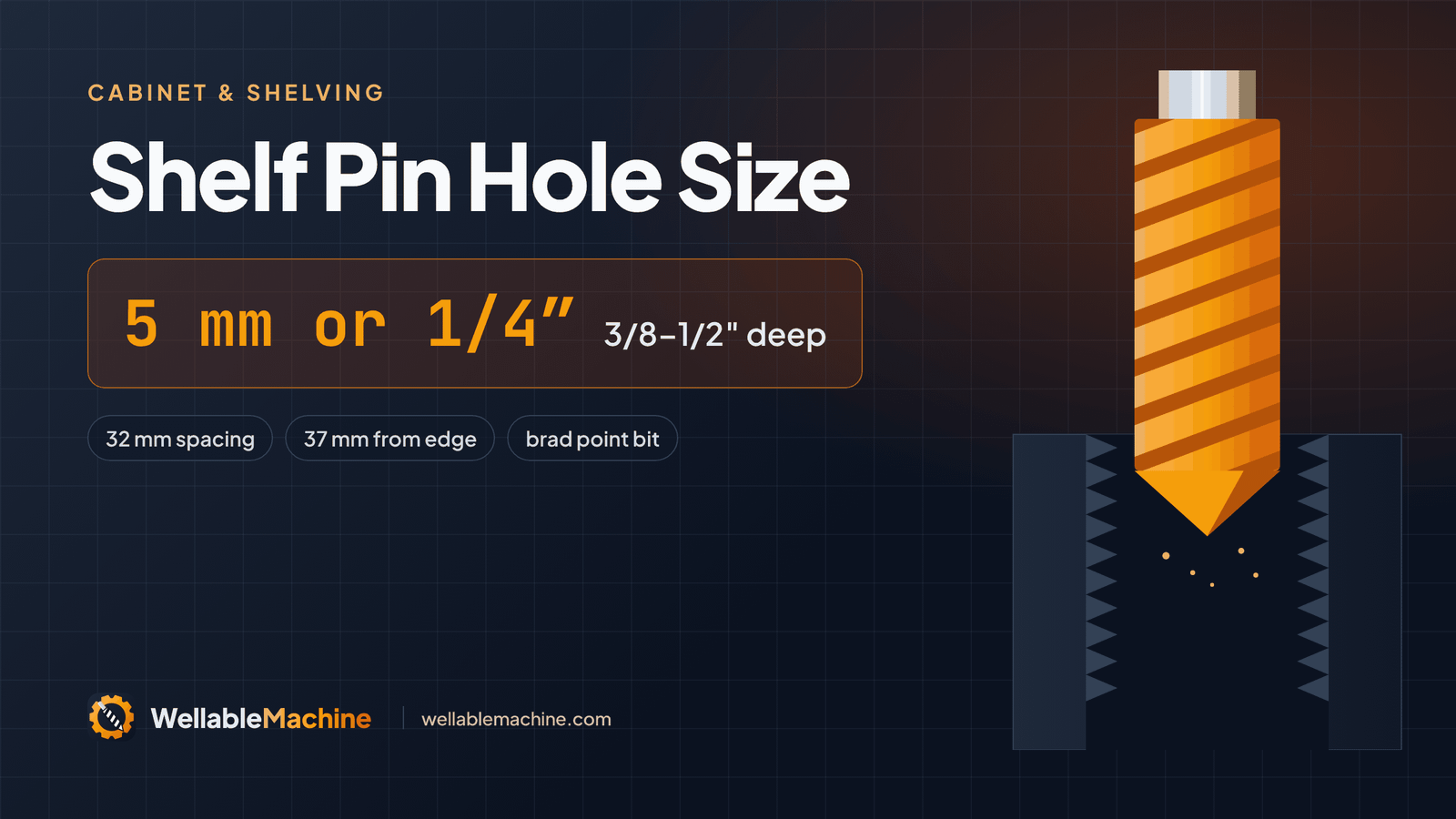
Quick answer: most shelf pins need either a 1/4 in (6.35 mm) or a 5 mm hole. Drill the hole the same size as the pin’s shank, about 3/8 to 1/2 in (10–12 mm) deep. Holes are usually spaced 32 mm apart vertically in European-style (frameless) cabinets, or 1 in to 2 in in many American cabinets and bookcases, and set about 37 mm (1-1/2 in) in from the front and back edges.
Adjustable shelves look simple, but a hole that’s a fraction too big lets the pins droop and the shelf rock, and one that’s too small cracks laminate or splits the side. Because 1/4 in and 5 mm pins look almost identical, mixing them up is the most common mistake. This guide covers how to identify your pins, which bit to use, spacing, depth, jigs and fixing holes that came out wrong.
Shelf Pin Hole Size Chart
| Pin type | Shank size | Drill bit | Hole depth | Where you see it |
|---|---|---|---|---|
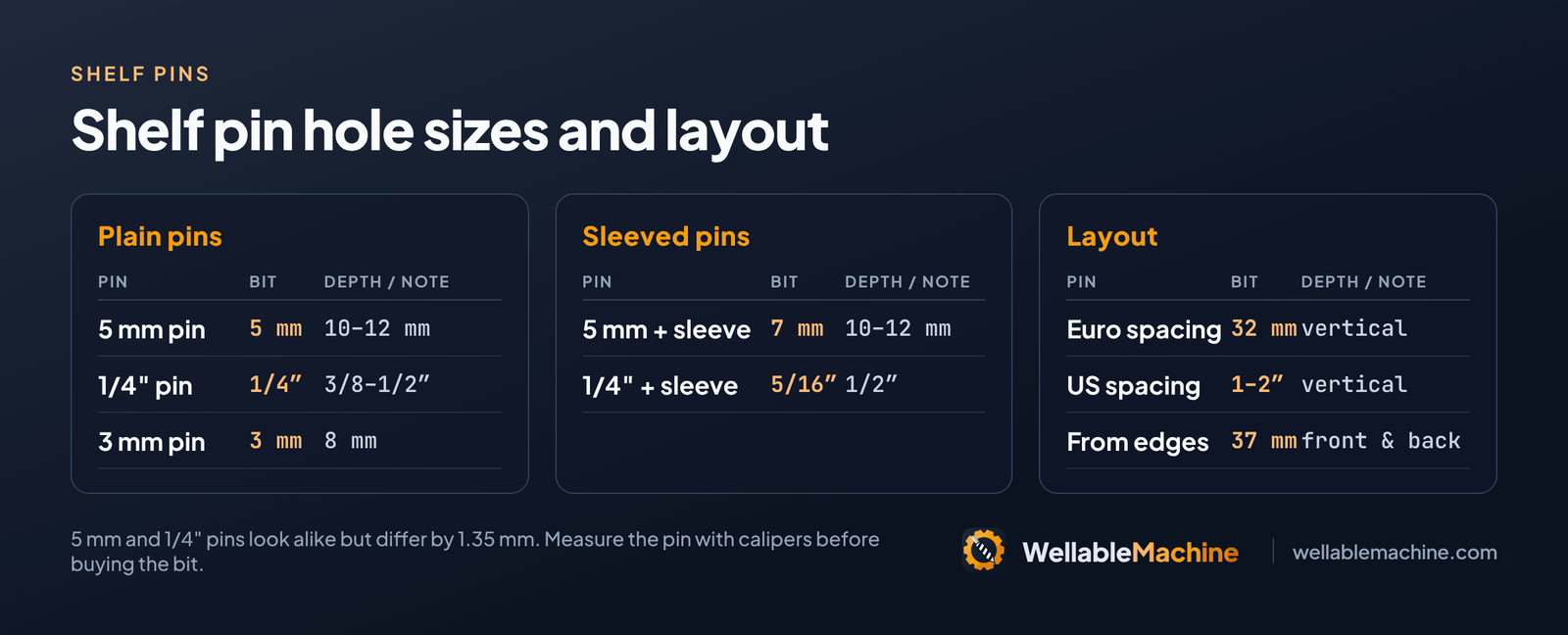
| 5 mm metal pin or spoon | 5 mm | 5 mm brad point | 10–12 mm | Flat-pack and European cabinets |
| 1/4 in metal pin or spoon | 1/4 in (6.35 mm) | 1/4 in brad point | 3/8–1/2 in | American bookcases, cabinets, closets |
| 3 mm pin | 3 mm | 3 mm | 8 mm | Small display cases, curio cabinets |
| Pin with 5 mm sleeve | 5 mm pin, 7 mm sleeve | 7 mm | 10–12 mm | Higher-end cabinets, frequent adjustment |
| Pin with 1/4 in sleeve | 1/4 in pin, 5/16 in sleeve | 5/16 in | 1/2 in | Bookcases with brass or nickel sleeves |
| Locking (shelf-lock) clip | 5 mm | 5 mm | 12 mm | Shelves that must not lift or slide |
| Plastic L-shaped support | Usually 5 mm | 5 mm | 10 mm | Furniture kits, laminate cabinets |
Pins and sleeves vary between suppliers, so measure your pin or sleeve with calipers before you buy a bit. The difference between 5 mm (0.197 in) and 1/4 in (0.250 in) is about 1.35 mm, which is easy to see once you measure, but hard to see by eye.
How to Tell a 5 mm Pin From a 1/4 in Pin
- Measure it. Calipers give the answer in seconds: about 4.9–5.0 mm for 5 mm pins, about 6.2–6.35 mm for 1/4 in pins.
- Try a drill bit. Hold the pin against the shank of a 5 mm bit and a 1/4 in bit; the one that matches is your size.
- Check the cabinet style. Frameless (European) cabinets and flat-pack furniture almost always use 5 mm on a 32 mm grid. Face-frame cabinets and site-built bookcases more often use 1/4 in.
- Look at the existing holes. A 1/4 in pin will not go into a 5 mm hole at all. A 5 mm pin in a 1/4 in hole wobbles visibly.
Which Drill Bit to Use
Use a brad point bit. Its center spur locates the hole exactly where you mark it, and the two outer spurs score the surface before the bit cuts, so you get a crisp edge without chipping the veneer or melamine. A regular twist drill tends to skate and tear the surface, which looks bad right at eye level on the front of a cabinet. Our brad point drill bits guide covers the different types.
- Add a stop collar or buy a dedicated shelf-pin bit with a built-in depth stop. Drilling through the side of a cabinet is the second most common mistake after the wrong diameter.
- Self-centering (Vix-style) bits are used with jigs; the spring sleeve keeps the bit centered in the jig hole.
- For melamine and laminate, a sharp carbide-tipped brad point stays crisp far longer than HSS.
Spacing and Layout
The 32 mm system
European frameless cabinets are built around a 32 mm grid. Shelf pin holes are 5 mm, spaced 32 mm apart vertically, with each column 37 mm in from the front edge of the cabinet side (and usually 37 mm from the back, or from the back panel). Hinges and drawer runners share the same grid, which is why one jig can lay out almost everything. The 32 mm cabinetmaking system article explains the origin.
Bookcases and face-frame cabinets
Here there is no single standard. Common choices are holes every 1 in, 1-1/4 in, 1-1/2 in or 2 in, with columns 1-1/2 to 2 in from the front and back edges. Closer spacing gives finer adjustment; for most bookcases, 1-1/4 to 2 in is plenty.
Layout rules that always apply
- Both sides must match exactly. Measure from the same reference edge (usually the bottom) on both sides, or the shelf will rock.
- Keep holes away from fixed shelves, hinges and drawer slides, usually at least 2 in.
- Skip the very top and bottom zones where shelves are never placed, which saves time and looks cleaner.
- Drill before assembly when you can. Flat panels on a bench are much easier to drill straight than the inside of a built cabinet.
How Deep to Drill
The hole should be slightly deeper than the length of the pin shank, so the pin seats fully and the support part sits flat against the side.
- 5 mm pins: 10–12 mm deep in 16–19 mm (5/8–3/4 in) panels.
- 1/4 in pins: 3/8 to 1/2 in deep in 3/4 in panels.
- Thin panels (1/2 in or 12 mm): limit depth to about 3/8 in or 9 mm, and use short-shank pins, so you don’t blow out the other face.
- Sleeved holes: deep enough for the sleeve to sit flush, usually the full sleeve length.
How to Drill Shelf Pin Holes
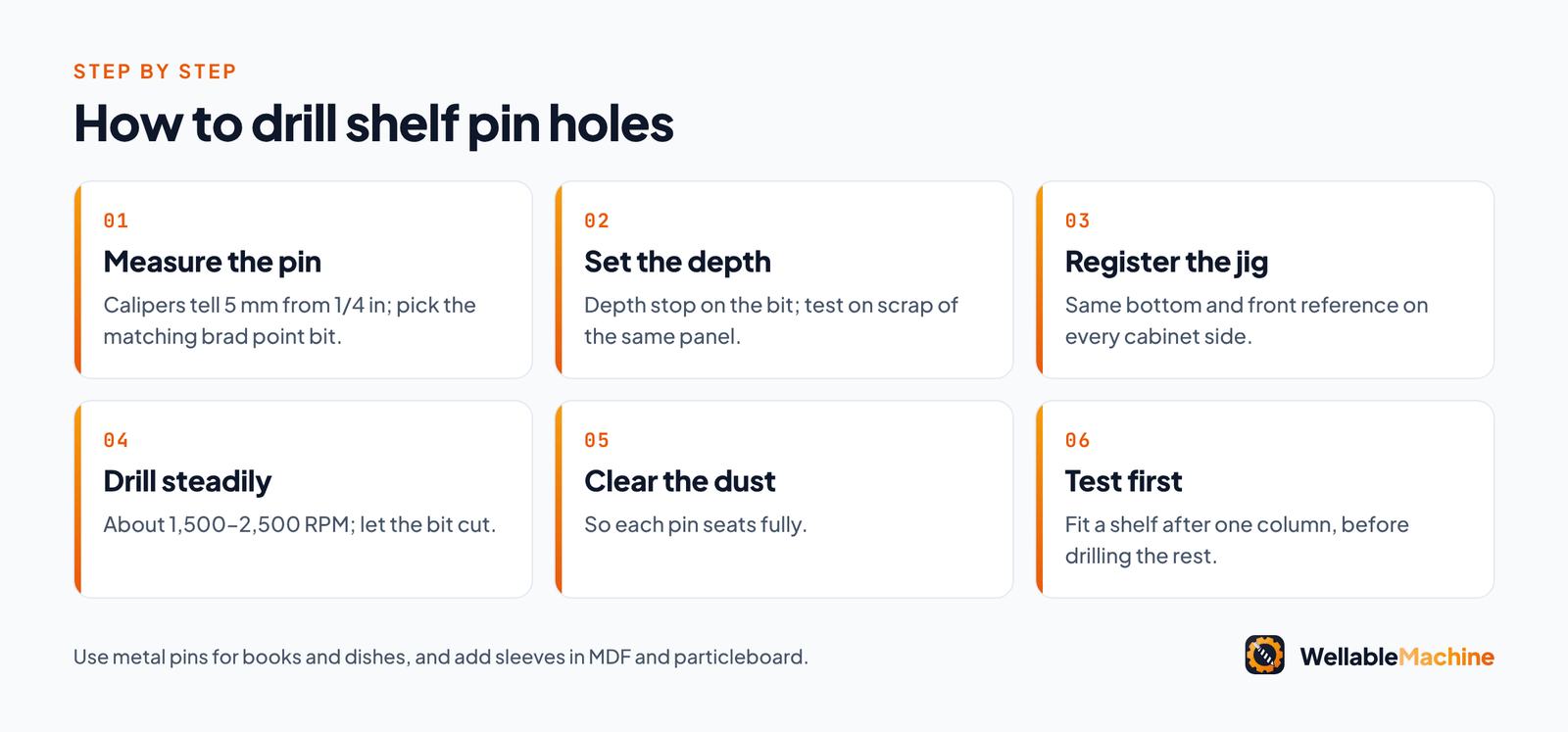
- Confirm the pin size with calipers and choose the matching brad point bit.
- Set the depth stop on the bit and test it on scrap of the same thickness.
- Position the jig. Register it against the bottom (or top) of the cabinet side and against the front edge. Use the same reference on every side.
- Drill at moderate speed. About 1,500–2,500 RPM works for a 5 mm or 1/4 in brad point in plywood, MDF and particleboard. Let the bit do the work and keep it square.
- Clear the dust from each hole so the pin seats fully.
- Test with a pin and shelf after the first column, before drilling all the rest.
If you don’t have a jig, a strip of pegboard makes a cheap one. Its holes are 1/4 in on a 1 in grid. Mark the bottom end, clamp it in place, and drill through it. Just remember pegboard holes wear quickly, so it’s best for one project. For general technique, see how to drill a straight hole.
Materials and What to Watch For
| Material | Watch out for | Tip |
|---|---|---|
| Melamine and laminate | Chipped edges around the hole | Sharp carbide brad point; moderate speed |
| Veneered plywood | Tear-out of the face veneer | Brad point; masking tape over the spot |
| MDF | Fuzzy hole walls; pins work loose with heavy use | Use sleeves for shelves that move often |
| Particleboard | Crumbling edges | Sharp bit, gentle feed; avoid holes near the edge |
| Solid wood | Splitting near ends; seasonal movement | Keep holes 1-1/2 in from edges |
How Much Weight Can Shelf Pins Hold?
Four good metal pins in solid material easily carry a typical bookshelf load. The usual weak point is not the pin but the shelf itself sagging, or the hole wall crushing in soft MDF and particleboard. To make shelves sturdier:
- Use metal pins rather than plastic for books and dishes.
- Choose spoon or L-shaped pins with a wide support face.
- Add brass sleeves in MDF and particleboard so the pin bears on metal.
- Keep shelf spans under about 30–32 in for 3/4 in plywood loaded with books, or add a center support.
Fixing Holes That Went Wrong
| Problem | Fix |
|---|---|
| Holes too big, pins droop | Use sleeves, step up to 1/4 in pins, or plug with glued dowels and re-drill |
| Holes too small, pins won’t go in | Re-drill with the correct bit; don’t force pins in or the panel may split |
| Shelf rocks | One hole set is out of line; move the pin up or down one hole, or plug and re-drill |
| Drilled through the side | Fill with a matching plug or wood filler; use stick-on caps on the outside |
| Chipped melamine around holes | Touch up with matching edge marker or filler; use a sharper bit next time |
Plugging with dowels works well: glue in a short length of 1/4 in dowel, trim flush, and re-drill. Our dowel hole size guide lists the right bits for each dowel. For cabinet doors on the same carcass, see 35 mm hinge cup hole.
Frequently Asked Questions
7 quick answers from our editors
01What size drill bit for shelf pins?
Match the pin: a 5 mm bit for 5 mm pins and a 1/4 in bit for 1/4 in pins. Measure the pin first, because they look similar.
02How deep should shelf pin holes be?
About 10–12 mm for 5 mm pins and 3/8 to 1/2 in for 1/4 in pins, slightly deeper than the pin shank.
03What is the standard spacing for shelf pin holes?
32 mm in European frameless cabinets. American bookcases and cabinets often use 1 in to 2 in.
04Can I use 1/4 in pins in 5 mm holes?
No, they won’t fit. You can enlarge the holes to 1/4 in, or use 5 mm pins instead.
05What bit is best for shelf pin holes?
A brad point bit with a depth stop. It starts exactly on the mark and leaves a clean edge.
06How far from the edge should shelf pin holes be?
Typically 37 mm (about 1-1/2 in) from the front and back edges, or 1-1/2 to 2 in in solid wood bookcases.
07Can I drill shelf pin holes in an assembled cabinet?
Yes. Use a jig that registers against the cabinet bottom, a short right-angle or compact drill if space is tight, and a stop collar so you don’t drill through the side.
Bottom Line
Measure the pin first, then drill a matching 5 mm or 1/4 in hole with a brad point bit and a depth stop, about 10–12 mm or 3/8–1/2 in deep. Use 32 mm spacing for European-style cabinets or 1–2 in for bookcases, keep columns about 37 mm from the edges, and reference every side from the same edge so shelves sit flat. Add sleeves in MDF or particleboard for shelves that move often.