Q Drill Bit Size: 0.332 in (8.43 mm), Uses and Substitutes
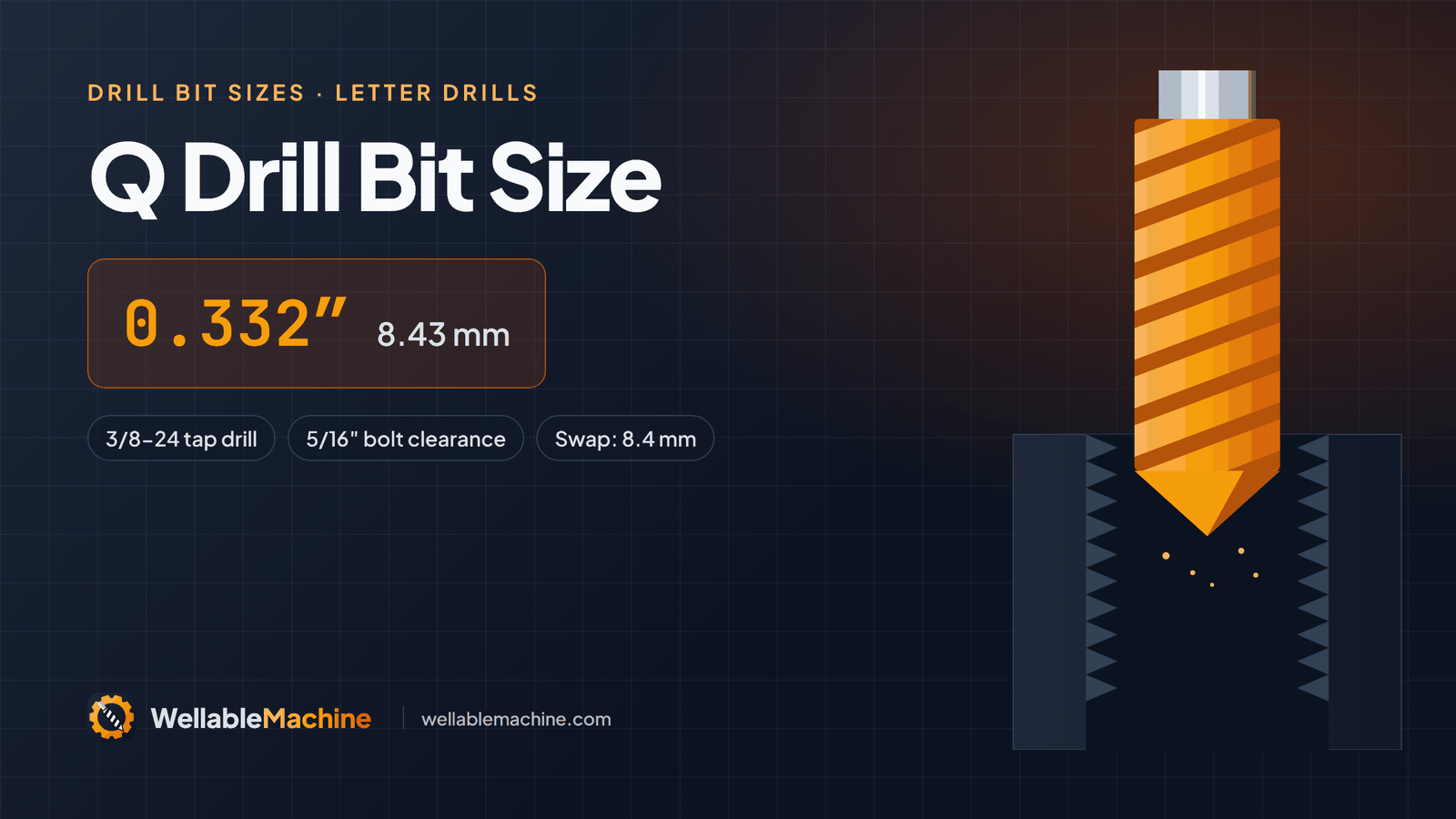
Quick answer: a Q drill is 0.332 in (8.43 mm) in diameter. It sits between a P drill (0.323 in) and an R drill (0.339 in), and it is slightly larger than 21/64 in (0.328 in). Its main jobs are the tap drill for 3/8-24 UNF threads (about 79% thread) and the free-fit clearance hole for 5/16 in bolts. If you don’t have one, an 8.4 mm drill is the closest metric swap and 8.5 mm is the easier-tapping choice.
Letter drills look odd the first time you meet them on a drawing or a tap chart, but they are just more steps between the fractional sizes. This guide covers the exact size of a Q drill, what it is used for, the best substitutes, what thread percentage each one gives in 3/8-24, and how to drill a clean, on-size Q hole in steel, aluminum and plastic.
Q Drill Size in Inches and Millimeters
| Measurement | Q drill |
|---|---|
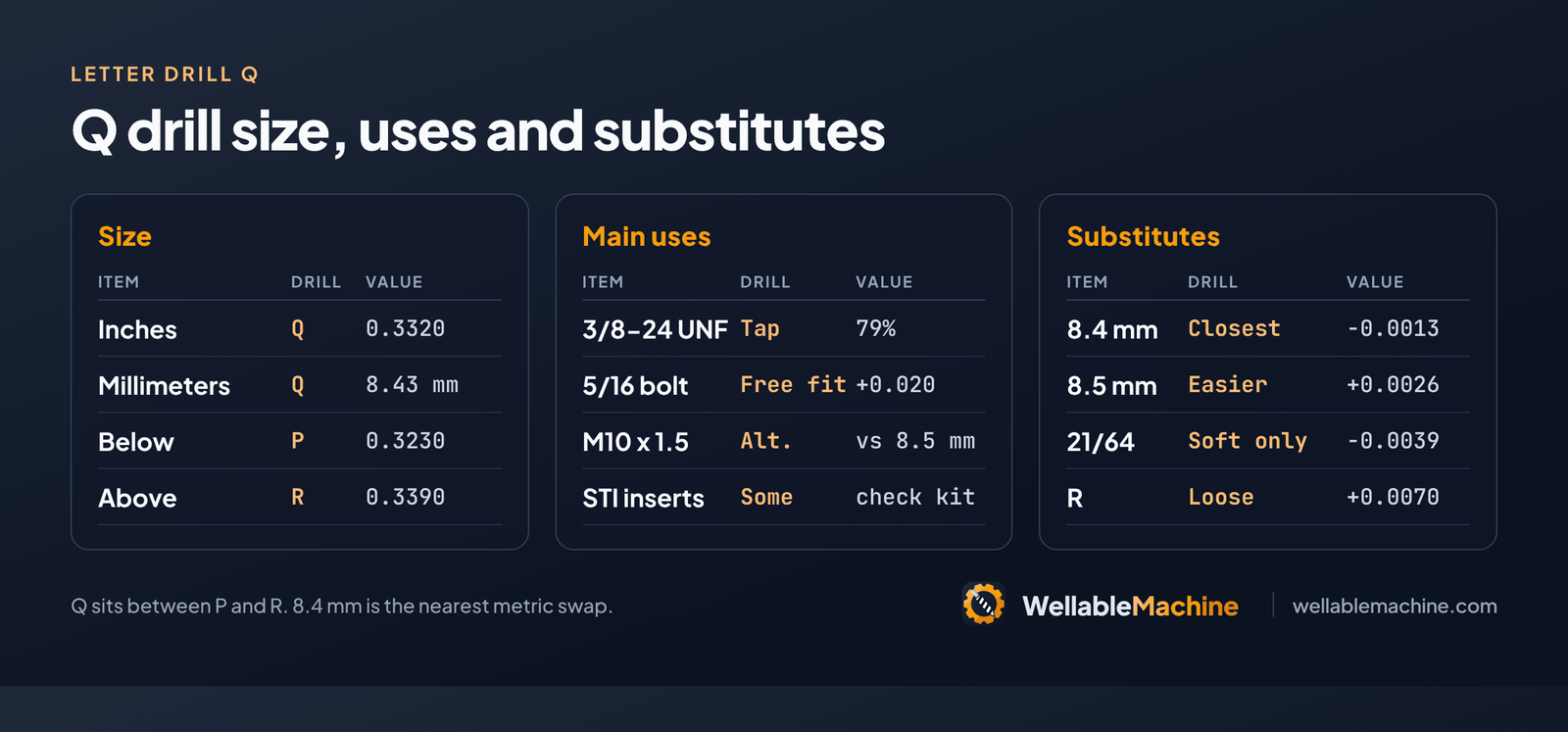
| Decimal inches | 0.3320 in |
| Millimeters | 8.43 mm |
| Nearest fraction (smaller) | 21/64 in (0.3281 in), 0.0039 in under |
| Nearest fraction (larger) | 11/32 in (0.3438 in), 0.0118 in over |
| Nearest metric | 8.4 mm (0.3307 in), 0.0013 in under |
| Letter below / above | P (0.323 in) / R (0.339 in) |
Letter drills run from A (0.234 in) to Z (0.413 in) and get bigger as you go through the alphabet. Q is the 17th size, about two-thirds of the way up the series. The full list of letter and number drills is in our number and letter drill size chart, and the background on how the series grew is in this drill bit sizes reference.
What Is a Q Drill Used For?
1. Tap drill for 3/8-24 UNF
This is the job that puts Q drills in most toolboxes. A 3/8-24 fine thread is common on automotive and motorcycle parts (brake and suspension fasteners, handlebar clamps, some axle and steering hardware), on hydraulic cylinder rod ends and on aircraft and race-car hardware. A Q drill leaves about 79% thread, which is right in the normal 75–80% target for steel. Our 3/8-24 tap drill size guide covers that thread in full.
2. Free-fit clearance hole for 5/16 in bolts
A 5/16 in bolt is 0.3125 in, so a Q hole gives about 0.020 in of total clearance. That is the standard “free” fit in most machinists’ references: the bolt drops through easily and the parts can shift slightly for alignment. If the holes are drilled together or on a drill press, a P drill (0.323 in) gives a closer fit. Both sizes are in the clearance hole size chart.
3. Metric work when you only have letter drills
The standard tap drill for M10 × 1.5 is 8.5 mm (0.3346 in). A Q drill is 0.0026 in smaller, so it gives a slightly fuller M10 thread that is still easy to tap in aluminum and mild steel. In stainless steel or hard alloys, stick with 8.5 mm. See the M10 tap drill size guide for the details.
4. Thread inserts and press fits
Some thread insert (STI) charts and press-fit tables call for a Q drill in the 5/16 in range. Insert makers set their drill sizes carefully for their own taps, so always use the size printed on the kit rather than a general chart.
Q Drill Substitutes
| Substitute | Size | Difference from Q | When it works |
|---|---|---|---|
| 8.4 mm | 0.3307 in | −0.0013 in | Best general swap; slightly tighter thread or fit |
| 8.5 mm | 0.3346 in | +0.0026 in | Easier tapping in steel and stainless |
| 21/64 in | 0.3281 in | −0.0039 in | Soft metals and plastics only; tight for tapping steel |
| R | 0.3390 in | +0.0070 in | Loose; about 66% thread in 3/8-24 |
| P | 0.3230 in | −0.0090 in | Too small to tap 3/8-24; good close-fit hole for 5/16 in bolts |
| 11/32 in | 0.3438 in | +0.0118 in | Clearance holes only; too big for tapping |
For most people the answer is simple: if you own a metric set, use 8.4 mm; if you only have fractional bits and you are tapping aluminum or brass, 21/64 in will do. In steel, buy a Q drill. They cost little and save broken taps.
Thread Percentage in 3/8-24 by Drill Size
Thread percentage tells you how much of the full theoretical thread depth is left after tapping. The common shop formula is % thread = 76.98 × TPI × (major diameter − drill diameter). For 3/8-24 that gives:

| Drill | Decimal | Thread % | Notes |
|---|---|---|---|
| 21/64 in | 0.3281 in | 87% | Very hard to tap in steel; fine in plastics |
| 8.4 mm | 0.3307 in | 82% | Strong; a little more tapping torque |
| Q | 0.3320 in | 79% | Standard choice |
| 8.5 mm | 0.3346 in | 75% | Good in stainless and tough alloys |
| R | 0.3390 in | 67% | Acceptable in hard metals and thick parts |
A 75% thread is only a few percent weaker than a 100% thread in a typical joint, but it needs far less torque to tap. That is why tap charts rarely go beyond about 80%. When the hole is deep (more than about 1.5 times the diameter) or the material is stainless, choose the 8.5 mm drill.
How to Drill an Accurate Q Hole
Drills tend to cut a little oversize, especially when they are hand-held or slightly dull. For a clearance hole that hardly matters, but for a tapped hole an extra 0.003 in can drop the thread percentage by 5 points. These steps keep the hole on size:
- Center punch the mark, then spot it with a center drill or spotting drill so the Q drill can’t walk.
- Use a pilot in hard metal. In steel thicker than about 1/4 in, drill a 1/8 in or 5/32 in pilot first. It cuts the thrust load of the chisel edge and keeps the hole straight. In thin sheet, skip the pilot; it can make the larger drill grab.
- Set the right speed. Starting points for an HSS Q drill: about 1,100 RPM in mild steel, 450 RPM in stainless, 2,800 RPM in aluminum and 1,500 RPM in acrylic or nylon. Cobalt drills can run about 25% faster in steel. Our drill speed chart lists other materials.
- Use cutting fluid in steel and aluminum, and peck out every few diameters of depth to clear chips.
- Clamp the work and use a drill press if you can. A straight hole matters more for a tapped hole than for a through hole. See how to drill a straight hole for hand-drill tricks.
- Chamfer the mouth with a countersink before tapping. It helps the tap start square and stops the first thread from lifting a burr.
Checking an Unmarked or Worn Q Drill
Letter drills are often stamped on the shank, and the stamp wears off. Measure across the body, just behind the tip, with calipers or a micrometer. Measure across the margins (the narrow lands at the outer edge of the flutes), not across the flutes. A new Q drill reads 0.332 in; anything under 0.330 in is probably a 21/64 in or 8.4 mm bit, and 0.339 in is an R. A drill index with all 26 letter sizes keeps them sorted, and a drill gauge plate with letter holes is a quick way to check a pile of loose bits.
A worn or badly sharpened drill can cut 0.003–0.005 in oversize, because one lip is longer than the other. If your test holes come out big, check the point on a gauge or resharpen it; our guide on how to sharpen drill bits shows how to keep both lips equal.
Q Drill vs Common Nearby Sizes
- P (0.323 in): close-fit clearance for 5/16 in bolts.
- Q (0.332 in): 3/8-24 tap drill; free-fit clearance for 5/16 in bolts.
- R (0.339 in): tap drill for 1/8 NPT pipe thread without reaming; see the 1/8 NPT tap drill size guide.
- 5/16 in (0.3125 in): tap drill for 3/8-16 UNC.
- U (0.368 in): tap drill for 7/16-14 UNC.
Mixing up Q and R is a common mistake on a busy bench. R is 0.007 in larger, enough to give a weak 3/8-24 thread, so check the stamp before you drill a tapped hole.
Tapping 3/8-24 After Drilling Q
A fine thread like 3/8-24 has shallow teeth, so it taps easily once the hole is right. Use a plug tap for through holes and follow with a bottoming tap in blind holes. Turn the tap one half turn forward and a quarter turn back to break the chip, add oil in steel, and keep the tap wrench level. In aluminum a spiral-point (gun) tap pushes chips ahead in through holes and can be run in one pass. Drill blind holes at least four threads (about 1/6 in) deeper than the thread you need so the tap’s chamfer has room. For the full process, see how to use a tap and die.
Buying Letter Drills
You can buy a Q drill on its own, but a 26-piece letter set (A to Z) in a metal index pays for itself if you tap often, because many common tap drills (F, I, Q, U) and clearance sizes (F, H, P, Q, W, X) are letters. Jobber-length HSS is fine for most work; choose cobalt (M35 or M42) if you drill a lot of stainless. A split-point tip starts without a center punch on flat surfaces and helps a hand-held drill stay on size.
Frequently Asked Questions
6 quick answers from our editors
01What size is a Q drill bit in inches?
0.332 in. That is slightly larger than 21/64 in (0.328 in) and smaller than 11/32 in (0.344 in).
02What size is a Q drill in mm?
8.43 mm. An 8.4 mm drill is the closest metric size.
03What tap uses a Q drill?
3/8-24 UNF. A Q drill gives about 79% thread.
04Can I use 21/64 instead of a Q drill?
In aluminum, brass and plastics, yes. In steel it leaves about 87% thread, which makes the tap much harder to turn and more likely to break.
05Is a Q drill bigger than 5/16?
Yes. A Q drill is 0.332 in and 5/16 in is 0.3125 in, so Q is about 0.020 in larger, which is why it makes a good clearance hole for 5/16 in bolts.
06What is the difference between Q and R drills?
R is 0.339 in, 0.007 in larger than Q. R is the tap drill for 1/8 NPT; Q is the tap drill for 3/8-24.
Bottom Line
A Q drill is 0.332 in (8.43 mm). Use it as the tap drill for 3/8-24 UNF and as a free-fit clearance hole for 5/16 in bolts. The best substitutes are 8.4 mm for a near-exact size and 8.5 mm for easier tapping in tough metals. Spot the hole, run the right speed, use cutting fluid and check the drill’s size if it is unmarked.