1/16 NPT Tap Drill Size: C Drill (0.242 in) and How to Tap It
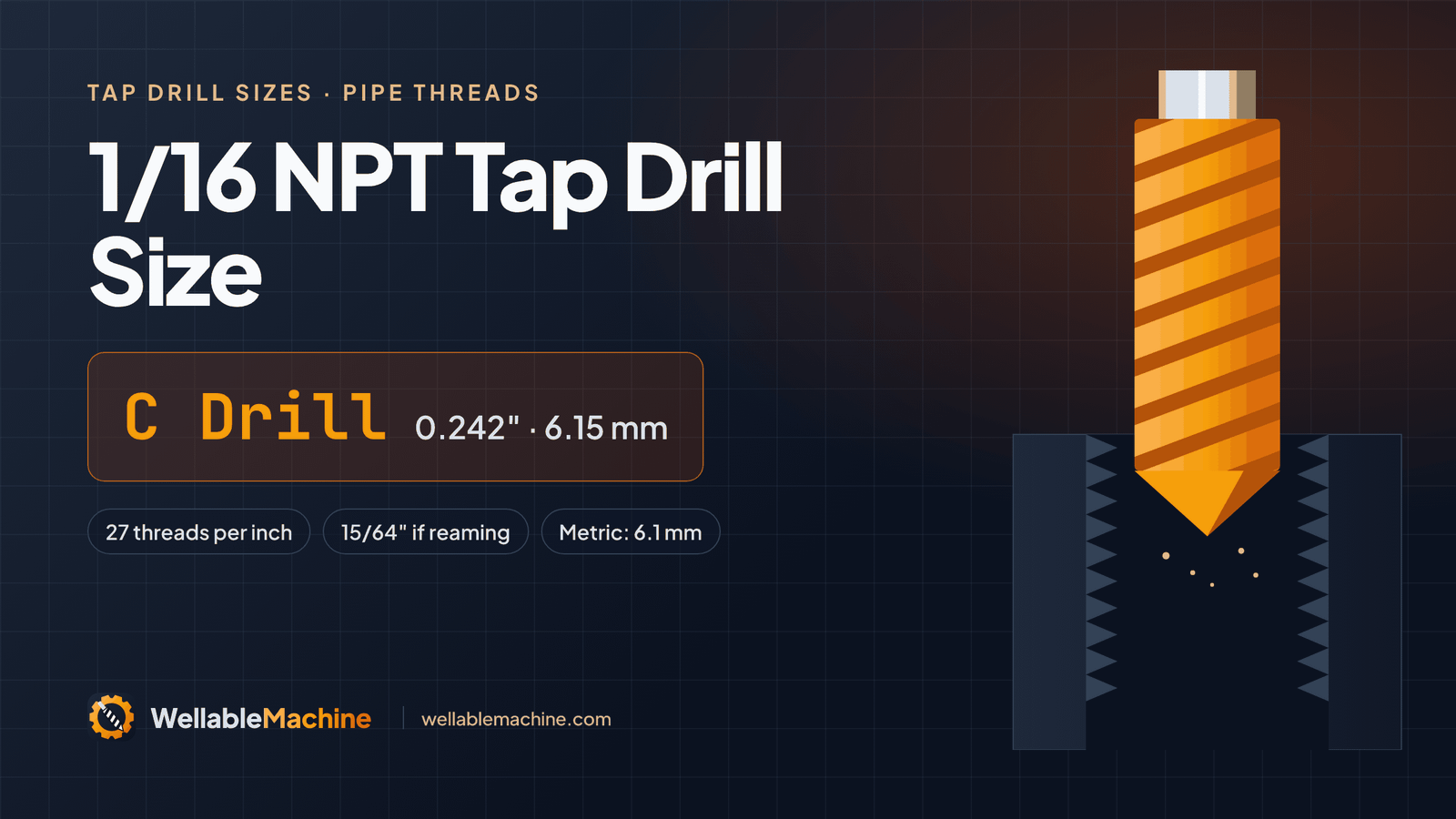
Quick answer: the standard tap drill for a 1/16-27 NPT pipe thread is a letter C drill (0.242 in / 6.15 mm) when you tap straight from the drill. If you ream the hole first with a 1/16 NPT taper pipe reamer, start with a smaller 15/64 in drill (0.2344 in / 5.95 mm). With a metric set, 6.1 mm or 6.2 mm are the closest swaps. Tap until the fitting threads in about 4 to 4-1/2 turns by hand, then stop.
1/16 NPT is the smallest common American pipe thread, and it is the one people most often get wrong. The name sounds tiny, but the outside diameter of the thread is 5/16 in, so a 1/16 in drill is nowhere near right. This guide explains what the size really measures, gives the drill, depth and speed for tapping it, shows where you will meet it, and covers the mistakes that make small pipe ports leak.
1/16 NPT Tap Drill Size at a Glance
| Specification | 1/16-27 NPT |
|---|---|
| Threads per inch | 27 (pitch 0.0370 in / 0.941 mm) |
| Outside diameter of thread (approx.) | 0.3125 in (7.94 mm) |
| Tap drill, no reamer | C (0.242 in / 6.15 mm) |
| Tap drill, with taper reamer | 15/64 in (0.2344 in / 5.95 mm) |
| Closest metric drills | 6.1 mm (tighter) or 6.2 mm (easier in steel) |
| Taper | 1 in 16 on diameter (3/4 in per foot) |
| Hand-tight engagement (L1) | 0.160 in, about 4.3 threads |
| Effective thread length (L2) | 0.261 in, about 7 threads |
| Wrench make-up after hand tight | about 3 turns |
Some older charts list a D drill (0.246 in) or even a 1/4 in drill for 1/16 NPT. Those are slightly loose and make tapping easier in tough metals, but they leave less thread at the top of the port. In brass, aluminum and mild steel the C drill is the better default.

Why a 1/16 in Pipe Thread Needs a 0.242 in Hole
Pipe sizes are nominal. They started out as rough bore sizes of old wrought-iron pipe, and the thread outside diameter was set to suit the pipe wall, not the name. For 1/16 NPT the thread’s outside diameter is about 5/16 in. Take away two thread depths and the small end of the thread, and you arrive at a minor diameter just under a quarter inch. That is why the tap drill is a letter drill near 1/4 in.
The National Pipe Thread standard (ANSI/ASME B1.20.1) uses a 60° thread with flattened crests and roots, and a taper of 1 in 16 on the diameter. Because of the taper, the hole you drill is a straight cylinder, but the tap cuts a cone. The tap removes very little metal at the bottom of the port and a full thread depth at the top. Pre-reaming the hole to the same taper spreads the cutting evenly, which is why the reamed drill size is smaller.
Where You Will Find 1/16 NPT
1/16 NPT is used wherever a sealed thread is needed but the part is too small for 1/8 NPT. Typical places are:
- Temperature and pressure sensors: small thermocouple compression fittings, some oil and water temperature senders, and instrument transducers.
- Gauge and test ports: lab instruments, small pressure gauges and the test points on fuel and hydraulic systems.
- Miniature pneumatics: tiny push-to-connect fittings for 1/8 in and 5/32 in tube, small air cylinders and valve manifolds.
- Lubrication and coolant lines: oilers, drip feeds and coolant nozzles on machine tools.
- Racing and model engines: fuel, vacuum and boost reference fittings on carburetors, throttle bodies and intake manifolds.
Most of these parts are made of brass, aluminum or thin steel, so the port wall is often only a few threads deep. That makes the depth of tapping just as important as the drill size.
1/16 NPT vs 1/8 NPT
The two smallest NPT sizes share the same 27 TPI pitch, which causes mix-ups when you are holding a loose fitting. The diameter tells them apart.
| 1/16 NPT | 1/8 NPT | |
|---|---|---|
| Threads per inch | 27 | 27 |
| Thread OD (approx.) | 0.3125 in (7.9 mm) | 0.405 in (10.3 mm) |
| Tap drill, no reamer | C (0.242 in) | R (0.339 in) |
| Tap drill, reamed | 15/64 in | 21/64 in |
| Hex size on a typical male fitting | about 5/16–3/8 in | about 7/16–1/2 in |
A quick check: if the male thread is a little over 5/16 in across the crests, it is 1/16 NPT. If it is about 13/32 in, it is 1/8 NPT. A pair of calipers settles it in a second. For the larger sizes, see the 1/8 NPT tap drill size and 1/4 NPT tap drill size guides.
NPT Pipe Tap Drill Chart (1/16 to 1 in)
| Pipe size | TPI | Drill, no reamer | Drill, with reamer |
|---|---|---|---|
| 1/16 NPT | 27 | C (0.242 in) | 15/64 in |
| 1/8 NPT | 27 | R (0.339 in) | 21/64 in |
| 1/4 NPT | 18 | 7/16 in | 27/64 in |
| 3/8 NPT | 18 | 37/64 in | 9/16 in |
| 1/2 NPT | 14 | 23/32 in | 11/16 in |
| 3/4 NPT | 14 | 59/64 in | 57/64 in |
| 1 NPT | 11.5 | 1-5/32 in | 1-1/8 in |
How to Drill and Tap a 1/16 NPT Port
- Check the wall. You need at least 3/8 in of solid material for a full-depth port. In thinner parts, use a weld-in bung or a 1/16 NPT half coupling instead of tapping the wall.
- Center punch and spot. Use a center drill or spotting drill so the C drill starts exactly where you want it. A wandering hole tilts the fitting.
- Drill with the C drill. Drill about 0.40 in deep for a blind port, which leaves room for the tap’s chamfer. Run at roughly 1,200–1,500 RPM in aluminum and brass and 500–700 RPM in mild steel. Our drill speed chart covers other metals.
- Ream if you have a reamer. If you drilled 15/64 in, run the 1/16 NPT taper reamer in by hand until the fitting would start about one turn.
- Tap slowly and straight. Use a tap wrench and a guide block, or start the tap in the drill press with the spindle turned by hand. Use plenty of cutting oil in steel; brass can be tapped dry.
- Test often. Back the tap out every few turns, clean the port and try the fitting. Stop when it threads in about 4 to 4-1/2 turns by hand.
- Deburr and clean. Lightly chamfer the mouth and blow out all chips, which would otherwise end up inside a sensor or valve.

How Deep to Tap 1/16 NPT
A tapered thread seals because the male and female cones wedge together. If you tap too deep, the fitting runs in too far before it gets tight, and it may bottom out or crack a thin housing before it seals. If you tap too shallow, the fitting stands proud and only a couple of threads carry the load.
For 1/16 NPT the standard hand-tight engagement is 0.160 in, a little over four threads, and a normal wrench make-up adds about three more turns. So a good port lets the fitting go in about four turns by hand and then tighten with roughly two to three turns of a wrench. With a thread gauge (an L1 plug gauge), the small end of the gauge should sit flush with the face of the part, within plus or minus one turn.
On very small fittings it is easy to overtighten. Brass sensor bodies and aluminum manifolds can crack around the port. Use a short wrench and stop when the fitting is snug plus a little more.
Sealing a 1/16 NPT Fitting
- PTFE tape: one and a half to two wraps of thin tape, wound clockwise when you look at the end of the male thread. Keep the first thread bare so no tape shreds into the system.
- Pipe dope or anaerobic sealant: better for small fittings on fuel, oil and instrument lines, because there is no tape to break off. Use a sealant rated for the fluid.
- Sensors with electrical grounding: some senders ground through the thread. Too much tape can break the ground and give odd readings, so use a conductive sealant or just a light coat of dope.
- Dryseal threads: NPTF (Dryseal) ports are made to seal metal to metal without sealant. Standard NPT taps work for most jobs, but NPTF taps give a better seal on fuel and hydraulic lines.
Common Problems and Fixes
| Problem | Likely cause | Fix |
|---|---|---|
| Fitting bottoms out before it is tight | Port tapped too deep | Use a fitting with a longer thread, add a little more sealant, or re-drill to a larger NPT size |
| Fitting only starts one or two turns | Port tapped too shallow | Run the tap in another half turn at a time and test again |
| Leaks at low pressure | Torn threads, wrong sealant, or BSPT fitting in an NPT port | Check the thread with a gauge; chase the port with a sharp tap |
| Tap breaks | Small tap forced in steel or packed with chips | Use a C drill (not smaller), more oil and frequent back-outs. See how to remove a broken tap |
| Housing cracks | Thin wall or overtightening | Use a thicker boss or a weld bung, and tighten less |
Metric and British Equivalents
There is no exact metric equal to 1/16 NPT. The British 1/16 BSPT thread has 28 threads per inch and a 55° thread angle, so it is close but not interchangeable. An NPT fitting may screw a turn or two into a BSPT port and feel tight, but it will usually seep under pressure. On equipment from Europe or Asia, check the port with a thread pitch gauge before you add sealant. For metric drills on other thread types, the tap drill size chart has inch and metric sizes side by side.
If you are short of a C drill, a 6.1 mm drill (0.240 in) is the closest swap and gives a slightly stronger thread. A 6.2 mm drill (0.244 in) is easier to tap in stainless steel. Both are listed with every other letter size in the number and letter drill size chart.
Frequently Asked Questions
7 quick answers from our editors
01What size drill do I use for a 1/16 NPT tap?
A letter C drill (0.242 in) if you tap without reaming, or a 15/64 in drill if you ream the hole first with a 1/16 NPT taper reamer.
02Is 1/16 NPT the same as 1/16 inch?
No. 1/16 is a nominal pipe size. The thread’s outside diameter is about 5/16 in (0.3125 in).
03How many threads per inch is 1/16 NPT?
27 threads per inch, the same as 1/8 NPT.
04Can I use a 1/4 in drill for 1/16 NPT?
You can in hard or tough metal, because it makes tapping easier, but the thread at the mouth will be shallower. A C drill gives a better seal in most materials.
05What is the metric drill for 1/16 NPT?
6.1 mm is the closest; 6.2 mm works well in stainless or other hard-to-tap metals.
06How deep should I tap a 1/16 NPT hole?
Until the male fitting threads in about four turns by hand, then tighten two to three more turns with a wrench.
07Will a 1/16 BSPT fitting fit a 1/16 NPT port?
Not reliably. BSPT has 28 TPI and a 55° thread form, so it will usually leak in an NPT port.
Bottom Line
Drill a C (0.242 in) hole for 1/16-27 NPT, or 15/64 in if you ream first. Tap until the fitting goes in about four turns by hand, seal it with a little dope or thin PTFE tape, and tighten gently, because small brass and aluminum parts crack easily. If the port wall is thinner than about 3/8 in, use a bung or coupling instead of tapping it.