M16 Tap Drill Size: 14 mm Drill Chart for M16 x 2.0 Threads
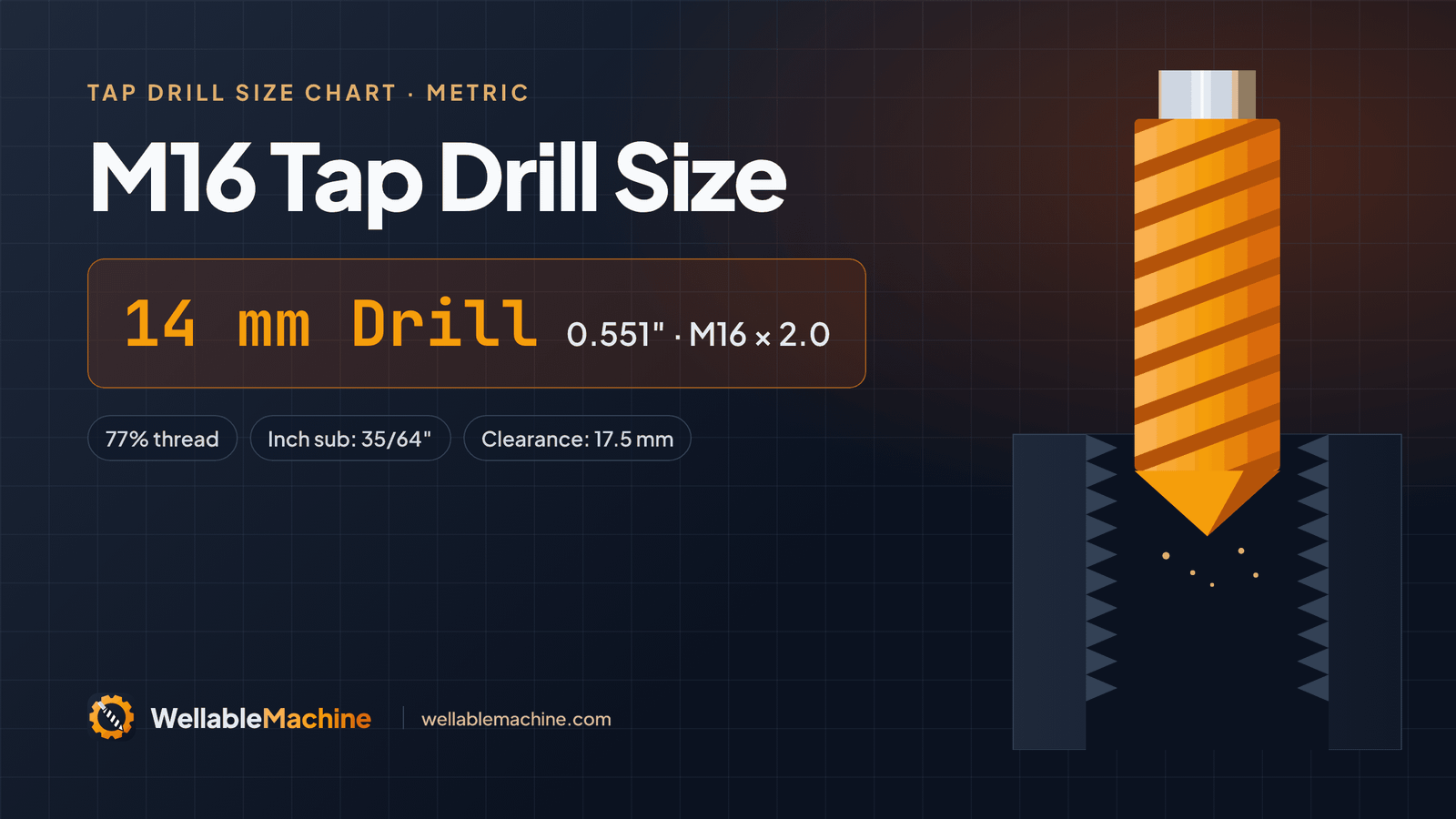
Quick answer: an M16 × 2.0 thread needs a 14 mm drill (0.551 in) for a standard 77% thread. With inch drills, 35/64 in (0.547 in) is the closest, and 9/16 in (0.5625 in) is easier to tap. In stainless or for hand tapping large holes in steel, 14.2–14.5 mm is a sensible choice.
M16 is a big structural thread used on heavy machinery, steel frames, lifting eyes and anchor bolts. Drilling and tapping it by hand is hard work, so this guide covers not just the drill size but the equipment, technique and alternatives that make the job realistic.
M16 Thread Specifications at a Glance
“M16” is an ISO metric thread with a 16 mm diameter and a coarse pitch of 2.0 mm. The common fine pitch is M16 × 1.5. See the ISO metric screw thread reference.
| Specification | Value |
|---|---|
| Thread series | ISO metric coarse (M) |
| Major diameter | 16.00 mm (0.630 in) |
| Pitch | 2.0 mm (12.7 TPI) |
| Basic minor diameter (internal) | 13.835 mm |
| Tap drill, ~77% thread | 14.0 mm (0.551 in) |
| Inch substitutes | 35/64 in, 9/16 in |
| Fine pitch | M16 × 1.5 → 14.5 mm |
| Clearance hole, normal fit | 17.5 mm |
| Hex head wrench size | 24 mm |
M16 Tap Drill Size Chart by Thread Percentage
Pick the drill by how much thread engagement you need. Around 75% is the shop standard for M16; going tighter mostly adds tapping torque and broken taps, while going looser makes hard metals much easier to thread. Each figure below comes from % thread = (D − drill) ÷ (1.299 × pitch) × 100.
| Drill | mm | Inches | Approx. thread | When to use it |
|---|---|---|---|---|
| 13.8 mm | 13.80 | 0.5433 | 85% | Too tight; huge torque |
| 35/64 | 13.89 | 0.5469 | 81% | Inch option; tight |
| 14.0 mm | 14.00 | 0.5512 | 77% | Standard choice for most materials |
| 14.2 mm | 14.20 | 0.5591 | 69% | Steel, hand tapping |
| 9/16 | 14.29 | 0.5625 | 66% | Inch option for steel |
| 14.5 mm | 14.50 | 0.5709 | 58% | Stainless; also the M16 × 1.5 drill |
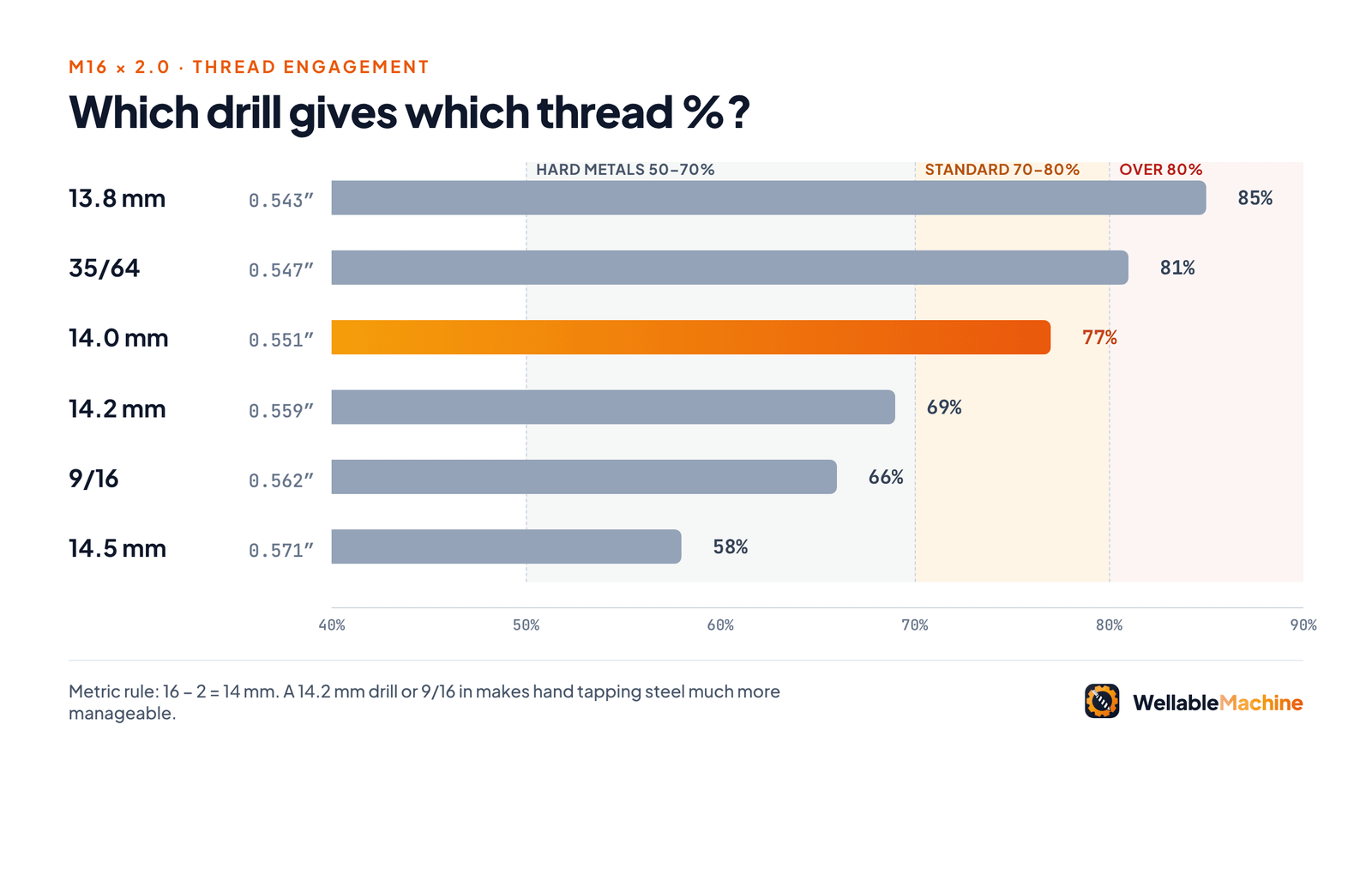
Which drill should you use? Use 14 mm when machine tapping or working in cast iron and aluminum. For hand tapping mild steel, 14.2 mm or 9/16 in lowers torque considerably. For stainless, 14.5 mm (about 58% thread) is the practical choice; an M16 bolt with that thread is still limited by the bolt, not the hole, in most joints.
Drilling a 14 mm Hole: Equipment Tips
A 14 mm hole is beyond what most cordless drills handle comfortably in steel. Use a drill press or magnetic drill if you can. Most 14 mm drills have a reduced 1/2 in (13 mm) shank so they fit standard chucks. Always pilot drill (6–8 mm) first, clamp the part firmly, and run slowly: about 200–250 RPM in mild steel and 100–150 RPM in stainless. For holes in plate on site, an annular cutter in a magnetic drill is faster and more accurate.
Clearance Hole Sizes for an M16 Bolt
ISO 273 clearance holes for M16:
| Fit | Drill | Inches | mm | Use it for |
|---|---|---|---|---|
| Close (fine) | 17 mm | 0.669 | 17.00 | Precise location |
| Normal (medium) | 17.5 mm | 0.689 | 17.50 | Most assemblies |
| Loose (coarse) | 18.5 mm | 0.728 | 18.50 | Structural steel, base plates |
M16 vs. M16 × 1.5 vs. 5/8-11
The inch 5/8-11 bolt is within 0.12 mm of M16 in diameter, which makes it easy to grab the wrong one on mixed equipment.
| Thread | Diameter | Pitch | Tap drill | Typical use |
|---|---|---|---|---|
| M16 × 2.0 | 16.00 mm | 2.0 mm | 14 mm | Heavy machinery, steelwork |
| M16 × 1.5 | 16.00 mm | 1.5 mm | 14.5 mm | Hydraulics, fine adjustment |
| 5/8-11 UNC | 15.88 mm | 2.309 mm (11 TPI) | 17/32 in | US structural and machinery |
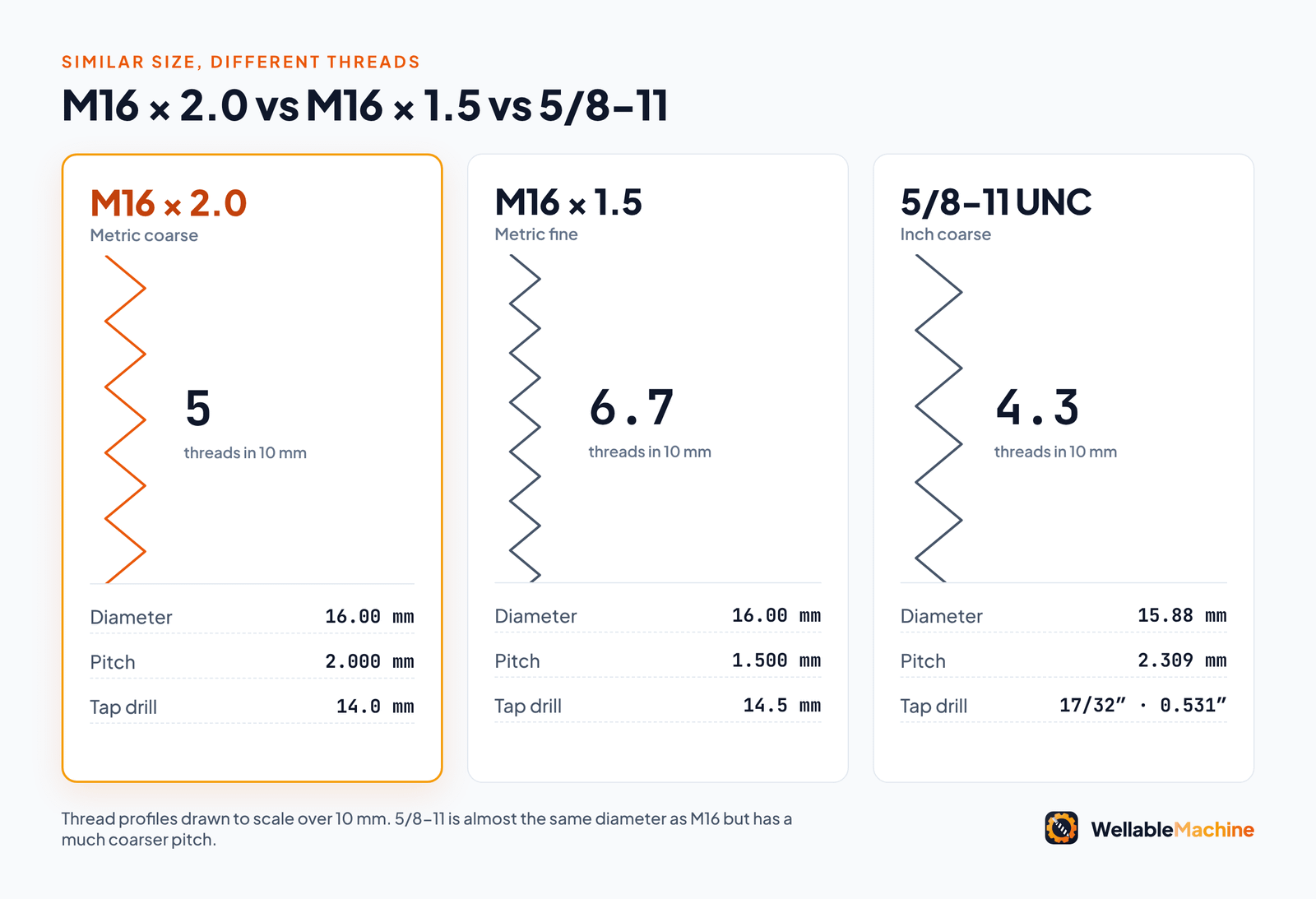
A 5/8-11 bolt will thread a turn into an M16 hole and then lock up. Always check the pitch on equipment that mixes standards.
Other M16 Hole Sizes You Might Need
- Forming (roll) tap: about 15.1 mm; mainly for machine use at this size.
- Helicoil / wire thread insert: drill 16.5 mm and use the M16 STI tap.
- Counterbore for an M16 socket head cap screw: 26 mm diameter, about 17.5 mm deep.
- Anchor bolts in concrete: use the anchor maker’s hole size, often 18 mm.
How to Drill and Tap a M16 Hole
- Mark and center punch the hole so the drill starts exactly where you want it.
- Drill with a 14.0 mm bit. In aluminum, run about 700 RPM; in mild steel, about 400 RPM; in stainless, slow down to about 200 RPM with steady pressure and cutting oil. Our guide on how to drill stainless steel explains why stainless needs low speed and constant feed.
- Add a light chamfer just wider than the thread diameter, so the screw starts easily and the top thread stays clean.
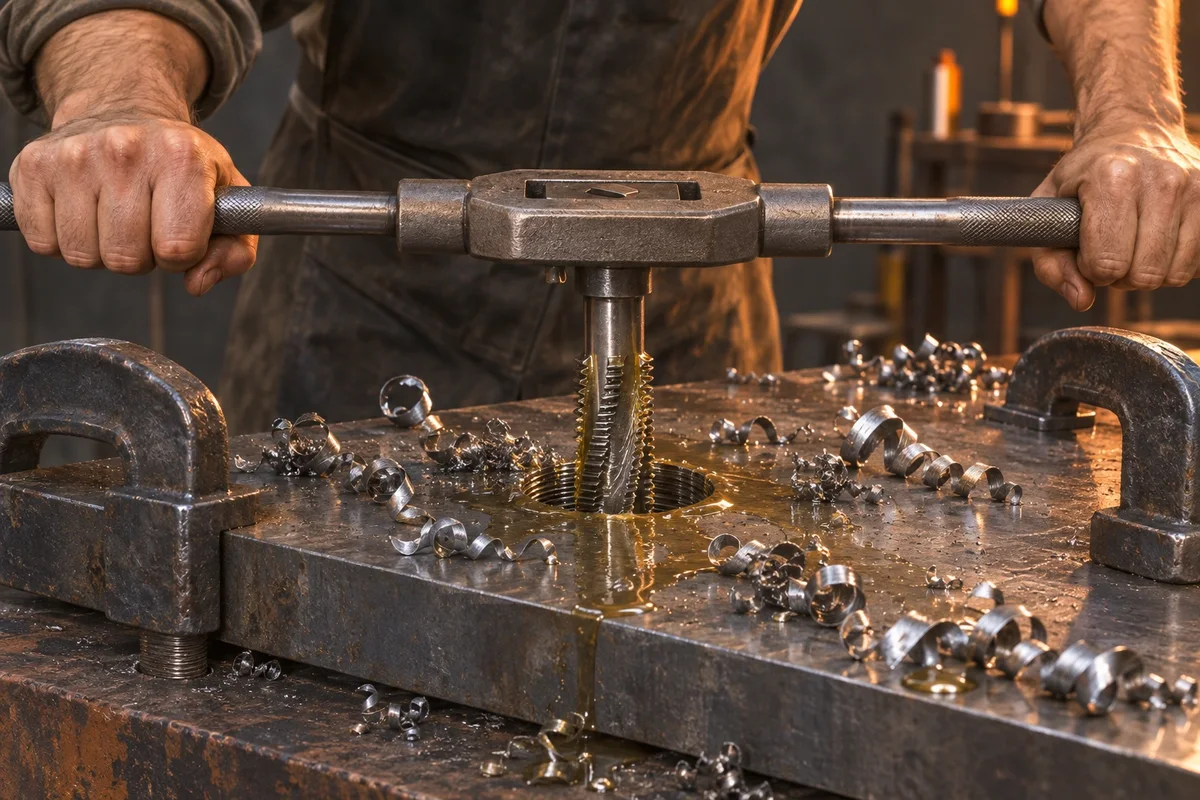
- Start the tap straight. Use the drill press spindle or a heavy guide block. An M16 tap is heavy and long, so support the far end of the wrench to keep it level.
- Keep the chips short: every half turn, back off a little so the chip breaks. Re-oil after every few turns, and back the tap right out if it starts to feel gritty.
- For blind holes, drill at least 8 mm deeper than the full thread you need, and finish with a bottoming tap.
Large holes need a well-sharpened drill; see how to sharpen drill bits. For the next sizes down, see the M12 tap drill size.
Which M16 Tap Should You Use?
Hand tapping M16 in steel is hard work. Use a taper tap first, then a plug tap, and a wrench at least 500 mm long. For several holes, a tapping attachment on a radial drill or a power tapping arm saves hours.
| Tap type | Best for | Notes |
|---|---|---|
| Taper tap | Starting threads by hand in hard material | Long chamfer; the easiest to start straight |
| Plug tap | Through-holes and most blind holes | The everyday hand tap |
| Bottoming tap | Full threads to the bottom of blind holes | Use only after a plug or taper tap |
| Spiral point (gun) tap | Through-holes, power tapping | Pushes chips ahead; strong core, fewer breaks |
| Spiral flute tap | Blind holes, power tapping | Lifts chips up and out of the hole |
| Forming (roll) tap | Aluminum, brass, mild steel | No chips; needs a larger 15.1 mm hole |
Tapping M16 in Different Materials
Soft metals forgive mistakes; tough ones do not. Use this table to adjust your drill, fluid and approach for the material in front of you.
| Material | Recommended drill | Tapping fluid | Tips |
|---|---|---|---|
| Aluminum | 14.0 mm | Light oil or WD-40 | Use a taper tap; chips are large |
| Mild steel | 14.0 mm | Sulfurized cutting oil | Standard plug tap works well |
| Stainless (304/316) | 14.5 mm | Heavy tapping paste | Cobalt tap; consider 14.5 mm |
| Brass and bronze | 14.0 mm | Light oil or dry | Cuts cleanly; avoid high-rake taps |
| Structural steel plate | 14.0–14.2 mm | Cutting oil | Consider a nut and through-bolt instead |
How Deep Should a M16 Thread Be?
A common rule is to engage at least one screw diameter in steel and more in softer metals. Past that, extra length adds work but very little holding power:
- Steel: 1 × diameter = 16 mm.
- Cast iron: 1.5 × diameter = 24 mm.
- Aluminum: 2 × diameter = 32 mm, or a Helicoil.
Where Is M16 Used?
M16 bolts appear on heavy machinery bases, crane and lifting attachments, structural steel connections, agricultural equipment, truck chassis parts and foundation anchors. It is roughly the metric counterpart of the 5/8 in bolt.
Common M16 Tapping Problems (and How to Fix Them)
- Can’t turn the tap: drill 14.2–14.5 mm, use more oil, and start with a taper tap.
- Drill wanders: pilot drill first and clamp the part.
- Thread crooked: start in a drill press or with a guide block.
- Bolt binds: it may be 5/8-11 or M16 × 1.5.
Frequently Asked Questions
5 quick answers from our editors
01What size drill bit for an M16 tap?
A 14 mm drill. It gives about a 77% thread.
02What inch drill for M16?
35/64 in is closest; 9/16 in is easier to tap.
03What size drill for M16 × 1.5?
14.5 mm.
04What size clearance hole for M16?
17.5 mm for a normal fit, 17 mm close and 18.5 mm loose.
05Is M16 the same as 5/8 in?
No. They are close in size, but the pitches differ, so they don’t thread together.
Bottom Line
For an M16 × 2.0 thread, drill 14 mm, or 9/16 in for easier hand tapping. Use 14.5 mm for stainless and for M16 × 1.5, and 17.5 mm for clearance. Pilot drill, clamp the part, and use a taper tap first. For other sizes, see our tap drill size chart.