How to Use a Magnetic Drill (Setup, Cutters, Speeds, Safety)
Quick answer: to use a magnetic drill (mag drill), clean the steel where the base will sit, place the drill and line up the pilot pin on your center punch mark, switch on the magnet, and attach the safety strap. Fit an annular cutter with coolant, start the motor at the right speed, and feed steadily until the slug drops out. The magnet needs at least 3/8 in (10 mm) of clean, flat steel under it to hold at full strength. On thinner material, add a steel plate underneath.
A magnetic drill is a compact drill press with an electromagnet in its base. It clamps itself to steel beams, columns, plates and structures, so you can drill large, accurate holes on site, including on vertical or overhead surfaces, without bringing the work to a drill press. With an annular cutter, it makes 1/2 in to 2 in holes in thick steel in seconds. This guide covers setup, cutters, speeds, safety and the most common mistakes.
What a Mag Drill Is Good For
- Structural steel: bolt holes in beams, columns, base plates and connection plates.
- Fabrication: large holes in plate too big to move to a drill press.
- Maintenance: drilling on installed machinery, frames, rails and equipment.
- Heavy trucks, trailers and rail: frame holes and repairs.
- Tapping: reversible mag drills with a tapping chuck can tap holes after drilling.
Parts of a Magnetic Drill
| Part | What it does |
|---|---|
| Electromagnetic base | Holds the drill to the steel when switched on |
| Motor and gearbox | Turns the cutter, often with two or more speeds |
| Feed handles | Move the motor and cutter down on a slide |
| Arbor | Holds annular cutters (usually a 3/4 in Weldon shank) |
| Pilot pin | Locates the hole on the punch mark and ejects the slug |
| Coolant bottle | Feeds cutting fluid through the arbor to the cutter |
| Safety strap or chain | Holds the drill if the magnet lets go |
Annular Cutters vs Twist Drills
An annular cutter cuts only a ring of metal at the edge of the hole, leaving a solid core (the slug). Because it removes far less metal than a twist drill, it needs much less power and makes the hole three to four times faster. The hole is round, accurate and nearly burr-free, so it usually needs no pilot or step drilling. The annular cutter article explains the geometry. Annular cutters come in:
- HSS: for mild steel and general structural work, up to about 2-3/8 in.
- Carbide-tipped (TCT): for stainless steel, hard steel, and higher speeds and production work.
- Depths of cut: commonly 1 in, 2 in and 3 in (25, 50 and 75 mm).
Most mag drills can also take a twist drill chuck through an adapter for smaller holes. Use a slow speed and a pilot, just as you would in a drill press. See how to drill a large hole in metal for other options.
How to Use a Magnetic Drill, Step by Step
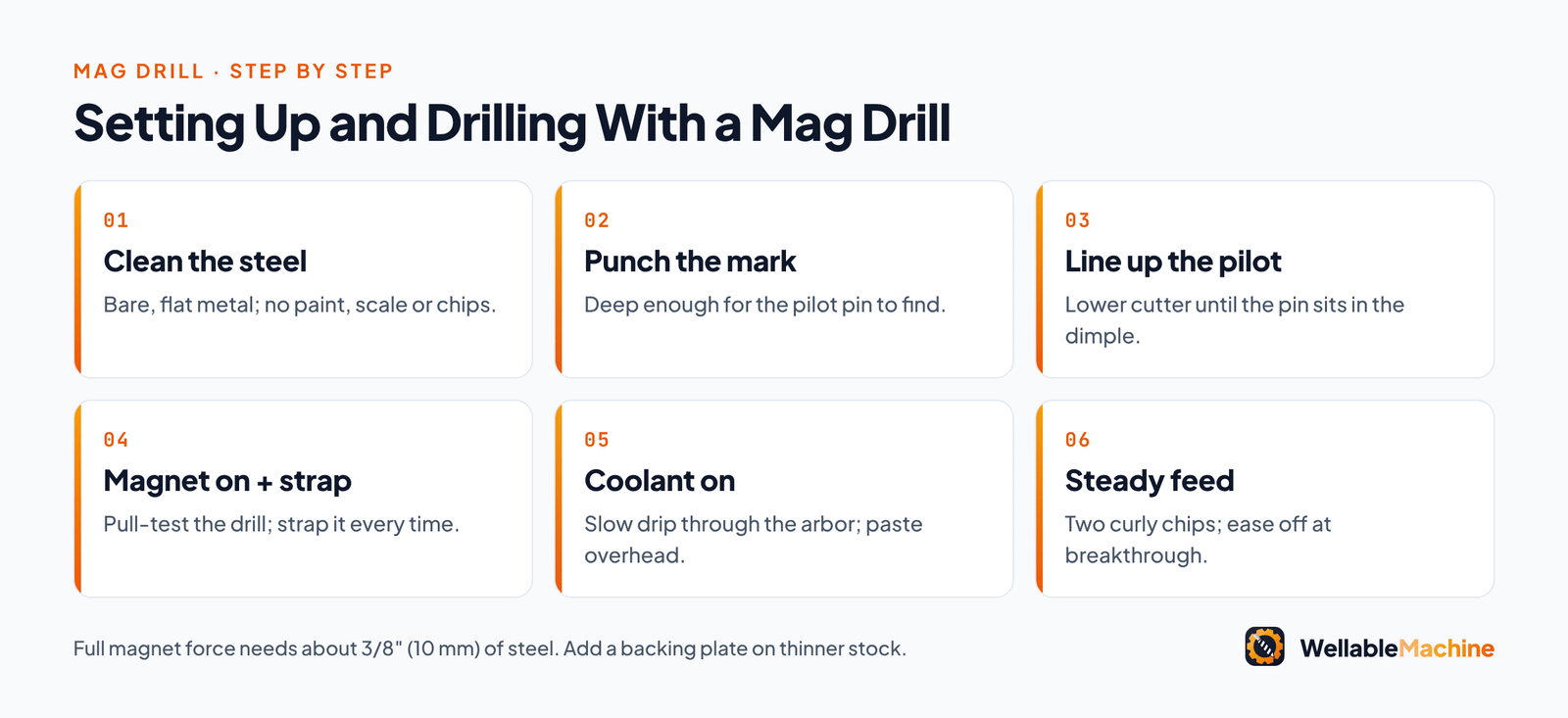
1. Prepare the surface
The magnet needs full, flat contact with bare steel. Remove paint, rust, mill scale, weld spatter and chips under the base with a wire brush or grinder. Wipe the bottom of the magnet too. Even a few chips under one corner can halve the holding force.
2. Mark the hole
Center punch the hole location deeply enough for the pilot pin to find it. See how to use a center punch.
3. Fit the cutter and pilot
Install the pilot pin in the cutter and lock the cutter in the arbor with its set screws on the flats of the Weldon shank. Check that the pilot moves freely.
4. Position and lock the magnet
Set the drill on the work, lower the cutter until the pilot touches the punch mark, and adjust until it sits exactly in the dimple. Switch the magnet on and check that it’s holding firmly before starting the motor. Many drills have an indicator light or won’t start the motor until the magnet is engaged.
5. Attach the safety strap
Wrap the strap around the beam or workpiece and tighten it. This is essential on vertical and overhead surfaces, and a good habit everywhere. If power is lost, the magnet releases instantly.
6. Turn on the coolant
Fill the coolant bottle with a water-soluble cutting fluid or a cutting oil, and open the valve so a slow drip reaches the cutter through the arbor. For overhead work, use a thick cutting paste on the cutter instead.
7. Drill
Start the motor, bring the cutter down gently until the teeth touch, then feed with steady, even pressure. You want two clean, curly chips coming off. Ease off as the cutter nears breakthrough, then retract. The pilot pin pushes the slug out. Watch where it goes, because it’s hot and sharp.
Speeds for Annular Cutters
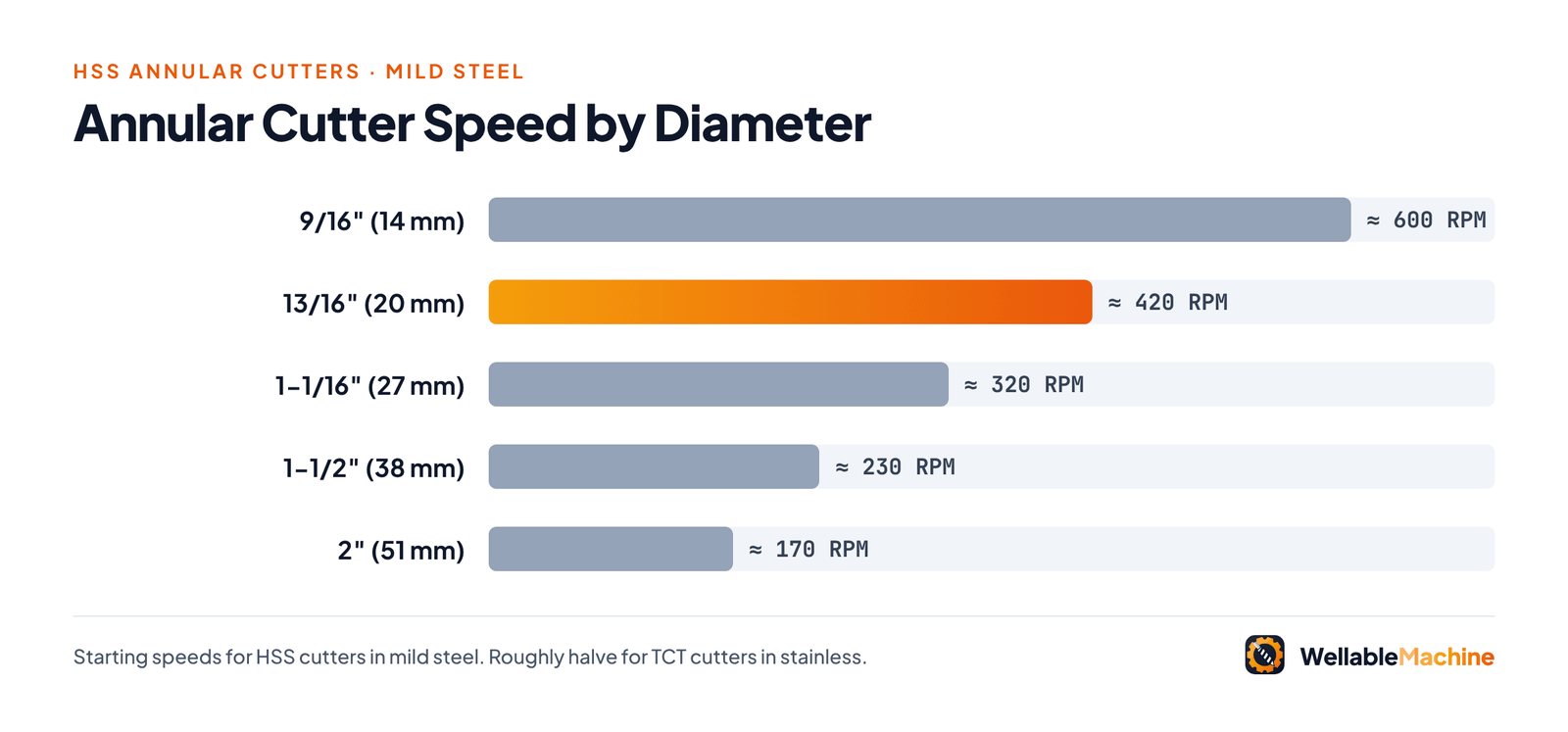
| Cutter diameter | Mild steel (HSS) | Stainless (TCT) |
|---|---|---|
| 9/16 in (14 mm) | About 600 RPM | About 300 RPM |
| 13/16 in (20 mm) | About 420 RPM | About 220 RPM |
| 1-1/16 in (27 mm) | About 320 RPM | About 170 RPM |
| 1-1/2 in (38 mm) | About 230 RPM | About 120 RPM |
| 2 in (51 mm) | About 170 RPM | About 90 RPM |
These are starting points. Many mag drills have only two or three gear speeds, so pick the closest and adjust your feed. Carbide cutters in mild steel can run faster, often double these figures. Always check the cutter maker’s chart.
Magnet Holding Force and Thin Material
An electromagnet’s grip depends on how much steel the magnetic field can pass through. Most mag drills are rated for full force on steel 3/8 in (10 mm) or thicker. On thinner material, the grip drops sharply. If you must drill thin plate or sheet:
- clamp a thick steel plate under the work so the magnet sits on both;
- use a smaller cutter and lighter feed;
- or use a drill press, a hole saw or a step drill instead.
Mag drills don’t hold on aluminum, stainless steel with an austenitic grade (most 300 series), or other non-magnetic metals. For those, use a vacuum base or clamp a steel plate to the work and set the drill on the plate.
Safety Rules
- Always use the safety strap, especially on vertical or overhead surfaces.
- Never weld on a structure while a mag drill is attached to it. Welding current can pass through the drill and damage it, and arc strikes can affect the magnet.
- Use a short, heavy extension cord of the right gauge. A long, thin cord drops voltage and weakens the magnet.
- Don’t drill through the magnet’s clearance zone or into a beam where the slug can fall on someone below.
- Keep hands clear of the rotating cutter and hot chips. Wear eye protection and remove gloves near the cutter.
- Check the magnet holds by pulling on the drill before starting the motor.
Common Problems
- Drill slides or lifts: dirty surface, thin material, paint, or low voltage. Clean, add a backing plate, shorten the cord.
- Cutter chips its teeth: feeding too hard at the start, the drill not held firmly, or a slug jammed. Start gently and keep the base clean.
- Slug won’t eject: the pilot pin is too short for the cutter, or the slug is jammed. Clear it before the next hole.
- Cutter overheats: no coolant or too high a speed. Turn on the coolant and slow down.
- Hole oversize or rough: worn cutter, loose slide gibs, or a cutter not seated in the arbor. Adjust the slide and check the cutter.
For bit choice in hard materials, see how to drill stainless steel and how to drill hardened steel. Machine and cutter makers’ manuals, and the OSHA hand and power tools hand and power tool guidance, cover more on safe use.
Choosing a Magnetic Drill
- Capacity: the largest annular cutter it can run (for example 1-3/8 in or 2 in) and the largest twist drill (often 1/2 or 5/8 in).
- Size and weight: compact drills fit inside beam flanges and between obstructions; larger ones have more power and stroke.
- Speeds and reverse: two or more speeds suit a wider range of cutters; reverse allows tapping.
- Swivel or tilting base: helps line up the hole without lifting the magnet.
- Cordless models: useful where power is hard to get, though they need a permanent or battery-powered magnet and have shorter run time.
Drilling on Vertical and Overhead Surfaces
On a column or the underside of a beam, gravity works against both the drill and the coolant. Strap the drill before starting, and double-check the magnet before every hole. Use a cutting paste on the cutter instead of the coolant bottle, which can’t feed upward. Lighten the feed, because you are also holding the drill’s weight against the handles, and make sure nobody is standing below where the hot slug will drop.
Frequently Asked Questions
6 quick answers from our editors
01What is a magnetic drill used for?
Drilling large, accurate holes in steel structures and plates on site, especially with annular cutters.
02How thick does steel need to be for a mag drill?
At least 3/8 in (10 mm) for full holding force. Use a backing plate on thinner steel.
03Can a mag drill work on aluminum or stainless?
The magnet won’t hold on aluminum or most stainless steel. Clamp a steel plate to the work or use a vacuum base.
04Do I need coolant with an annular cutter?
Yes. Coolant extends cutter life a lot and gives cleaner holes.
05Can I use twist drills in a mag drill?
Yes, with a chuck adapter, at low speed.
06Why is the safety strap needed?
If power fails or the magnet slips, the strap stops the drill falling or spinning.
Bottom Line
Clean the steel, punch the mark, line up the pilot pin, switch on the magnet, and always fit the safety strap. Use annular cutters with coolant, run at a slow speed suited to the cutter size, and feed steadily. Make sure there’s at least 3/8 in of clean steel under the base, and use a backing plate or another tool on thinner or non-magnetic material.