
Glass and Tile Drill Bits: Which Type to Use (and Why)

Quick answer: for glass, mirrors and soft ceramic wall tile, a carbide spear-point (arrowhead) bit works well for holes up to about 1/2 in. For porcelain tile, stone and larger holes in glass, use a diamond core bit. Choose vacuum-brazed or wax-filled dry diamond bits for porcelain, and sintered or electroplated bits used wet for glass and stone. Never use hammer mode, and never use an ordinary masonry bit on glazed tile or glass.
The bit you need depends far more on the material than on the hole size. Glass is brittle and hard to start in. Ceramic wall tile has a hard glaze over a soft body. Porcelain is dense and harder than most masonry bits can cut. Granite and quartz are tougher still. This guide explains every type of glass and tile bit, what each is good at, and how to pick and use the right one. For step-by-step drilling, see our guides on drilling glass, drilling tile and drilling porcelain tile.
Types of Glass and Tile Drill Bits
| Bit type | How it cuts | Best for | Sizes | Wet or dry |
|---|---|---|---|---|
| Carbide spear point (arrowhead) | Flat carbide tip ground to a spear point; scrapes and grinds | Glass, mirror, ceramic wall tile | 1/8 to 1/2 in (3 to 12 mm) | Slow, with water or oil |
| Carbide cross-tip (4-cutter) tile bit | Four carbide edges | Ceramic tile, some porcelain, brick | 3/16 to 1/2 in | Dry or with water |
| Electroplated diamond core | Single layer of diamond on a hollow tube | Glass, ceramic, light porcelain | 1/4 to 2 in | Wet |
| Vacuum-brazed diamond core | Large exposed diamonds brazed on | Porcelain, stone, quartz, ceramic | 1/4 to 3 in | Dry or wet |
| Wax-filled dry diamond core | Diamond rim with wax inside that melts as a lubricant | Porcelain tile, especially with a drill | 1/4 to 2-1/2 in | Dry |
| Sintered diamond core | Diamond mixed through a metal segment; wears to expose fresh diamond | Granite, glass, stone, heavy use | 1/4 to 6 in and up | Wet |
| Diamond hole saw (angle grinder) | Brazed or sintered rim on an M14 or 5/8-11 arbor | Large holes in porcelain and stone | 1 to 4 in and up | Usually dry |

Carbide Spear-Point Glass and Tile Bits
These are the classic “glass and tile bits” sold in small sets. A flat piece of tungsten carbide is brazed into a steel shank and ground to a spear shape. The point lets the bit start on slick glass, and the edges grind their way through. They’re cheap, widely available and good for:
- holes up to about 1/2 in in glass, mirrors and glass shelves;
- wall-anchor holes in glazed ceramic wall tile;
- the occasional hole in thin porcelain or stoneware, slowly.
Run them slowly, around 300 to 600 RPM depending on size, with light pressure and a drop of water or cutting oil. Too much speed or pressure dulls the carbide or cracks the glass. They wear quickly in porcelain, so use diamond bits there.
Diamond Core Bits
Diamond bits don’t cut with an edge; they grind with industrial diamond, the hardest material available. The diamond tool article explains how diamond tools grind. They come in three main constructions:
- Electroplated: one layer of diamond plated on. Sharp and fast at first, cheap, but the diamond wears off and the bit is done. Great for glass and occasional tile jobs. Always use water.
- Vacuum-brazed: bigger diamonds brazed on with more exposure, so they cut aggressively and handle heat better. The most popular choice for porcelain tile. They can be used dry for short holes, but last longer with water.
- Sintered: diamond is mixed into a metal matrix. As the bit wears, new diamond is exposed, so it lasts far longer. Used wet in glass, stone and granite, especially by professionals.
Wax-filled dry bits are vacuum-brazed or sintered bits with wax inside the core. The wax melts as the bit heats up and lubricates the cut, so you can drill porcelain dry with a drill or angle grinder. They’re very convenient for bathroom and kitchen jobs where water is messy.
Which Bit for Which Material?
| Material | Small holes (up to 1/2 in) | Larger holes | Notes |
|---|---|---|---|
| Window and picture glass | Carbide spear point | Electroplated or sintered core, wet | Never drill tempered glass; it shatters |
| Mirror | Carbide spear point | Diamond core, wet | Drill from the glass side, not the backing |
| Glass bottles and jars | Diamond core, wet | Diamond core, wet | Curved surface; use a guide |
| Ceramic wall tile | Spear point or cross-tip carbide | Diamond core | Switch to a masonry bit once through the tile |
| Porcelain floor and wall tile | Diamond (vacuum-brazed or wax-filled) | Diamond core or grinder hole saw | Carbide bits wear out fast |
| Natural stone (marble, travertine) | Diamond | Diamond core, wet | Softer stones can use carbide slowly |
| Granite and quartz | Diamond, wet | Sintered core, wet | Slow and steady; keep the bit cool |
| Glass block | Diamond core, wet | Diamond core, wet | Drill the mortar where possible |
Shanks and Fittings
- Round shank: fits any drill chuck. Common on spear-point and small diamond bits.
- 1/4 in hex shank: fits quick-change chucks and impact drivers, though you should use the impact driver only in drill mode, never impacting.
- M14 or 5/8-11 thread: fits angle grinders. Lets you use the grinder’s high speed for larger porcelain holes with dry diamond bits.
- Core bit arbors: larger core bits screw onto an arbor with a pilot or centering guide.
Check your drill’s chuck size before buying large shank bits; see drill chuck sizes.
How to Use Glass and Tile Bits Well
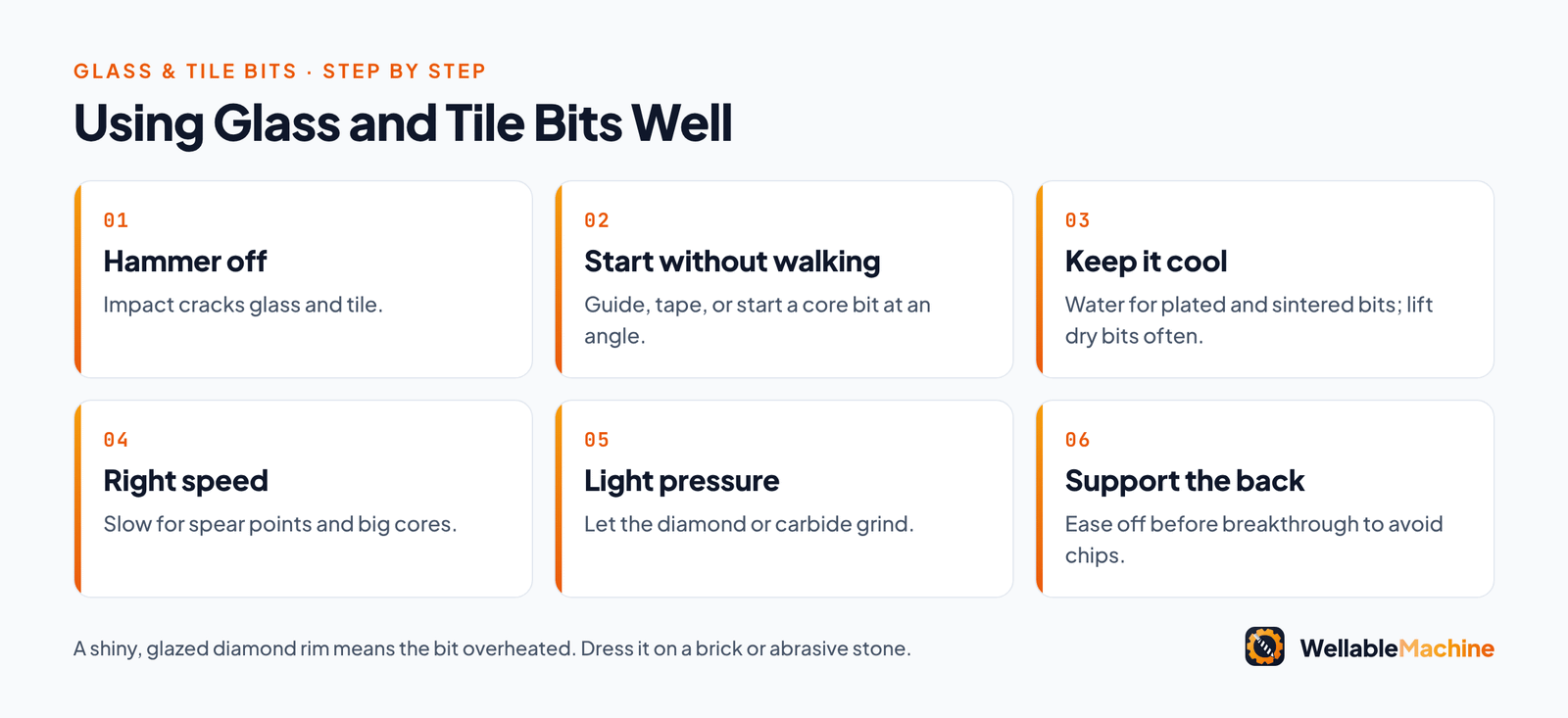
- Turn off hammer mode. Impact cracks glass and tile.
- Start the hole without walking. Use a centering guide, a piece of masking tape, or start diamond bits at an angle, then gradually bring them upright as the rim bites.
- Keep it cool. Use water for electroplated and sintered bits; a damp sponge, a putty dam or a spray bottle works. Dry bits need to be lifted often to cool.
- Use the right speed. Slow for spear points and large diamond cores, faster for small diamond bits. Follow the maker’s speed on the package.
- Let the bit do the work. Light, steady pressure. Pushing hard overheats the bit and cracks tile.
- Ease off before breakthrough and support the back of glass and tile to avoid chipping.
How Long Do These Bits Last?
Bit life varies hugely with material, heat and pressure. As a rough guide, a carbide spear-point bit might drill dozens of holes in glazed ceramic but only a few in porcelain. An electroplated diamond bit may do 10 to 30 holes in porcelain before slowing down. A good vacuum-brazed or sintered bit can do many more, especially when kept cool. The fastest way to destroy any diamond bit is to run it dry and hot until the diamond glazes or the segment loses its diamonds. Signs a bit is worn: it stops cutting, the rim looks shiny rather than gritty, or it burns and smokes.
Why Not Use a Masonry Bit?
Masonry bits are made to chip through brick and concrete with a hammer action. On glazed tile they skid, chip the glaze and, in hammer mode, crack the tile. On porcelain they barely cut at all. Use a tile or diamond bit to get through the tile, then switch to a masonry bit for the wall behind it. See masonry vs concrete drill bits and wall anchor drill bit sizes for the second stage.
Buying Tips
- Buy by material: a pack labeled “glass and tile” is usually carbide spear points for glass and ceramic, not porcelain.
- Match the anchor size: buy the diameter your wall plug or fixture needs, commonly 1/4 in (6 mm) or 5/16 in (8 mm).
- For plumbing holes (shower valves, toilet flanges), buy a diamond core in the exact size, often 1 to 4 in.
- For many porcelain holes, spend more on vacuum-brazed or sintered bits. They’re cheaper per hole.
Starting Diamond Bits Without Walking
Hollow diamond core bits have no center point, so they skate on glazed tile and glass. Three reliable ways to start them: use a drill guide or template with a hole the size of the bit, held by suction or by hand; start the bit at an angle of about 45° so only one edge of the rim touches, grind a small crescent, then slowly bring the drill upright; or use a core bit with a spring-loaded centering pilot. Once the rim has cut a full ring a millimeter or two deep, it guides itself.
Frequently Asked Questions
6 quick answers from our editors
01What drill bit is best for glass?
A carbide spear-point bit for small holes, and a diamond core bit with water for larger ones.
02What drill bit is best for porcelain tile?
A diamond bit: vacuum-brazed or wax-filled dry diamond is the easiest choice with a drill.
03Can I use glass and tile bits on porcelain?
Carbide spear-point bits will cut porcelain very slowly and wear out quickly. Diamond bits are much better.
04Do diamond drill bits need water?
Electroplated and sintered bits do. Wax-filled and many vacuum-brazed bits can be used dry for short holes.
05Can I drill tempered glass?
No. Tempered glass shatters when drilled. Holes must be made before tempering.
06What speed should I use for a glass drill bit?
Slow: about 300 to 600 RPM for carbide spear points, and the maker’s recommended speed for diamond bits.
Bottom Line
Use carbide spear-point bits for small holes in glass and ceramic wall tile, and diamond bits for porcelain, stone and larger holes, choosing vacuum-brazed or wax-filled dry bits for porcelain and sintered or electroplated bits with water for glass and granite. Keep the bit cool, the speed down and hammer mode off, and switch to a masonry bit only after you’re through the tile.