12V vs 18V vs 20V Drills: What the Numbers Really Mean

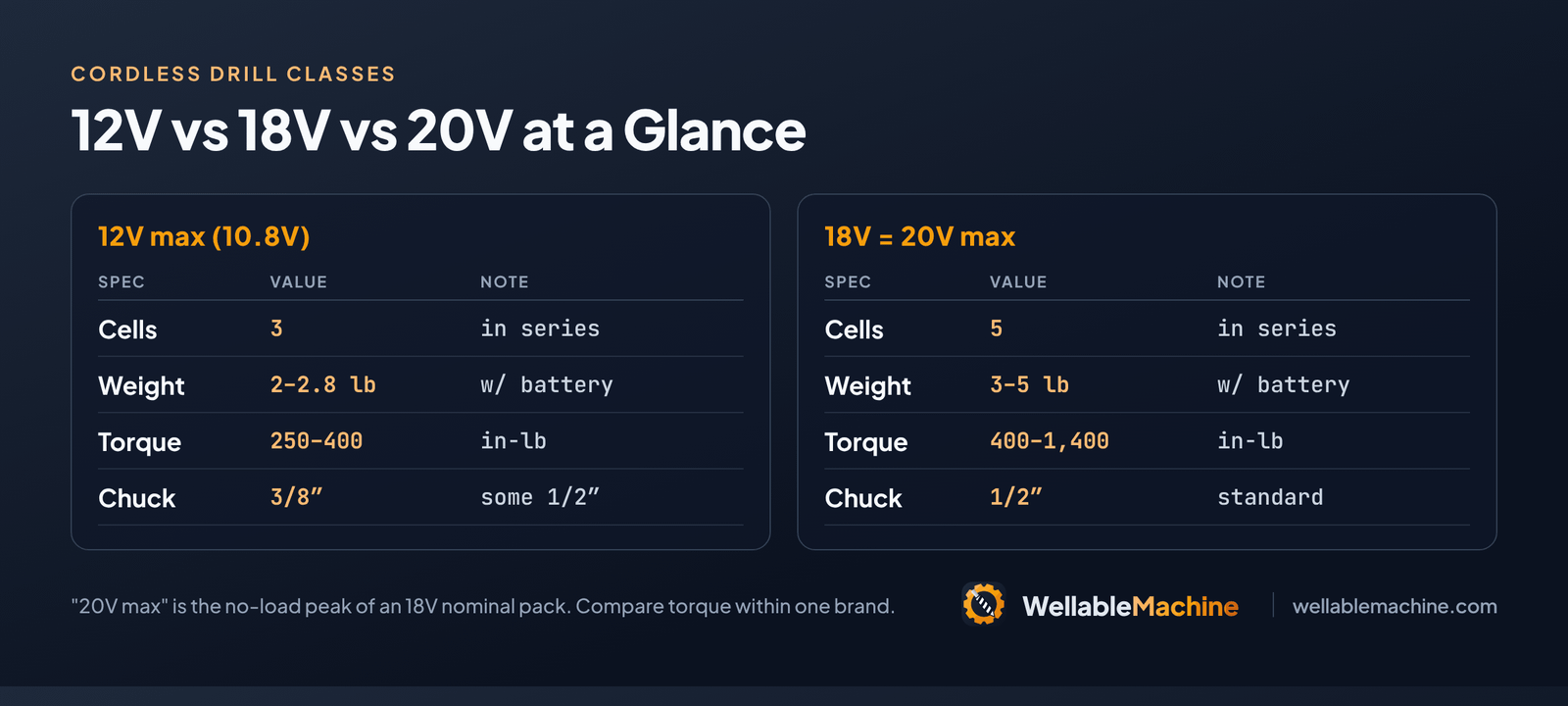
Quick answer: 18V and 20V drills are the same class of tool. “20V max” is the voltage of a fresh battery with no load, while “18V” is its nominal voltage; both use five lithium-ion cells in series. The real choice is between 12V and 18V/20V. A 12V drill is smaller and lighter, typically about 2 to 2.8 lb with up to about 250 to 400 in-lb of torque, which is enough for most household jobs, cabinets, and pilot holes. An 18V/20V drill weighs about 3 to 5 lb and gives roughly 400 to 1,400 in-lb, so it’s better for large holes, hole saws, long screws, and all-day work.
Battery platform is a long-term decision, because once you own a few batteries, you’ll likely stick with that system for years. This guide explains what the numbers mean, how 12V and 18V/20V compare on power, run time, weight, and price, and which one suits which kind of user.
12V vs 18V vs 20V at a Glance
| 12V (12V max) | 18V | 20V max | |
|---|---|---|---|
| Nominal voltage | 10.8V | 18V | 18V |
| Lithium-ion cells in series | 3 | 5 | 5 |
| Typical weight with battery | 2–2.8 lb | 3–5 lb | 3–5 lb |
| Typical max torque | 250–400 in-lb | 400–1,400 in-lb | 400–1,400 in-lb |
| Typical chuck | 3/8 in (some 1/2 in) | 1/2 in | 1/2 in |
| Common battery sizes | 2.0–6.0 Ah | 2.0–12.0 Ah | 2.0–12.0 Ah |
| Good for | Furniture, cabinets, electrical work, tight spaces | General construction, decks, big bits | Same as 18V |
Why 18V and 20V Are the Same
A lithium-ion cell has a nominal voltage of about 3.6V and reaches about 4.0 to 4.2V when fully charged with no load. Five cells in series give 18V nominal and about 20V at full charge. In North America, some brands label these packs “20V max,” using the peak number, while brands in the rest of the world (and some in the US) label the same type of pack “18V.” Likewise, “12V max” packs have three cells: 10.8V nominal and about 12V peak. So:
- A “20V max” drill and an “18V” drill have the same battery voltage under load.
- A “12V max” drill and a “10.8V” drill are the same class.
- The power difference between brands comes from the motor, the electronics, and the battery size, not from the 18 vs 20 label.
The same logic applies to bigger platforms: “40V max” or “36V” (10 cells), “60V max” or “54V” (15 cells). For background on how lithium-ion cell voltage works, see the lithium-ion battery overview.
Power and Torque
Torque is what turns big bits and drives long screws. In practice:
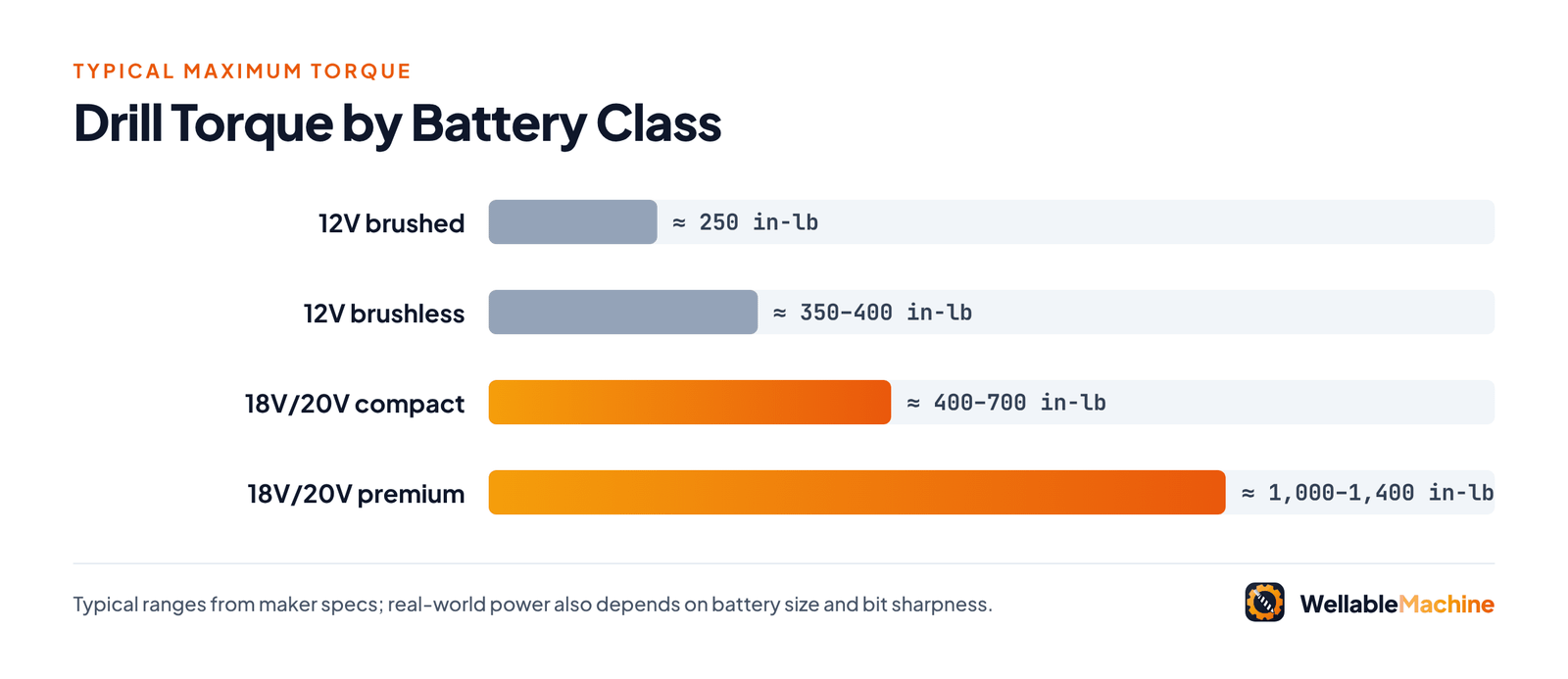
- 12V drills drive 3 in deck screws, drill up to about 1/2 in in wood and 3/8 in in steel comfortably, and run small hole saws (up to about 1-1/2 in) in thin material. Brushless 12V models are surprisingly strong for their size.
- 18V/20V compact drills handle 1 in spade bits, 2 in hole saws, and 1/2 in twist bits in steel with ease.
- 18V/20V premium and hammer drills push 4 in hole saws, large auger bits, and masonry work. See hammer drill vs drill for when you need hammer mode.
Maker torque figures are measured differently by different brands, so compare within a brand rather than across brands. Speed matters too: most drills have a low gear (about 0 to 450 RPM) for driving and large bits, and a high gear (about 0 to 1,500 to 2,000 RPM) for small bits. Our drill speed chart shows which speed to use for each bit size.
Weight, Size and Comfort
A 12V drill is about 6 to 7 in long and fits between studs, inside cabinets, and in an apron pocket. Over a day of overhead work or installing hinges, it’s much less tiring. 18V/20V compact drills have closed the gap a lot; many now weigh only a little more than 12V tools with a small 2.0 Ah battery. But fit a 5.0 Ah or larger battery, and an 18V drill becomes noticeably front-heavy and bulky. If you work in tight spaces or for long periods with your arms raised, the 12V size is a real advantage.
Run Time and Batteries
Run time depends on watt-hours (Wh), which is voltage × amp-hours. A 12V 2.0 Ah pack holds about 22 Wh, while an 18V 5.0 Ah pack holds 90 Wh, about four times as much energy. For light DIY tasks, that rarely matters; for drilling dozens of large holes, it matters a lot.
| Battery | Approx. energy | Typical use |
|---|---|---|
| 12V 2.0 Ah | 22 Wh | Light DIY, furniture, small screws |
| 12V 4.0 Ah | 43 Wh | Trade use with a small tool |
| 18V/20V 2.0 Ah | 36 Wh | Compact drill/driver, light use |
| 18V/20V 5.0 Ah | 90 Wh | General construction |
| 18V/20V 8.0–12.0 Ah | 144–216 Wh | Grinders, saws, heavy drilling |
Larger batteries also deliver high current more easily, so a powerful drill often feels stronger on a bigger pack.
Brushless vs Brushed at Each Voltage
Voltage isn’t the only factor. A brushless 12V drill can match or beat an older brushed 18V drill in everyday tasks while running longer per charge. For any new drill, brushless is worth the extra cost if you use it regularly. Our brushless vs brushed drills guide explains why.
Chuck Size
Most 12V drills have a 3/8 in chuck, which limits shanks to 3/8 in. That’s fine for most twist bits and small hole saws, but not for large bits with 1/2 in shanks. Nearly all 18V/20V drills have a 1/2 in chuck. Some high-end 12V drills now have 1/2 in chucks too. See drill chuck sizes for more.
Price and Platform
- 12V kits are usually cheaper to start with, and the batteries cost less.
- 18V/20V platforms have far more tools: saws, grinders, nailers, vacuums, lights, mowers, and more. If you’ll want other tools, 18V/20V gets you there.
- Battery compatibility: batteries only fit tools from the same brand and platform. A brand’s 12V and 18V/20V batteries don’t interchange.
- Two platforms: many pros and serious DIYers keep both: a 12V drill and impact driver for light work, and 18V/20V for heavy work.
Which Should You Buy?
| You mostly… | Choose |
|---|---|
| Hang shelves, assemble furniture, do small repairs | 12V brushless drill/driver |
| Install cabinets, do electrical or HVAC work, work overhead | 12V (plus an 18V for big holes) |
| Build decks, fences, sheds; drill large holes | 18V/20V brushless drill |
| Drill into brick and concrete | 18V/20V hammer drill, or a rotary hammer for heavy work |
| Want one platform for many tools | 18V/20V |
| Drive lots of screws | Add an impact driver; see impact driver vs drill |
Common Myths
- “20V is more powerful than 18V.” No. It’s the same voltage, labeled differently.
- “12V drills are toys.” Modern brushless 12V drills handle most household and trade jobs.
- “More voltage always means faster drilling.” Bit sharpness and correct speed matter as much as voltage. A dull bit in a powerful drill is still slow.
- “Bigger batteries make drills heavier but not better.” They add run time and can also deliver more current under heavy load.
What Each Class Handles in Real Jobs
| Task | 12V | 18V/20V compact | 18V/20V premium |
|---|---|---|---|
| Assemble flat-pack furniture | Ideal | Fine, a bit bulky | Overkill |
| Hang shelves and TV mounts into studs | Yes | Yes | Yes |
| Drill 1/4 in holes in steel | Yes | Yes | Yes |
| Drill 1/2 in holes in steel | Slow, possible with a good bit | Yes | Easy |
| 1 in spade bit through a 2×4 | Struggles | Yes | Easy |
| 2-1/8 in hole saw for a door lock | Possible in soft wood with a full battery | Yes | Easy |
| 4 in hole saw or large auger bit | No | Hard work | Yes, with the side handle |
| Drive 3 in deck screws | Yes, slowly | Yes | Yes (an impact driver is faster) |
| Mix thinset or paint | No | Light batches | Yes |
| Small holes in brick (hammer mode) | Rarely available | Yes, if a hammer drill | Yes |
A useful rule: if the bit is larger than about 3/4 in in wood or 3/8 in in steel, or you’ll drill more than a couple of dozen holes in a row, the 18V/20V class saves time and battery swaps.
Safety With High-Torque Drills
An 18V/20V drill with 1,000+ in-lb of torque can twist your wrist hard if a large bit catches, especially when a hole saw or auger bit breaks through. Use the side handle, start in low gear, and set the clutch when driving. Many premium drills now have electronic kickback control that cuts power if the tool suddenly rotates; it’s worth having if you use large bits. A 12V drill is far less likely to hurt you when a bit jams, which is another reason it’s popular for overhead and ladder work.
Battery Care for Any Voltage
- Store batteries partly charged (about 40 to 60%) if you won’t use them for months.
- Keep them out of hot cars and freezing sheds; heat shortens battery life most.
- Let a hot battery cool before charging it.
- Use the maker’s charger and avoid cheap unbranded batteries without proper protection circuits.
Frequently Asked Questions
6 quick answers from our editors
01Is 18V the same as 20V?
Yes. Both are five-cell lithium-ion packs. “20V max” is the peak voltage, and 18V is the nominal voltage.
02Is a 12V drill strong enough?
For most home tasks, yes: furniture, shelves, cabinets, and pilot holes. For large holes, hole saws over 2 in, or masonry, choose 18V/20V.
03Can I use a 20V battery in an 18V tool?
Only if both are from the same brand and platform. The voltage label alone doesn’t mean they fit.
04How much torque does a 12V drill have?
Usually about 250 to 400 in-lb, depending on model.
05Which is better for drilling concrete?
An 18V/20V hammer drill for occasional holes, and a rotary hammer for many or large holes. See how to drill into concrete.
06Do 18V drills last longer per charge?
With the same amp-hour rating, yes, because the pack stores more energy.
Bottom Line
18V and 20V are the same; the real choice is 12V vs 18V/20V. Pick a 12V brushless drill if you value light weight and compact size for household jobs, cabinets, and tight spaces. Pick an 18V/20V brushless drill for large bits, hole saws, decks, masonry, and a bigger family of tools. Many people end up with both.