How to Remove a Rounded Bolt: 8 Methods That Work

Quick answer: to remove a rounded bolt, start with the gentlest method that still grips: soak it with penetrating oil, then try a tight-fitting 6-point socket (or one size smaller, hammered on). If that slips, use a bolt extractor socket with a reverse spiral, or clamp locking pliers hard on the head. Stubborn bolts may need heat, a slot cut for a screwdriver, a nut welded on, or as a last resort drilling out the bolt.
A rounded bolt head, where the corners have been worn off so a wrench just spins, is one of the most frustrating problems in any repair. The good news is that there is almost always a way out, and most of them need only basic tools. This guide works through the methods from easiest to most drastic, explains why bolts round off in the first place, and shows how to avoid doing it again.
Why Bolts Round Off
- 12-point sockets and open-end wrenches grip only the corners of the head. Under high torque they slip and shave the corners off.
- Wrong size tools: a 13 mm socket on a 1/2 in head, or a worn socket, has slack that lets it slip.
- Corrosion: rust makes the bolt seize and also eats away the head, so it rounds easily.
- Soft heads: low-grade or stainless bolts deform more easily than hardened ones.
- Angled pull: a wrench that isn’t fully seated or is pulled at an angle rides up the flats.
The single best prevention is a good-quality 6-point socket pushed fully onto the head, with the force applied straight. Check sizes in our bolt size chart; on mixed equipment, make sure you know whether the bolt is inch or metric.
Method 1: Penetrating Oil and Patience
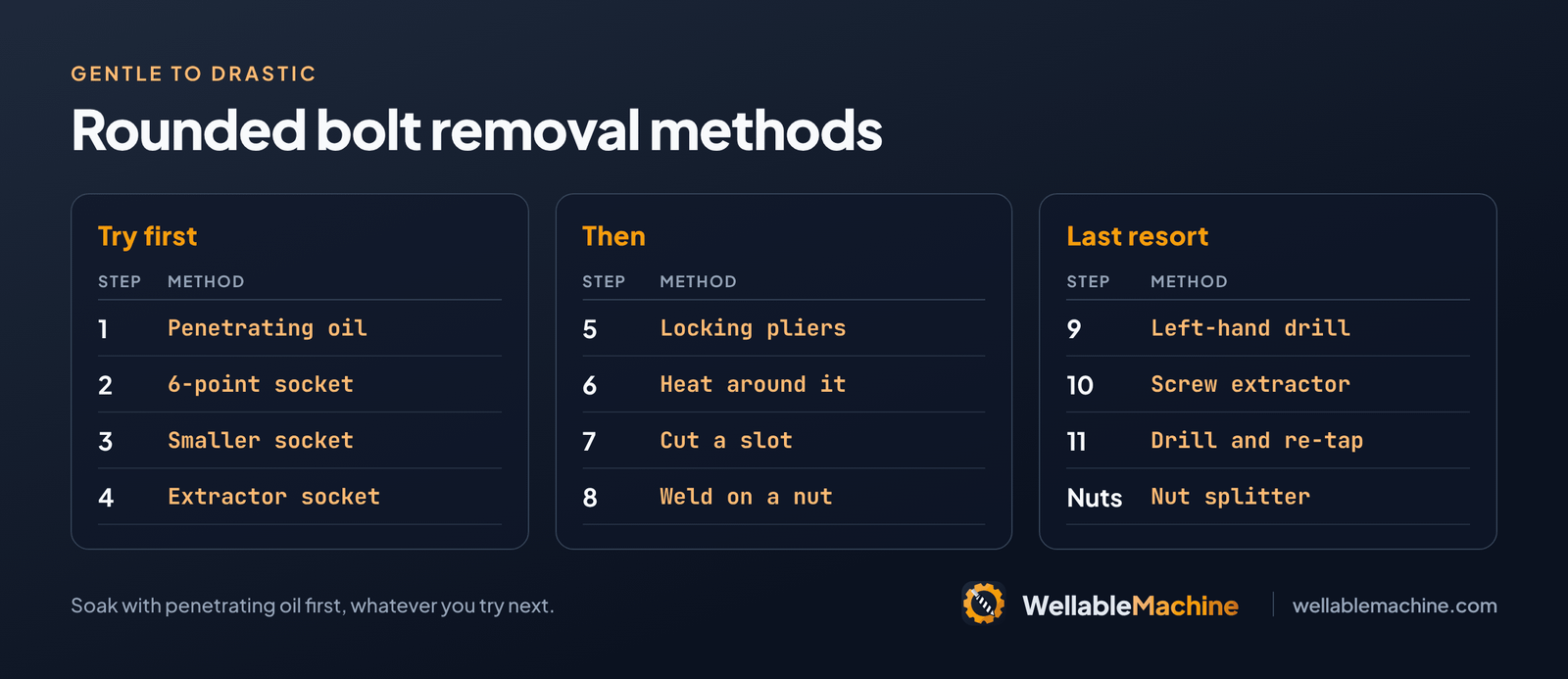
Whatever method you use, start here. Spray a good penetrating oil on the threads, not just the head, tap the bolt a few times with a hammer to help it creep in, and leave it for 15 minutes or longer; overnight for badly rusted parts, with a second application. A seized bolt that is freed this way needs far less force, which means less chance of rounding it further or snapping it.
Method 2: A Tighter Socket
- 6-point socket: a socket with six points grips the flats, not the corners, and often works on a lightly rounded head.
- Next size down or a near size: if the head has shrunk, a slightly smaller socket (or a metric socket on an inch bolt, such as 12 mm on a slightly worn 1/2 in head, or 1/2 in on a worn 13 mm) can be hammered on to bite. Use an old socket you don’t mind damaging.
- Flank-drive or “wrench-off” sockets grip the sides of the flats and work well on mildly rounded heads.
Use a breaker bar for steady force rather than an impact wrench at this stage; a sharp impact can finish rounding a weak head.
Method 3: Bolt Extractor Sockets
Extractor sockets (also called bolt-out or twist sockets) have reverse spiral flutes inside. You hammer the socket onto the head, and as you turn it counterclockwise, the flutes bite deeper. They work on rounded hex heads, nuts and even round-headed fasteners. Use the smallest socket that can be hammered fully on, and turn with a breaker bar. To free the bolt from the socket afterwards, clamp it in a vise and tap it out through the drive hole with a punch.

Method 4: Locking Pliers
Large locking pliers clamped as tight as you can get them will turn many rounded bolts, especially smaller ones and those with some head height. File two small flats on opposite sides first so the jaws have something to grip. Re-clamp tighter if they slip; each slip polishes the head a little more.
Method 5: Heat
Heat breaks rust and makes the surrounding part expand. Heat the part around the bolt (the nut, boss or casting) with a propane or MAP gas torch for 30–60 seconds, then try again while it’s hot. Alternating heat with penetrating oil can draw oil into the threads as the parts cool. Keep heat away from fuel lines, rubber bushings, seals, plastic and electrical parts, and have a fire extinguisher handy. Avoid heating aluminum parts hard; they can soften or distort.
Method 6: Cut a Slot or New Flats
If the head stands proud, a thin cutting disc on a rotary tool or angle grinder can cut a slot across it for a large flat screwdriver or an impact driver bit. Alternatively, file or grind two new flats to fit a smaller wrench. Both methods work best on bolts that are no longer seized after oil and heat.
Method 7: Weld a Nut On
For seized bolts on steel parts, welding a nut onto the rounded head is one of the most reliable fixes. Place a nut slightly smaller than the head over it and weld through the center hole to fill it. The welding heat also helps break the rust. Let it cool a little, then turn the new nut with a 6-point socket. This is a common trick for exhaust studs and suspension bolts.
Method 8: Drill It Out
When everything else fails, or the head shears off, drill the bolt. Center punch the middle, start with a small pilot, and use a left-hand drill bit in a reversible drill: the bit often catches and spins the bolt out. If it doesn’t, follow with a screw extractor, or drill to the tap drill size and re-tap the thread. These steps are covered in detail in how to remove a broken bolt; for re-tapping, see how to use a tap and die and the tap drill size chart.
Special Cases
- Rounded nuts: a nut splitter cracks the nut off without harming the bolt threads; replace the nut afterwards.
- Rounded Allen (socket head) bolts: hammer a slightly larger Torx bit into the socket, or use a hex extractor bit.
- Stripped screw heads: different tools apply; see how to remove a stripped screw.
- Bolts in aluminum: be gentle with heat and force; aluminum threads strip easily. Plan on a thread insert if the thread is damaged.
Preventing Rounded Bolts
- Use 6-point sockets and box-end wrenches for tight or rusty bolts.
- Check the fit: the socket should slide on snugly with no rock.
- Seat the socket fully and pull straight.
- Soak rusty fasteners first, and use steady force before impact.
- On reassembly, use anti-seize on exposed threads and replace corroded bolts with new ones of the same grade.
For driving and removing many fasteners, an impact driver or wrench helps, but only once the head grips well; see impact driver vs drill.
Tools Worth Keeping in the Kit
A small set of the right tools turns a rounded bolt from a lost afternoon into a five-minute job:
- Quality 6-point sockets in both inch and metric, plus a breaker bar.
- A bolt extractor socket set covering roughly 3/8 in to 3/4 in (10–19 mm).
- Large and small locking pliers.
- Penetrating oil, a wire brush and a hammer.
- A propane or MAP gas torch for rusted parts.
- Left-hand drill bits and screw extractors for heads that break off.
- A nut splitter for seized nuts.
Cobalt left-hand bits last longest in hardened bolts; see HSS vs cobalt drill bits.
Frequently Asked Questions
7 quick answers from our editors
01What is the easiest way to remove a rounded bolt?
Penetrating oil plus a tight 6-point socket or a bolt extractor socket hammered onto the head.
02Do bolt extractor sockets really work?
Yes, on most rounded hex heads and nuts. Hammer them fully on and turn steadily with a breaker bar.
03Can I use locking pliers on a rounded bolt?
Yes, clamped very tight, ideally after filing two small flats for the jaws.
04Should I use heat on a rounded bolt?
Heat on the surrounding part helps break rust, but keep it away from fuel, rubber, plastic and wiring.
05What if the bolt head breaks off?
Drill it with a left-hand bit, use a screw extractor, or drill and re-tap. See our broken bolt guide.
06Why do 12-point sockets round bolts?
They grip only near the corners, so under high torque they slip and shave the corners off.
07Can an impact wrench remove a rounded bolt?
Only with an extractor socket or a socket that grips well. With a loose socket, an impact wrench usually rounds the head further.
Bottom Line
Work from gentle to drastic: penetrating oil, a tight 6-point socket, an extractor socket, locking pliers, then heat, a cut slot or a welded nut, and finally drilling out. Most rounded bolts come out at the first or second step if you soak them well and use a socket that fits. Next time, use 6-point sockets and steady force so it doesn’t happen again.