Drill Speed Chart: RPM for Metal, Wood and Plastic

Quick answer: the bigger the bit and the harder the material, the slower the drill should turn. For high-speed steel (HSS) twist bits, a 1/4 in bit runs at about 3,000 RPM in aluminum, 1,200 RPM in mild steel and 550 RPM in stainless steel. A 1/2 in bit runs at about 1,550, 600 and 250 RPM. The full charts for metal, wood and plastic are below, along with the simple formula to work out any size.
Running a drill too fast is the most common cause of dull bits, burned wood and work-hardened stainless. Running too slowly mostly wastes time, though large bits that turn too slowly can grab. A drill speed chart takes the guesswork out, whether you set a drill press by its belt or simply squeeze the trigger on a cordless drill.
The Drill Speed Formula
Every material has a recommended cutting speed, measured in surface feet per minute (SFM): how fast the outer edge of the bit should move across the metal. Turn that into RPM with:
RPM = (SFM × 3.82) ÷ drill diameter in inches
In metric, use RPM = (cutting speed in m/min × 1000) ÷ (3.14 × diameter in mm). The charts below use these HSS cutting speeds, which are on the safe side for hand-fed drill presses: aluminum 200 SFM, brass 150, cast iron 70, mild steel 80 and stainless steel 35. Cobalt bits can run about 10–20% faster in steel; carbide bits can run two to three times faster in a rigid machine. For more on the theory, see the speeds and feeds reference.
Drill Speed Chart for Metal (Inch Bits)
| Bit size | Aluminum | Brass | Cast iron | Mild steel | Stainless |
|---|---|---|---|---|---|
| 1/16 in | 3,000+ | 3,000+ | 3,000+ | 3,000+ | 2,150 |
| 1/8 in | 3,000+ | 3,000+ | 2,150 | 2,450 | 1,050 |
| 3/16 in | 3,000+ | 3,000+ | 1,450 | 1,650 | 700 |
| 1/4 in | 3,000+ | 2,300 | 1,050 | 1,200 | 550 |
| 5/16 in | 2,450 | 1,850 | 850 | 1,000 | 450 |
| 3/8 in | 2,050 | 1,550 | 700 | 800 | 350 |
| 7/16 in | 1,750 | 1,300 | 600 | 700 | 300 |
| 1/2 in | 1,550 | 1,150 | 550 | 600 | 250 |
| 5/8 in | 1,200 | 900 | 450 | 500 | 200 |
| 3/4 in | 1,000 | 750 | 350 | 400 | 200 |
| 1 in | 750 | 550 | 250 | 300 | 150 |
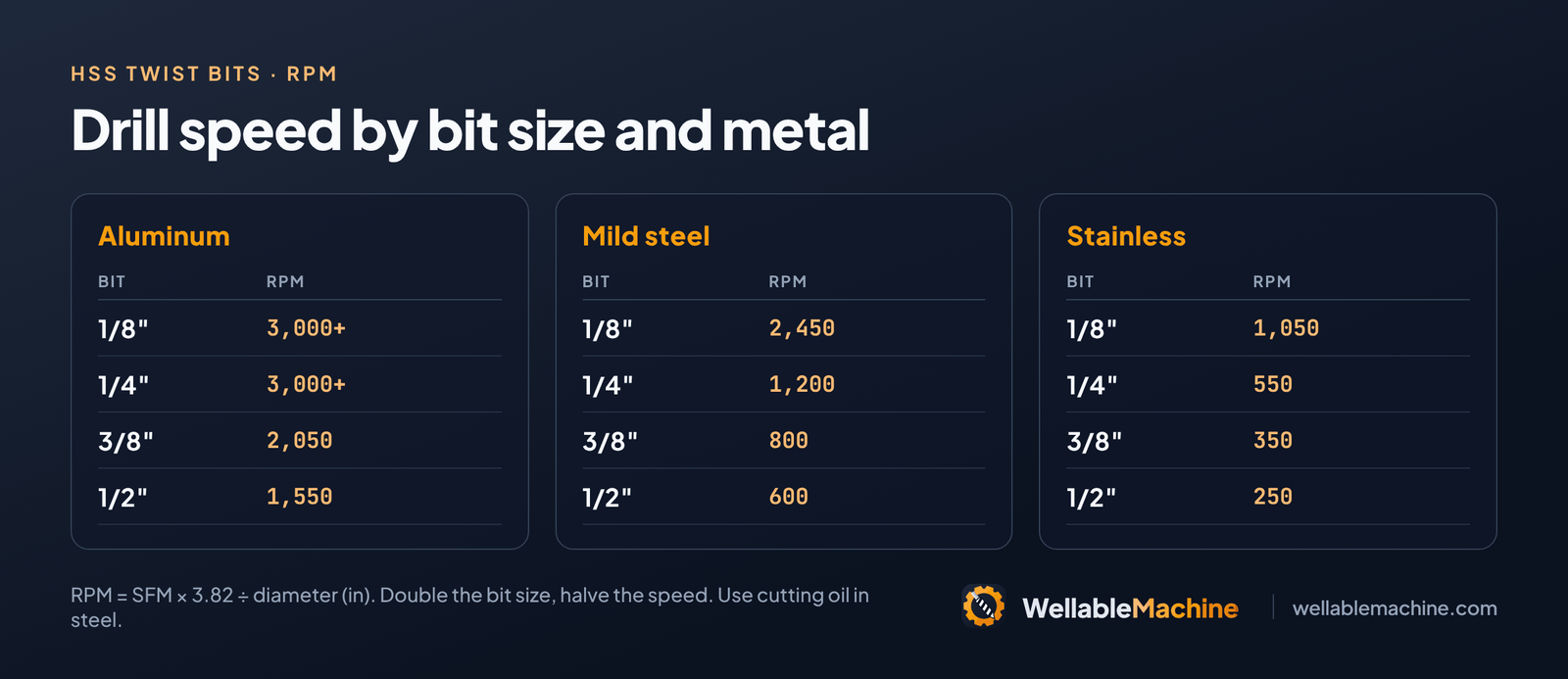
“3,000+” means the formula speed is higher than most drill presses and cordless drills can turn. Just run at the top speed you have. Small bits break from side load long before they suffer from low speed.
Drill Speed Chart for Metal (Metric Bits)
| Bit size | Aluminum | Brass | Cast iron | Mild steel | Stainless |
|---|---|---|---|---|---|
| 3 mm | 3,000+ | 3,000+ | 2,250 | 2,600 | 1,150 |
| 5 mm | 3,000+ | 2,900 | 1,350 | 1,550 | 700 |
| 6 mm | 3,000+ | 2,450 | 1,150 | 1,300 | 550 |
| 8 mm | 2,450 | 1,800 | 850 | 950 | 400 |
| 10 mm | 1,950 | 1,450 | 700 | 800 | 350 |
| 12 mm | 1,600 | 1,200 | 550 | 650 | 300 |
| 16 mm | 1,200 | 900 | 400 | 500 | 200 |
| 20 mm | 950 | 750 | 350 | 400 | 150 |
Drill Speed Chart for Wood
| Bit | Size | Softwood | Hardwood |
|---|---|---|---|
| Twist or brad point | 1/16–3/16 in | 3,000 RPM | 3,000 RPM |
| Twist or brad point | 1/4–3/8 in | 3,000 RPM | 1,800–2,400 RPM |
| Twist or brad point | 7/16–1/2 in | 1,800 RPM | 1,200 RPM |
| Spade bit | 1/2–1 in | 2,000 RPM | 1,500 RPM |
| Spade bit | 1-1/8–1-1/2 in | 1,500 RPM | 1,000 RPM |
| Forstner bit | 1/4–1 in | 1,200 RPM | 700 RPM |
| Forstner bit | 1-1/8–2 in | 600 RPM | 400 RPM |
| Forstner bit | Over 2 in | 300 RPM | 250 RPM |
| Hole saw | 1–2 in | 500 RPM | 350 RPM |
| Hole saw | Over 2 in | 300 RPM | 200 RPM |
Wood is forgiving, but burn marks, smoking chips and a squealing bit all mean too fast or too dull. Large Forstner bits in particular should always run slowly.
Plastics, Tile and Masonry
- Acrylic and polycarbonate: about 1,000–1,500 RPM for 1/4 in bits, slower for bigger ones. Too fast melts the plastic onto the bit. A bit with a “dubbed” (flattened) cutting edge stops acrylic from grabbing and cracking.
- PVC and soft plastics: moderate speed and light feed. Clear chips often.
- Ceramic tile: 400–600 RPM with a spear-point bit, no hammer; see how to drill through tile.
- Concrete and brick: full speed in hammer mode; the hammer does the cutting.
Setting Speed on Your Drill
- Drill press: the speed chart is usually inside the belt cover. Move the belt to the pulley pair closest to the speed you need. Unplug the press first.
- Cordless drill: gear 1 (low) gives roughly 0–500 RPM and more torque; gear 2 (high) gives roughly 0–1,500 to 2,000 RPM. Use gear 1 for big bits and steel, gear 2 for small bits and wood, and fine-tune with the trigger.
- Corded drill: most have a variable-speed trigger and sometimes a dial that caps the top speed. Set the dial so a full squeeze gives the speed you want.

Signs Your Speed Is Wrong
| What you see | What it means | Do this |
|---|---|---|
| Blue or brown chips in steel | Too fast | Slow down; add cutting oil |
| Squealing, shiny glazed hole in stainless | Too fast and too little feed; work hardening | Slow down and push harder |
| Burned, smoking wood | Too fast or dull bit | Slow down; sharpen or replace |
| Melted plastic on the bit | Too fast | Slow down; clear chips often |
| Large bit grabs and chatters | Too slow with too little feed, or no pilot | Drill a pilot; feed steadily |
| Corners of the bit wear fast | Too fast for the material | Drop speed 25% and re-sharpen |
Stainless steel is the material that punishes the wrong speed most. Our guide on how to drill stainless steel explains why slow speed and firm, constant pressure matter so much. A dull bit acts like a bit running too fast, so keep yours sharp with our drill sharpening guide.
Feed: How Hard to Push
Speed is only half the story. Feed is how fast the bit moves into the work, and the right feed matters just as much as the right RPM.
- Steel: push hard enough to make a continuous curled chip. Powdery chips or a squeak mean you’re rubbing instead of cutting.
- Stainless: firm, steady feed that never pauses. Letting the bit dwell work-hardens the bottom of the hole.
- Aluminum and brass: moderate feed; brass can grab as the bit breaks through, so ease off at the end.
- Thin sheet: light feed near breakthrough, with a scrap block behind the sheet.
- Small bits (under 1/8 in): light feed and frequent backing out to clear chips; they snap easily.
Using Cutting Fluid
Cutting fluid cools the bit and the work, washes chips out and reduces friction, so the edge lasts longer at any speed. Use sulfurized cutting oil in steel and stainless, light oil or kerosene in aluminum, and nothing in cast iron and brass, which cut cleanly dry. In wood and plastic, never use oil. A few drops before you start and a few more halfway down a deep hole is enough for hand work.
Pilot Holes for Large Bits
Big twist drills have a wide chisel edge in the center that doesn’t cut well; it mostly pushes. A pilot hole about the width of that chisel edge, often 1/8 to 3/16 in, lets the big bit cut freely at its proper speed, needs much less force, and keeps the hole where you marked it. For bits over 1/2 in in steel, step up in two or three stages. Keep the speed for each step set by that bit’s own size, not the final size.
Step Bits and Hole Saws in Metal
A step bit cuts at many diameters, so set the speed for the largest step you will use: around 500–800 RPM in mild steel for steps up to 3/4 in, and slower in stainless. Hole saws in metal run slowly: about 300–400 RPM for a 1 in bi-metal saw in mild steel and 100–150 RPM for 3 in. Use oil and keep pressure steady.
Frequently Asked Questions
6 quick answers from our editors
01What speed should I drill steel at?
For mild steel with an HSS bit, about 1,200 RPM for 1/4 in and 600 RPM for 1/2 in. Use cutting oil.
02What speed for drilling stainless steel?
About a third of mild steel speed: roughly 550 RPM for 1/4 in and 250 RPM for 1/2 in, with steady pressure.
03What speed for drilling aluminum?
Fast: about 3,000 RPM for 1/4 in and 1,550 RPM for 1/2 in, with a little lubricant to stop chips sticking.
04Should larger drill bits run slower?
Yes. Speed is inversely proportional to diameter: double the bit size, halve the RPM.
05What is SFM?
Surface feet per minute: the speed of the bit’s outer edge. Each material has a recommended SFM.
06Can cobalt bits run faster than HSS?
Somewhat, about 10–20% in steel. The main advantage of cobalt is that it keeps its edge at the slow speeds stainless needs.
Bottom Line
Set the speed by bit size and material: RPM = SFM × 3.82 ÷ diameter. As a rule of thumb, a 1/4 in HSS bit runs about 3,000 RPM in aluminum, 1,200 in mild steel and 550 in stainless, and every time the bit doubles in size the speed halves. Run big Forstner bits and hole saws slowly, use oil in metal, and watch the chips: they tell you when the speed is wrong. For bit sizes in decimals and millimeters, see our fractional drill bit sizes chart.