1/4-20 Tap Drill Size (with Chart)
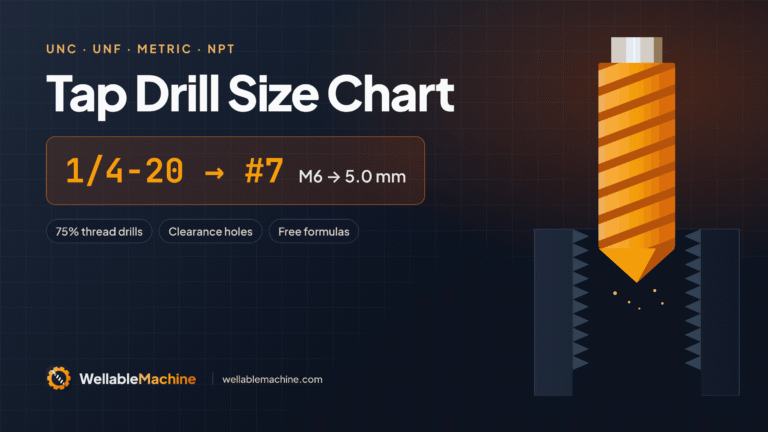
Quick answer: The standard tap drill for a 1/4-20 UNC thread is a #7 drill (0.201 in / 5.11 mm). It gives about 75% thread engagement, which is the industry default for steel, aluminum and most other metals. If you don’t have a #7, a 13/64 in (0.2031 in) bit or a 5.1 mm metric bit works almost the same.
Below you’ll find a full chart for different thread percentages, the clearance hole sizes for a 1/4-20 bolt, the forming tap and Heli-Coil sizes, and a few shop tips that keep your tap from snapping in the hole.
1/4-20 Thread at a Glance
| Specification | Value |
|---|---|
| Thread series | UNC (Unified National Coarse) |
| Nominal (major) diameter | 0.250 in (6.35 mm) |
| Threads per inch (TPI) | 20 |
| Pitch | 0.050 in (1.27 mm) |
| Standard tap drill (75%) | #7 = 0.201 in (5.11 mm) |
| Fractional alternative | 13/64 in = 0.2031 in (about 72%) |
| Metric alternative | 5.1 mm = 0.2008 in (about 76%) |
| Close-fit clearance hole | F = 0.257 in (6.53 mm) |
| Normal-fit clearance hole | H = 0.266 in (6.76 mm) |
1/4-20 Tap Drill Size Chart by Thread Percentage
Thread percentage tells you how much of a “full” thread the tap can cut. A smaller drill leaves more material, so the thread is stronger on paper but much harder to tap. In practice, going above 75% adds very little strength and a lot of tapping torque. The percentages below are calculated with the standard formula: % thread = 76.98 × TPI × (major diameter − drill diameter).
| Drill | Diameter (in) | Diameter (mm) | Approx. thread % | Best for |
|---|---|---|---|---|
| #8 | 0.1990 | 5.05 | 79% | Soft materials, thin sheet where every bit of thread counts |
| 5.1 mm | 0.2008 | 5.10 | 76% | Metric drill set equivalent to #7 |
| #7 | 0.2010 | 5.11 | 75% | Standard choice for steel, aluminum, brass |
| 13/64 | 0.2031 | 5.16 | 72% | Most common fractional substitute |
| #6 | 0.2040 | 5.18 | 71% | Tough steels, easier tapping |
| 5.2 mm | 0.2047 | 5.20 | 69% | Stainless steel, hand tapping |
| #5 | 0.2055 | 5.22 | 69% | Stainless and hardened alloys |
| #4 | 0.2090 | 5.31 | 63% | Very hard or gummy material, deep holes |
| #3 | 0.2130 | 5.41 | 57% | Plastics; also the tap drill for 1/4-28 UNF |
Rule of thumb: use #7 or 13/64 for general work. Step up to #5 or 5.2 mm when you are hand tapping stainless steel or titanium. A 65–70% thread in those materials is still stronger than the bolt in most real-world joints, and it cuts your chance of breaking a tap dramatically.
Clearance Hole Sizes for a 1/4-20 Bolt
If the bolt should pass through the part instead of threading into it, you need a clearance hole, not a tap drill.
| Fit | Drill | Diameter (in) | Diameter (mm) | When to use it |
|---|---|---|---|---|
| Close fit | F | 0.257 | 6.53 | Accurate location, parts drilled together |
| Normal (free) fit | H | 0.266 | 6.76 | Most general assemblies |
| Loose fit | 9/32 | 0.281 | 7.14 | Hole patterns that may not line up perfectly |
Other 1/4-20 Hole Sizes You Might Need
- Forming (roll) tap: about 0.228 in (5.8 mm). Forming taps push metal instead of cutting it, so they need a larger hole. Always check the tap maker’s chart, because the ideal size varies by brand.
- Heli-Coil / STI thread insert: 17/64 in (0.2656 in) drill, followed by the matching 1/4-20 STI tap.
- 1/4-28 UNF (fine thread): #3 drill (0.213 in). Don’t mix this up with 1/4-20; the fine thread needs a bigger hole.
- Wood or plastic with a 1/4-20 threaded insert: follow the insert’s own spec, usually between 5/16 and 3/8 in.
Metric Equivalent: Is 1/4-20 the Same as M6?
No. They are close in size but not interchangeable. A 1/4-20 bolt is 6.35 mm in diameter with a 1.27 mm pitch, while an M6 bolt is 6.0 mm with a 1.0 mm pitch. An M6 thread uses a 5.0 mm tap drill. If you force an M6 bolt into a 1/4-20 hole (or the other way around), you will cross-thread and ruin the hole.
How to Drill and Tap a 1/4-20 Hole (Step by Step)
- Mark and center punch the hole location so the drill doesn’t wander.
- Spot drill or use a short pilot bit (around 1/8 in) in hard material.
- Drill with the #7 bit at the right speed. For mild steel, about 1,500 RPM is a good starting point; for stainless, slow down to roughly 600–800 RPM and use firm, steady pressure.
- Use cutting fluid for both drilling and tapping. It makes a bigger difference than most people expect.
- Chamfer the hole lightly with a countersink so the tap starts straight and the first thread doesn’t burr.
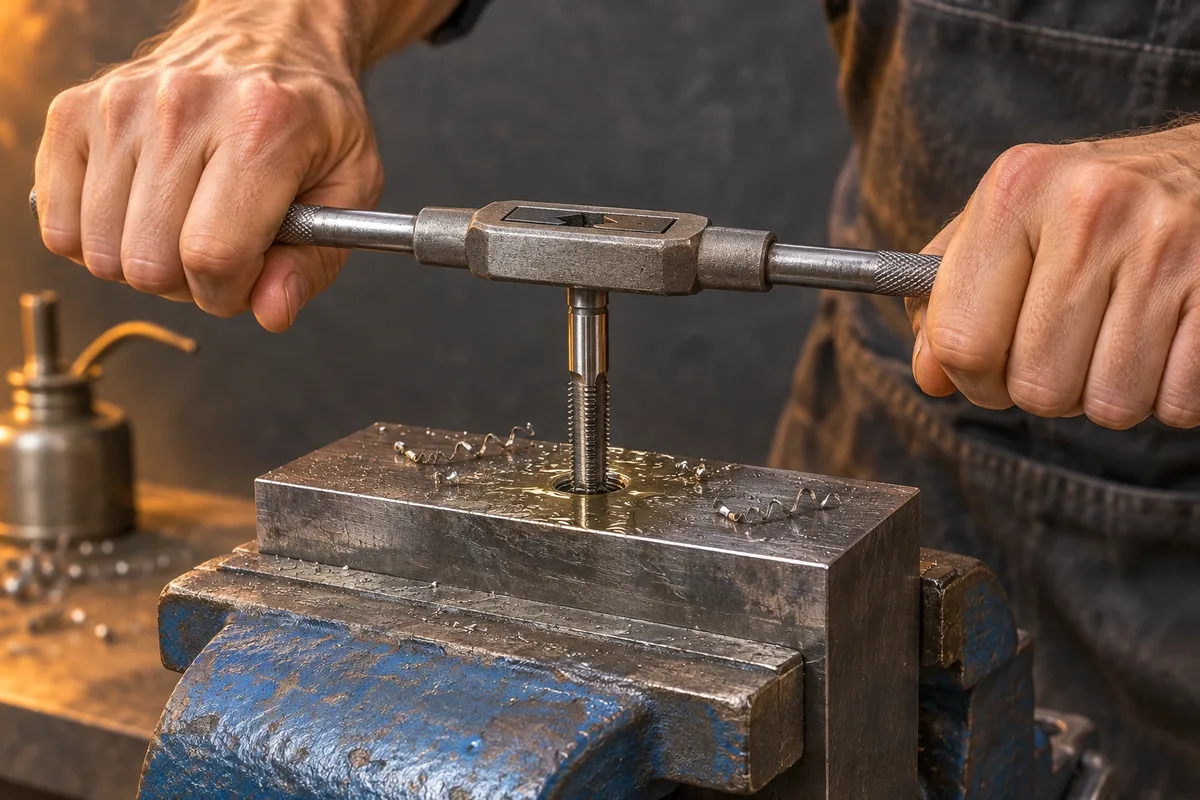
- Tap the hole. Start square (a tap guide or drill press helps), turn about half a turn forward and a quarter turn back to break the chip with a hand tap. Spiral-point taps can go straight through in through-holes.
- For blind holes, drill at least 3–4 thread pitches (about 0.15–0.20 in) deeper than the thread depth you need, and finish with a bottoming tap.
Recommended Tools for 1/4-20 Threads
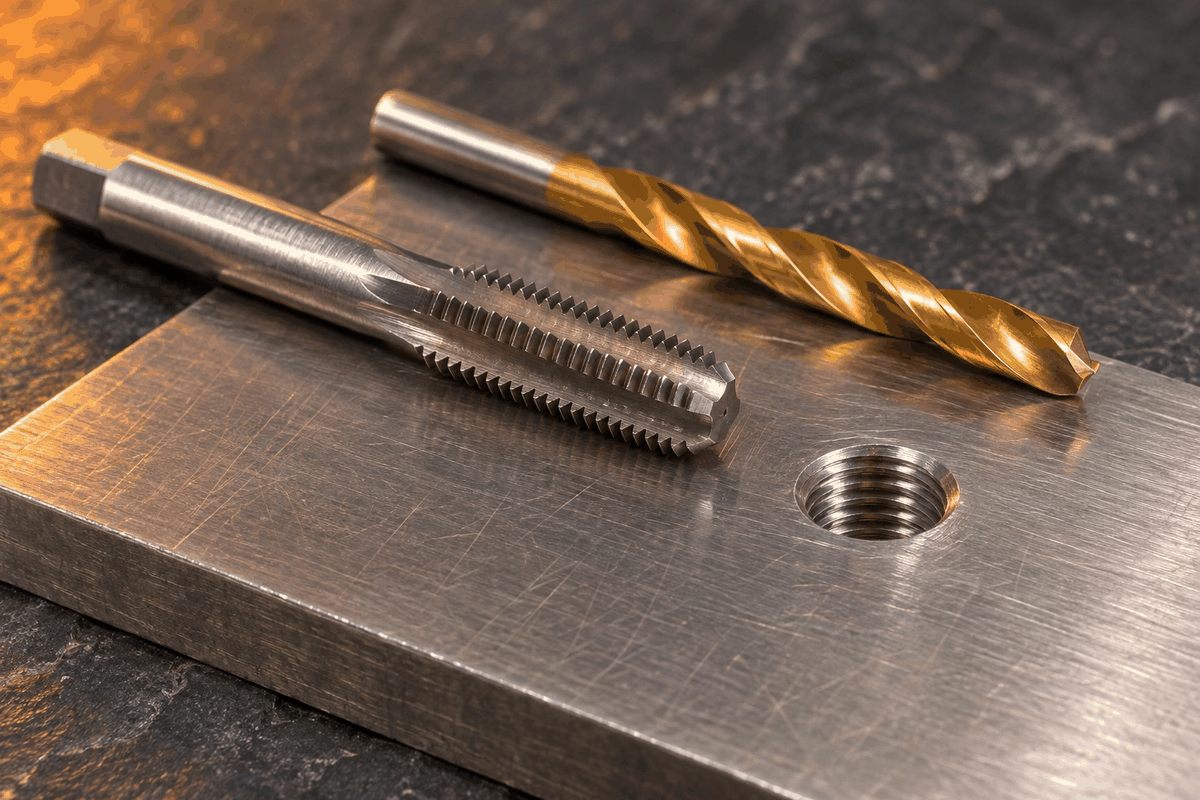
You don’t need a full number drill index to tap one size. A single good-quality #7 cobalt bit plus a 1/4-20 tap is enough for most jobs, and many tap and drill kits pair them together. Look for:
- A #7 cobalt (M35 or M42) jobber bit if you work with steel or stainless. Cobalt holds its edge far longer than plain HSS.
- A 1/4-20 spiral-point (gun) tap for through-holes and a spiral-flute tap for blind holes.
- A T-handle tap wrench for better feel and control than a standard bar wrench.
- Tapping fluid made for the material you’re cutting.
If you are drilling stainless, read our guide to the best drill bits for stainless steel and our step-by-step guide on how to drill stainless steel before you start.
Frequently Asked Questions
What size drill bit for a 1/4-20 tap?
Use a #7 drill (0.201 in). A 13/64 in bit is the closest fractional size and works for almost all jobs.
Can I use a 13/64 drill instead of a #7 for 1/4-20?
Yes. 13/64 is only 0.002 in larger than #7 and produces about a 72% thread, which is plenty strong and slightly easier to tap.
What is the metric tap drill for 1/4-20?
5.1 mm. It is practically the same as a #7 drill.
What size hole for a 1/4-20 bolt to pass through?
For a normal clearance fit, use an H drill (0.266 in) or a 17/64 in bit. For a tight fit, use an F drill (0.257 in). For a loose fit, use 9/32 in.
Is 7/32 OK for a 1/4-20 tap?
Not for a cutting tap. A 7/32 in (0.219 in) hole leaves less than 50% thread, which can strip under load. It is closer to the size used for some forming taps, so check the tap’s packaging first.
What does 1/4-20 mean?
The “1/4” is the nominal bolt diameter in inches and the “20” is the number of threads per inch. It is the coarse (UNC) thread for a quarter-inch fastener.
Bottom Line
For a 1/4-20 thread, drill with a #7 bit (0.201 in), or use 13/64 in or 5.1 mm if that’s what you have. Go up to a #5 or 5.2 mm when hand tapping stainless steel, and drill an F or H hole when the bolt only needs to pass through. Don’t mix 1/4-20 with M6 hardware. For every other size, see our full tap drill size chart, or the 10-32 and 3/8-16 guides.