Tap Drill Size Chart: UNC, UNF, Metric & NPT (Printable)
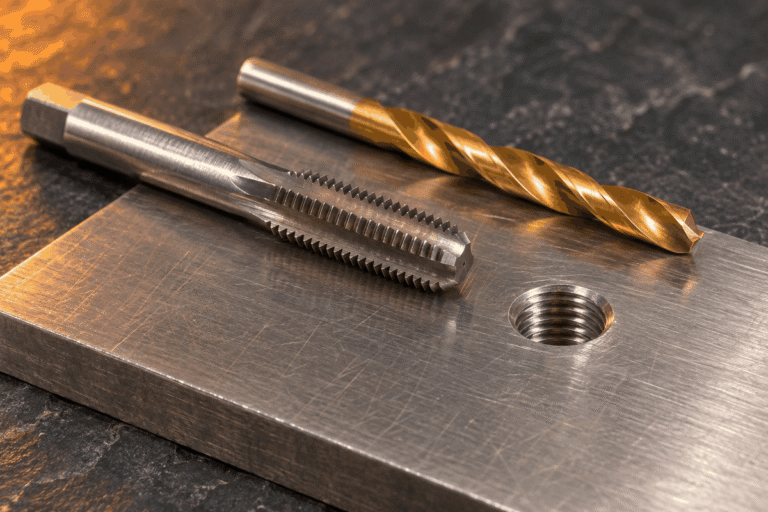
A tap drill is the drill you use to make a hole before cutting threads into it with a tap. Pick a drill that is too small and the tap binds or snaps; too large and the thread strips. This tap drill size chart lists the correct drill for every common UNC, UNF, metric and NPT thread, along with clearance hole sizes, so you can find the right bit in seconds.
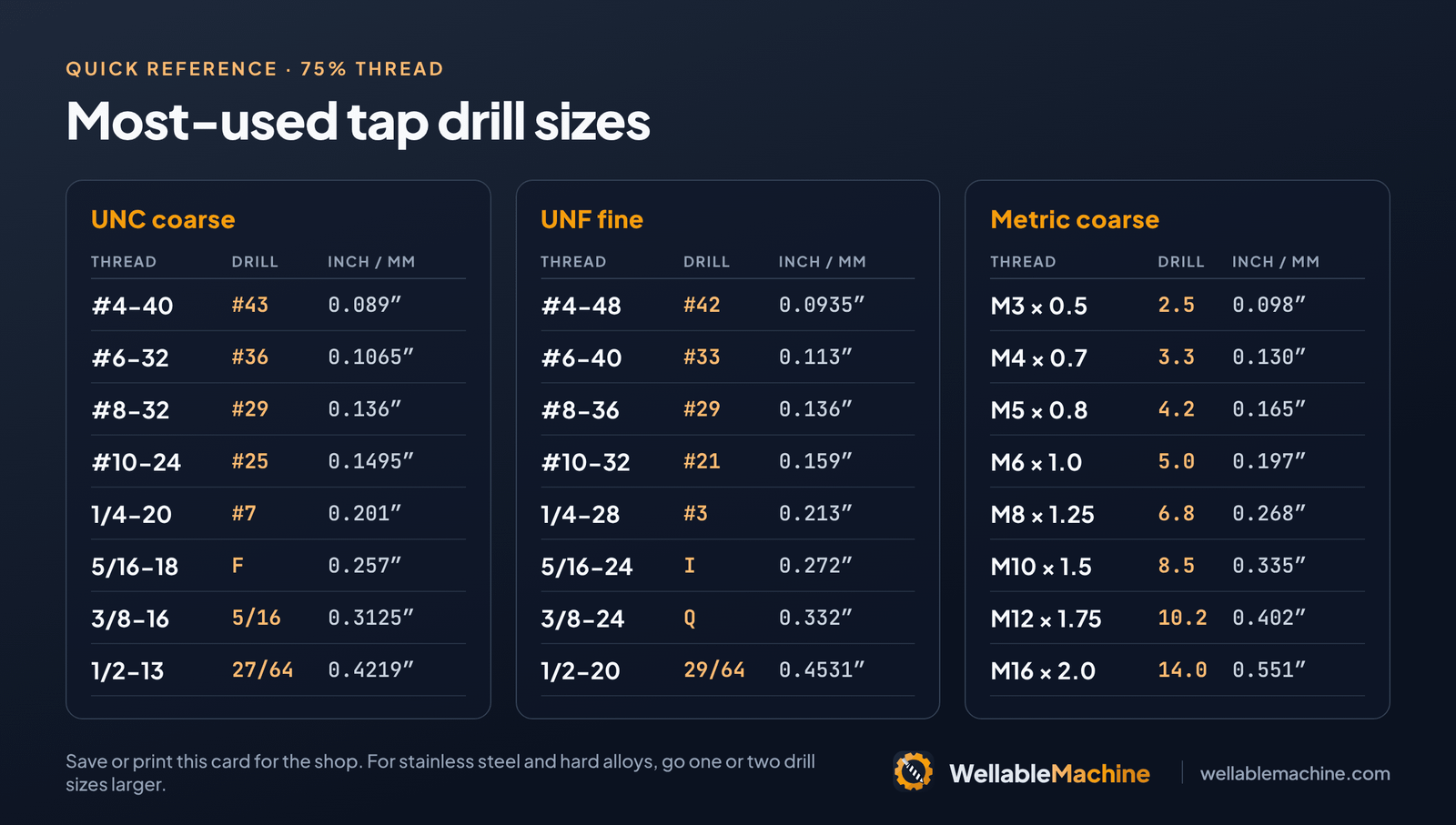
All inch tap drills below give roughly a 75% thread, the industry standard for steel, aluminum, brass and cast iron. Metric tap drills use the simple rule major diameter − pitch. If you’re tapping stainless steel or another tough material by hand, go one or two sizes larger; we explain why further down.
How to Read a Thread Size
Every thread callout tells you two things: the diameter and how fine the thread is. Inch threads list diameter and threads per inch (TPI); metric threads list diameter and pitch in millimeters.
- 1/4-20 UNC: 1/4 in diameter, 20 threads per inch, Unified Coarse series.
- 10-32 UNF: #10 screw gauge (0.190 in), 32 threads per inch, Unified Fine series.
- M8 × 1.25: 8 mm diameter, 1.25 mm between threads. If no pitch is given (just “M8”), it means the coarse pitch.
- 1/8-27 NPT: a tapered pipe thread for a nominal 1/8 in pipe, 27 threads per inch.
The Unified Thread Standard (ASME B1.1) defines the inch sizes, and ISO metric screw threads cover the metric ones.
UNC Tap Drill Size Chart (Coarse Thread)
Coarse threads are the most common for general hardware and are more forgiving in soft materials.
| Thread | Tap drill (75%) | Decimal (in) | Close-fit clearance | Free-fit clearance |
|---|---|---|---|---|
| #2-56 | #50 | 0.0700 | #43 (0.089) | #41 (0.096) |
| #4-40 | #43 | 0.0890 | #32 (0.116) | #30 (0.1285) |
| #6-32 | #36 | 0.1065 | #27 (0.144) | #25 (0.1495) |
| #8-32 | #29 | 0.1360 | #18 (0.1695) | #16 (0.177) |
| #10-24 | #25 | 0.1495 | #9 (0.196) | #7 (0.201) |
| #12-24 | #16 | 0.1770 | #2 (0.221) | #1 (0.228) |
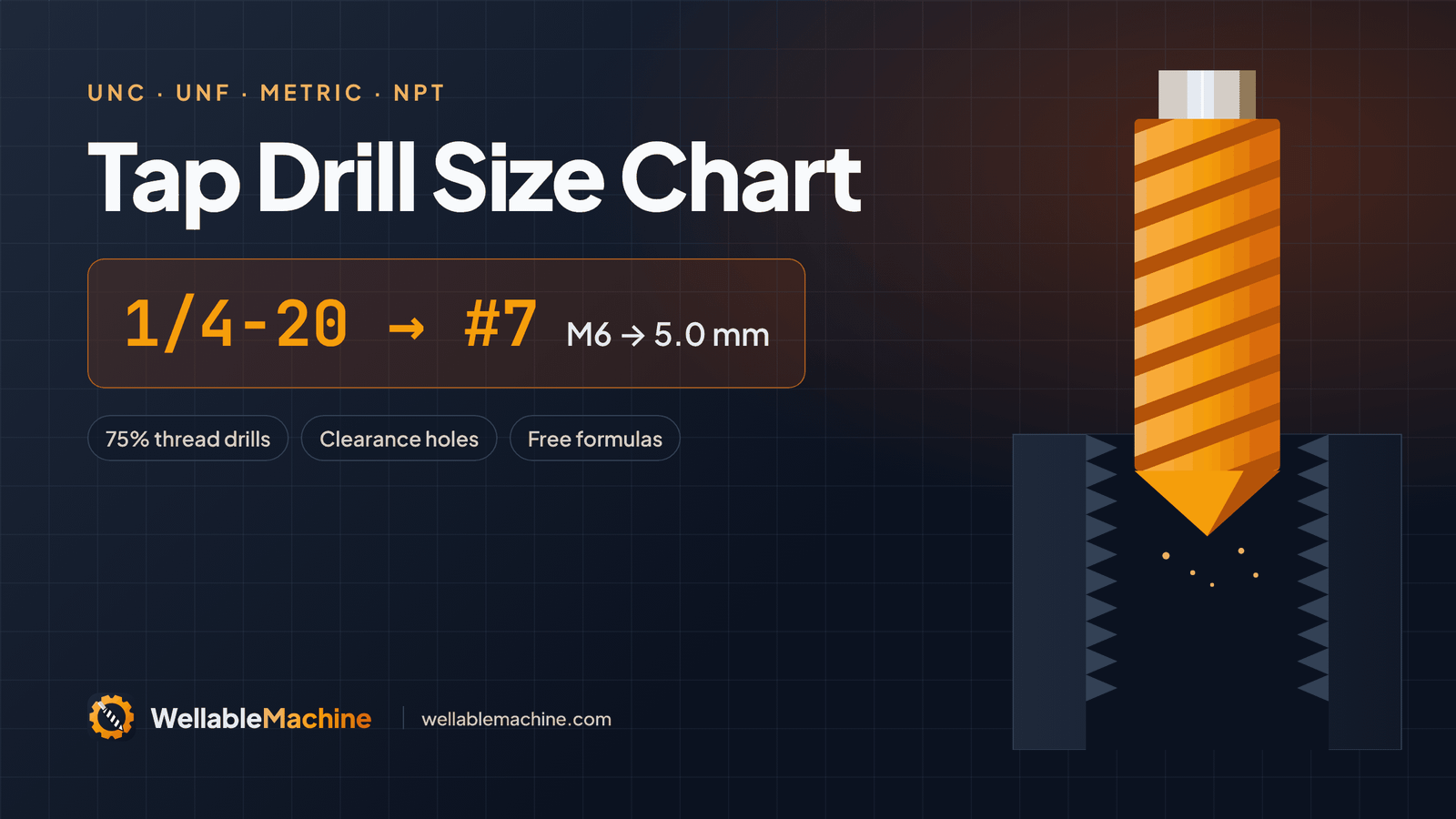
| 1/4-20 | #7 | 0.2010 | F (0.257) | H (0.266) |
| 5/16-18 | F | 0.2570 | P (0.323) | Q (0.332) |
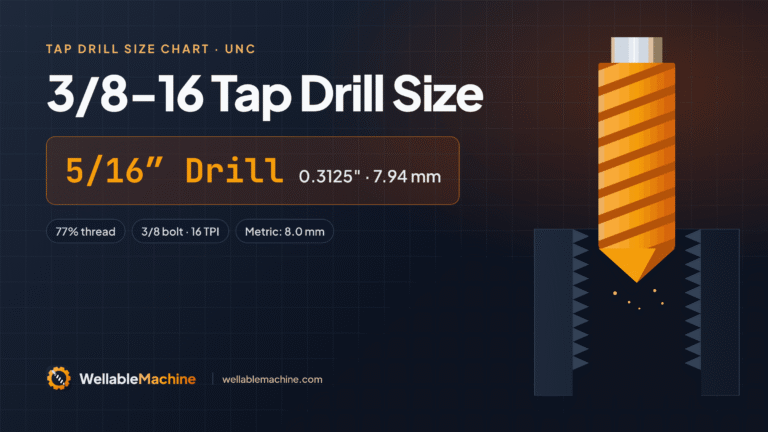
| 3/8-16 | 5/16 | 0.3125 | W (0.386) | X (0.397) |
| 7/16-14 | U | 0.3680 | 29/64 (0.4531) | 15/32 (0.4688) |
| 1/2-13 | 27/64 | 0.4219 | 33/64 (0.5156) | 17/32 (0.5312) |
| 9/16-12 | 31/64 | 0.4844 | 37/64 (0.5781) | 19/32 (0.5938) |
| 5/8-11 | 17/32 | 0.5312 | 41/64 (0.6406) | 21/32 (0.6562) |
| 3/4-10 | 21/32 | 0.6562 | 49/64 (0.7656) | 25/32 (0.7812) |
| 7/8-9 | 49/64 | 0.7656 | 57/64 (0.8906) | 29/32 (0.9062) |
| 1-8 | 7/8 | 0.8750 | 1-1/64 (1.0156) | 1-1/32 (1.0312) |
UNF Tap Drill Size Chart (Fine Thread)
Fine threads have shallower teeth, so they need a slightly larger tap drill than the coarse thread of the same diameter. They’re used in thin walls, for fine adjustment and where vibration is a concern. Clearance holes are the same as the UNC table above.
| Thread | Tap drill (75%) | Decimal (in) | Metric near-equivalent |
|---|---|---|---|
| #4-48 | #42 | 0.0935 | 2.4 mm |
| #6-40 | #33 | 0.1130 | 2.9 mm |
| #8-36 | #29 | 0.1360 | 3.5 mm |
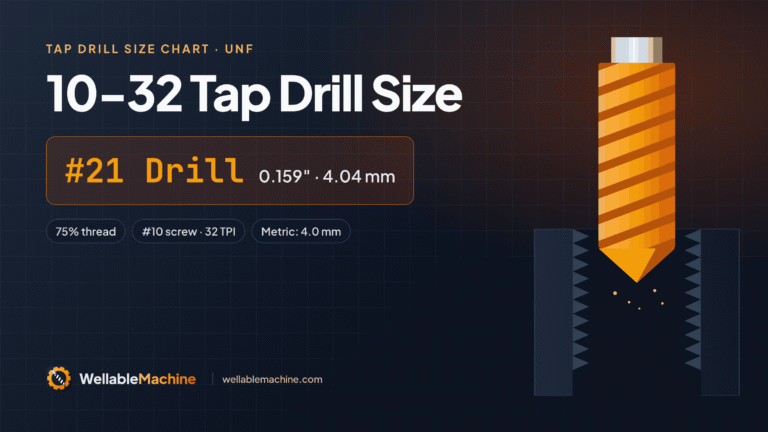
| #10-32 | #21 | 0.1590 | 4.0 mm |
| #12-28 | #14 | 0.1820 | 4.6 mm |
| 1/4-28 | #3 | 0.2130 | 5.4 mm |
| 5/16-24 | I | 0.2720 | 6.9 mm |
| 3/8-24 | Q | 0.3320 | 8.4 mm |
| 7/16-20 | 25/64 | 0.3906 | 9.9 mm |
| 1/2-20 | 29/64 | 0.4531 | 11.5 mm |
| 9/16-18 | 33/64 | 0.5156 | 13.1 mm |
| 5/8-18 | 37/64 | 0.5781 | 14.7 mm |
| 3/4-16 | 11/16 | 0.6875 | 17.5 mm |
| 7/8-14 | 13/16 | 0.8125 | 20.6 mm |
| 1-12 | 15/16 | 0.9375 | 23.8 mm |
Metric Tap Drill Size Chart (Coarse and Fine)
For metric threads, the tap drill is simply the major diameter minus the pitch. An M6 × 1.0 thread uses a 6 − 1 = 5.0 mm drill. Clearance sizes follow ISO 273.
| Thread | Pitch (mm) | Tap drill (mm) | Inch equivalent | Close clearance | Normal clearance |
|---|---|---|---|---|---|
| M2 | 0.4 | 1.6 | #52 / 1/16 | 2.2 | 2.4 |
| M2.5 | 0.45 | 2.05 | #46 | 2.7 | 2.9 |
| M3 | 0.5 | 2.5 | #39 | 3.2 | 3.4 |
| M4 | 0.7 | 3.3 | #30 | 4.3 | 4.5 |
| M5 | 0.8 | 4.2 | #19 | 5.3 | 5.5 |
| M6 | 1.0 | 5.0 | #9 | 6.4 | 6.6 |
| M8 | 1.25 | 6.8 | H | 8.4 | 9.0 |
| M8 fine | 1.0 | 7.0 | J | 8.4 | 9.0 |
| M10 | 1.5 | 8.5 | Q | 10.5 | 11.0 |
| M10 fine | 1.25 | 8.8 | 11/32 | 10.5 | 11.0 |
| M12 | 1.75 | 10.2 | Y | 13.0 | 13.5 |
| M12 fine | 1.5 | 10.5 | Z | 13.0 | 13.5 |
| M14 | 2.0 | 12.0 | 15/32 | 15.0 | 15.5 |
| M16 | 2.0 | 14.0 | 35/64 | 17.0 | 17.5 |
| M20 | 2.5 | 17.5 | 11/16 | 21.0 | 22.0 |
| M24 | 3.0 | 21.0 | 53/64 | 25.0 | 26.0 |
NPT Pipe Thread Tap Drill Chart
NPT threads are tapered (1/16 in per inch), so the tap cuts deeper as it goes in. The drill sizes below are for tapping without a taper reamer, which is how most shops do it. Tap only until a fitting threads in hand-tight about 3–4 turns.
| Pipe size | TPI | Tap drill | Decimal (in) |
|---|---|---|---|
| 1/16 NPT | 27 | D | 0.246 |
| 1/8 NPT | 27 | R | 0.339 |
| 1/4 NPT | 18 | 7/16 | 0.4375 |
| 3/8 NPT | 18 | 37/64 | 0.5781 |
| 1/2 NPT | 14 | 23/32 | 0.7188 |
| 3/4 NPT | 14 | 59/64 | 0.9219 |
| 1 NPT | 11.5 | 1-5/32 | 1.1563 |
| 1-1/4 NPT | 11.5 | 1-1/2 | 1.5000 |
| 1-1/2 NPT | 11.5 | 1-47/64 | 1.7344 |
| 2 NPT | 11.5 | 2-7/32 | 2.2188 |
How to Calculate a Tap Drill Size
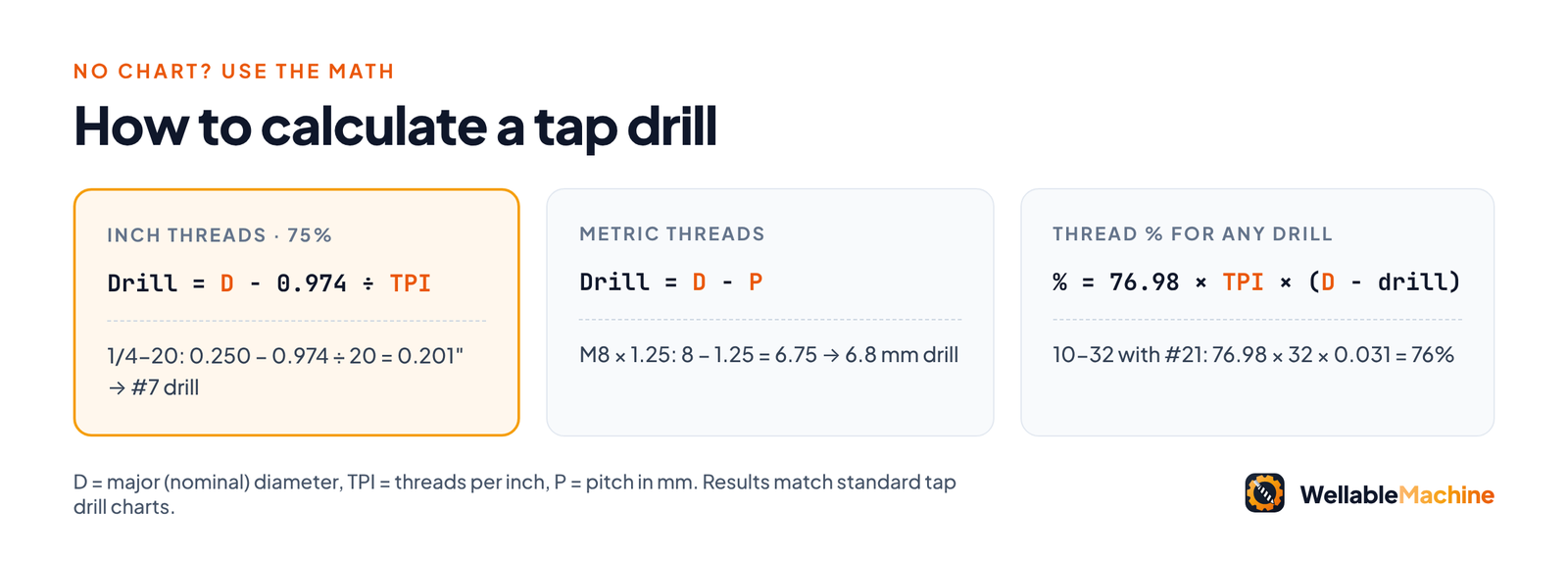
You don’t need a chart if you remember two formulas.
- Inch threads (75%): tap drill ≈ major diameter − (0.974 ÷ TPI). For 1/4-20: 0.250 − 0.0487 = 0.201 in, which is a #7 drill.
- Metric threads: tap drill = major diameter − pitch. For M8 × 1.25: 8 − 1.25 = 6.75 mm, so use 6.8 mm.
- Thread percentage for any drill: % thread = 76.98 × TPI × (major diameter − drill diameter).
Choosing a Larger Drill for Hard Materials
A 75% thread is only slightly stronger than a 60–65% thread, but it takes much more force to tap. That extra force is what snaps taps in stainless steel, titanium and hardened alloys. Many machinists drill one or two sizes larger in these materials. For example, use a #5 or 5.2 mm drill instead of #7 for 1/4-20 in stainless. For drilling tips in tough metals, read our guide on how to drill stainless steel and see our picks for the best drill bits for stainless steel.
Cutting Taps vs. Forming Taps
Everything in the tables above is for standard cutting taps, which remove metal to form the thread. Forming (roll) taps push the metal into shape without making chips and need a noticeably larger hole, roughly halfway between the tap drill and the major diameter. For example, a 1/4-20 forming tap uses about a 0.228 in hole instead of 0.201 in. Forming taps work best in aluminum, copper, brass and mild steel. Always use the forming-tap chart from the tap’s manufacturer.
Tips for Clean, Strong Threads
- Drill straight. A crooked hole makes a crooked thread. Use a drill press or a drill guide when you can.
- Chamfer the hole with a countersink so the tap starts square and the first thread isn’t raised.
- Use cutting fluid for both drilling and tapping. Sulfur-based oil works well in steel; a light oil or tapping fluid is fine in aluminum.
- Break the chip with hand taps: turn forward half a turn, back a quarter turn.
- Choose the right tap: spiral-point (gun) taps for through-holes, spiral-flute taps for blind holes, and a bottoming tap to finish threads at the bottom of a blind hole.
- Drill blind holes deeper than the thread you need, by at least 3–4 pitches.
Types of Taps and When to Use Each
| Tap type | Chamfer | Best for |
|---|---|---|
| Taper | 7–10 threads | Starting threads by hand, hard materials |
| Plug | 3–5 threads | General use; the default in most tap sets |
| Bottoming | 1–2 threads | Finishing threads to the bottom of blind holes |
| Spiral point (gun) | Plug | Through-holes; pushes chips ahead |
| Spiral flute | Plug or bottoming | Blind holes; pulls chips out |
| Forming (roll) | Plug or bottoming | Ductile metals; no chips, larger drill |
For a deeper look at tap styles and how they’re made, see the tap and die overview.
How to Identify an Unknown Thread
- Measure the outside diameter of the bolt with calipers. A reading of about 0.245–0.250 in is a 1/4 in thread; 5.9–6.0 mm is M6.
- Check the pitch with a thread pitch gauge. Try both the inch (TPI) and metric leaves; the one that sits with no light showing is the match.
- Decide coarse or fine. Compare the TPI with the UNC and UNF tables above.
- For a threaded hole, try known bolts by hand. Never force one, or you’ll damage the thread.
How Deep Should a Tapped Thread Be?
As a rule, thread engagement of 1 × the bolt diameter in steel, 1.5 × in cast iron and brass, and 2 × in aluminum lets the bolt reach full strength before the thread strips. In blind holes, drill at least 3–4 pitches deeper than the thread you need.
| Thread | Steel (1 × D) | Cast iron (1.5 × D) | Aluminum (2 × D) |
|---|---|---|---|
| #10 (10-24 / 10-32) | 0.19 in | 0.29 in | 0.38 in |
| 1/4 in | 0.25 in | 0.38 in | 0.50 in |
| 3/8 in | 0.38 in | 0.56 in | 0.75 in |
| 1/2 in | 0.50 in | 0.75 in | 1.00 in |
| M6 | 6 mm | 9 mm | 12 mm |
| M10 | 10 mm | 15 mm | 20 mm |
Common Tapping Mistakes
- Using the clearance size as the tap drill (or the other way round). Tap drills are always smaller than the bolt.
- Confusing similar threads such as 10-32 and M5, or 3/8-16 and M10. They start, then bind.
- Tapping dry. Fluid cuts torque and improves the finish in every material.
- Forcing a tap that won’t turn. Back it out, clear the chips and check the hole size.
- Using a cutting-tap drill with a forming tap. Forming taps need a bigger hole.
Frequently Asked Questions
What is a tap drill?
It’s the drill bit used to make the hole before tapping. Its diameter is a little larger than the thread’s minor diameter so the tap has metal to cut into without binding.
What size drill for a 1/4-20 tap?
A #7 drill (0.201 in) or 13/64 in. See our full 1/4-20 tap drill size guide.
What size drill for a 10-32 tap?
A #21 drill (0.159 in). See the 10-32 tap drill size guide for metric and stainless options.
What size drill for a 3/8-16 tap?
A 5/16 in drill (0.3125 in). Details are in our 3/8-16 tap drill size guide.
What size drill for an M6 tap?
5.0 mm for a standard M6 × 1.0 thread. If you only have inch bits, a #9 (0.196 in) is the closest.
What size drill for a 1/8 NPT tap?
A letter R drill (0.339 in). An 11/32 in drill is a common substitute.
Why is the tap drill smaller than the bolt?
The tap needs material to cut the thread’s teeth. The hole is sized close to the thread’s minor (root) diameter, and the tap cuts outward to the full major diameter.
What is the difference between a tap drill and a clearance drill?
A tap drill makes a hole to be threaded. A clearance drill makes a hole slightly larger than the bolt so it can pass through freely without threads.
Where can I see all the number and letter drill sizes?
This drill bit sizes reference lists the full number, letter and fractional series with decimal equivalents.
Bottom Line
For inch threads, a 75% tap drill from the UNC or UNF tables is the right choice for nearly every job: #7 for 1/4-20, #21 for 10-32, 5/16 for 3/8-16. For metric threads, just subtract the pitch from the diameter. Go one or two sizes larger in stainless and hard alloys, use the manufacturer’s chart for forming taps, and drill a separate clearance size when a bolt only needs to pass through. Save the quick reference card above, and see our detailed guides for 1/4-20, 10-32 and 3/8-16 threads.