3/8-16 Tap Drill Size: Chart, Metric & Clearance Holes
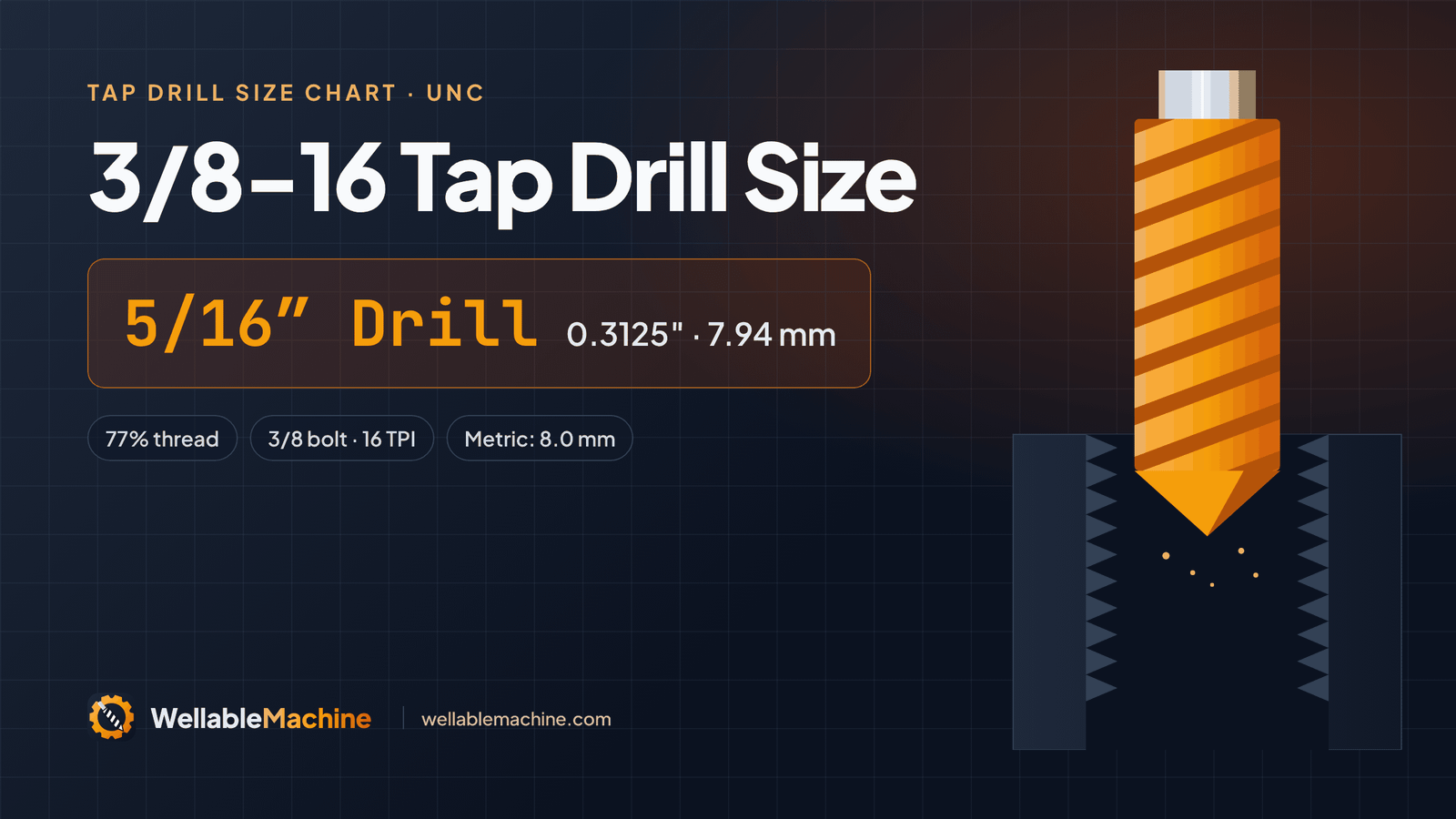
Quick answer: the tap drill for a 3/8-16 UNC thread is a 5/16 in drill (0.3125 in / 7.94 mm). It gives about a 77% thread, the standard for steel, cast iron and aluminum. The closest metric size is 8.0 mm. For hand tapping stainless steel or other tough alloys, a letter P (0.323 in) or 21/64 in drill leaves a 58–64% thread that is much easier to cut and still more than strong enough.
Below you’ll find the complete 3/8-16 drill chart by thread percentage, clearance hole sizes for a 3/8 bolt, the forming-tap and Heli-Coil drill sizes, and how 3/8-16 compares with 3/8-24 and M10. There is also a step-by-step tapping routine for a thread this size, which takes far more torque than small machine-screw threads.
3/8-16 Thread Specifications
“3/8-16” means a bolt with a nominal diameter of 3/8 in and 16 threads per inch. It is the coarse (UNC) thread for this diameter in the Unified Thread Standard and one of the most common bolt sizes in machinery, fixtures and construction hardware.
| Specification | Value |
|---|---|
| Thread series | UNC (Unified National Coarse) |
| Major diameter | 0.375 in (9.53 mm) |
| Threads per inch | 16 |
| Pitch | 0.0625 in (1.588 mm) |
| Basic minor diameter | 0.2983 in (7.58 mm) |
| Tap drill, 75% thread | 5/16 in = 0.3125 in (7.94 mm) |
| Tap drill, 50% thread | Q = 0.332 in (8.43 mm) |
| Close-fit clearance | W = 0.386 in (9.80 mm) |
| Free-fit clearance | X = 0.397 in (10.08 mm) |
3/8-16 Tap Drill Chart by Thread Percentage
A 3/8-16 tap removes a lot of metal, so the drill you choose has a big effect on how hard the tap is to turn. Above about 75% you gain almost no strength but need much more torque. The values below use % thread = 76.98 × TPI × (major diameter − drill diameter).
| Drill | Inches | mm | Approx. thread | When to use it |
|---|---|---|---|---|
| 19/64 | 0.2969 | 7.54 | 96% | Too small; the tap will likely bind or break |
| 5/16 | 0.3125 | 7.94 | 77% | Standard choice for most materials |
| 8.0 mm | 0.3150 | 8.00 | 74% | Best metric substitute |
| O | 0.3160 | 8.03 | 73% | Mild steel with a hand tap |
| 8.1 mm | 0.3189 | 8.10 | 69% | Steel and cast iron |
| P | 0.3230 | 8.20 | 64% | Stainless steel, tough alloys |
| 21/64 | 0.3281 | 8.33 | 58% | Hard stainless, titanium |
| Q | 0.3320 | 8.43 | 53% | Very hard materials, deep blind holes |
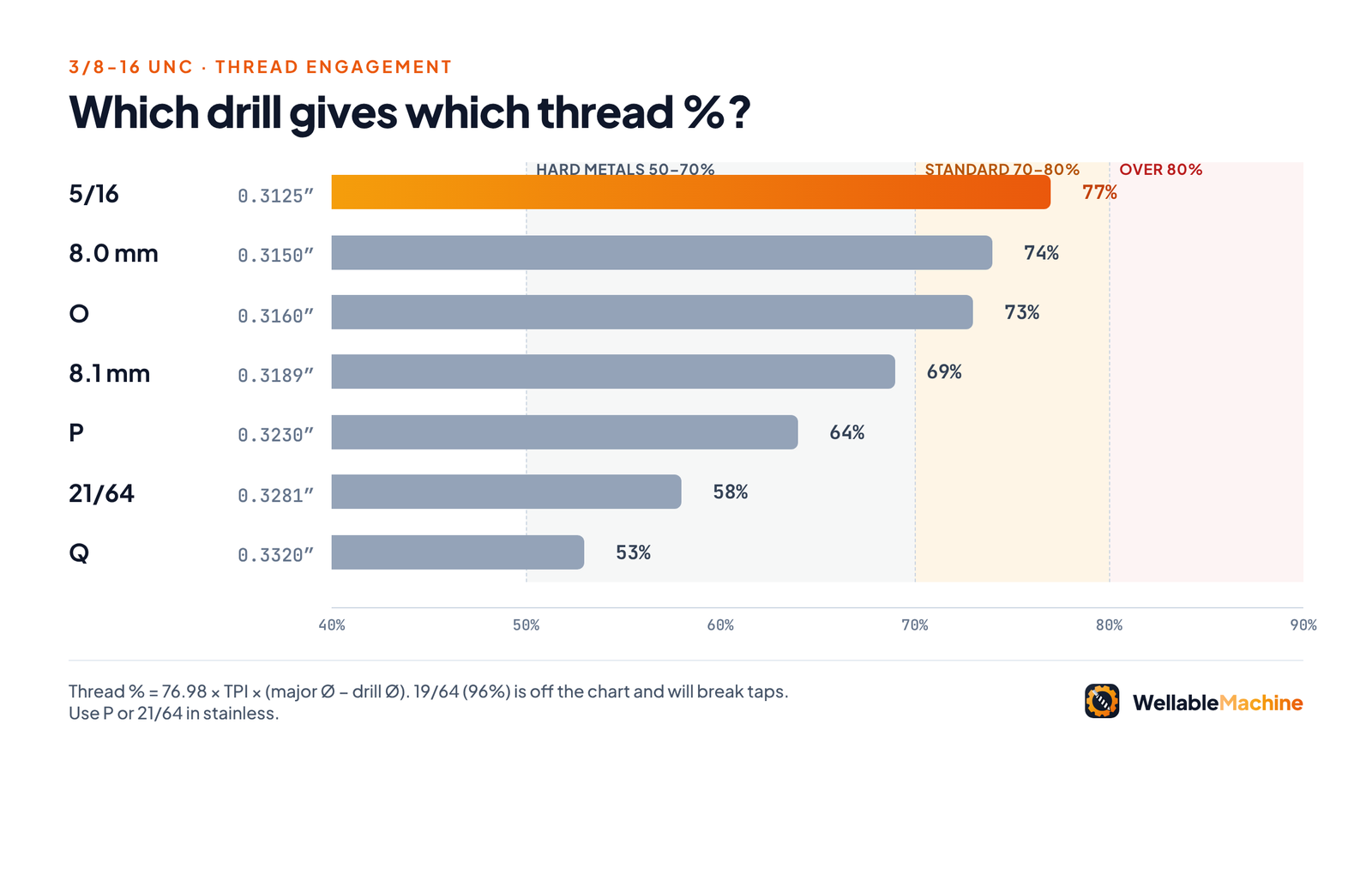
Which drill should you use? A 5/16 bit is the right answer for nearly every job, and it’s in every fractional drill set, so you don’t need a letter-size bit. Use 8.0 mm if your set is metric. If you’re tapping 304 or 316 stainless by hand, go to a P or 21/64 drill; the joint will still hold more than the bolt in most real assemblies.
Clearance Holes for a 3/8 in Bolt
For a bolt that passes through a part, drill a clearance hole instead. These sizes are the same for 3/8-16 and 3/8-24 bolts.
| Fit | Drill | Inches | mm | Use it for |
|---|---|---|---|---|
| Close fit | W | 0.3860 | 9.80 | Precise alignment, dowel-like location |
| Free fit | X | 0.3970 | 10.08 | General machinery and fixtures |
| Common fractional | 13/32 | 0.4063 | 10.32 | Brackets, frames, field drilling |
3/8-16 vs. 3/8-24 vs. M10
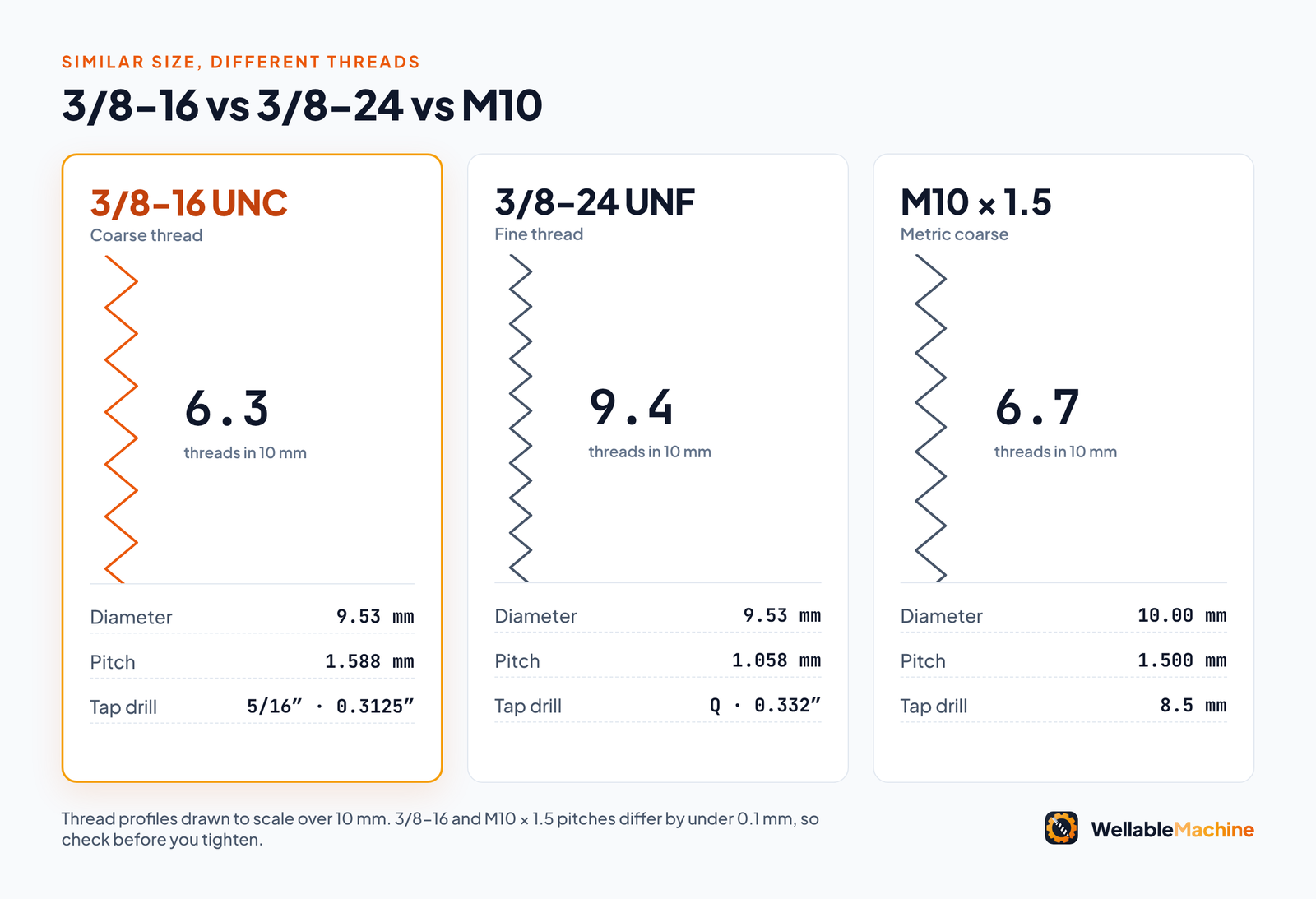
These three threads are close in size, and 3/8-16 and M10 × 1.5 have pitches only 0.09 mm apart. An M10 bolt can start in a 3/8-16 hole and then jam, so always confirm the thread before you tighten anything.
| Thread | Diameter | Pitch | Tap drill | Clearance (free) |
|---|---|---|---|---|
| 3/8-16 UNC | 9.53 mm | 1.588 mm | 5/16 in | X (0.397 in) |
| 3/8-24 UNF | 9.53 mm | 1.058 mm | Q (0.332 in) | X (0.397 in) |
| M10 × 1.5 | 10.00 mm | 1.500 mm | 8.5 mm | 11 mm |
Other 3/8-16 Hole Sizes
- Forming (roll) tap: about 0.345 in, an 11/32 in or 8.8 mm drill. Check the tap maker’s chart, since forming taps vary.
- Heli-Coil / STI insert: a 25/64 in (0.3906 in) drill and a 3/8-16 STI tap.
- Threaded insert in wood: most 3/8-16 inserts need a 1/2 in hole; follow the insert’s spec.
- Counterbore for a socket head cap screw: 9/16 in diameter, about 3/8 in deep.
How to Drill and Tap a 3/8-16 Hole
- Center punch and spot drill the location. A 5/16 bit can walk on a hard surface.
- Drill a pilot hole of about 1/8 in in steel, then open it up with the 5/16 bit. This keeps the hole straight and reduces the load on the larger drill.
- Use the right speed. For a 5/16 bit, start around 1,000 RPM in mild steel, 2,500 RPM in aluminum and 400–500 RPM in stainless. Read our guide on how to drill stainless steel if you’re working with 304 or 316.
- Chamfer the hole with a countersink so the tap starts square.
- Tap with plenty of cutting fluid. Use a full-size T-handle or bar tap wrench; a 3/8 tap needs leverage. Turn half a turn, back off a quarter turn to break the chip, and repeat.
- Keep the tap square. A drill press with the chuck lightly holding the tap shank, or a tap guide block, makes a big difference on a thread this size.
- For blind holes, drill at least 3 pitches (about 3/16 in) deeper than the thread you need and finish with a bottoming tap.
Cobalt drills make the 5/16 hole much easier in hard metals. See our picks for the best drill bits for stainless steel. For smaller threads, see the 1/4-20 tap drill size and 10-32 tap drill size guides, or jump to the full tap drill size chart.
Where Is 3/8-16 Used?
3/8-16 is a workhorse thread. You’ll find it on machine bases, jigs and fixtures, structural brackets, strut channel hardware, trailer and equipment mounts, and on camera tripods, where the larger 3/8-16 screw attaches the tripod head (cameras themselves use 1/4-20). The coarse pitch tolerates dirt and minor damage better than 3/8-24, which is used where vibration resistance or fine adjustment matters.
Which 3/8-16 Tap Should You Use?
| Tap type | Best for | Notes |
|---|---|---|
| Taper tap | Starting by hand in steel and stainless | Long chamfer spreads the load; easiest to keep straight |
| Plug tap | Most through-holes and blind holes | The standard hand tap in most tap and die sets |
| Bottoming tap | Full threads to the bottom of a blind hole | Use only after a taper or plug tap has cut the thread |
| Spiral point tap | Through-holes, drill press or tapping head | Pushes chips forward; strong and fast |
| Spiral flute tap | Blind holes with power tapping | Lifts chips out; good in aluminum |
| Forming tap | Aluminum and mild steel | Needs an 11/32 in or 8.8 mm hole, not 5/16 in |
How Deep Should a 3/8-16 Thread Be?
Thread engagement is the length of thread actually holding the bolt. In steel, about one bolt diameter is enough for the bolt to break before the thread strips. Softer metals need more.
| Material | Rule of thumb | 3/8-16 thread depth |
|---|---|---|
| Steel and stainless | 1 × diameter | about 3/8 in (9.5 mm) |
| Cast iron, brass, bronze | 1.5 × diameter | about 9/16 in (14 mm) |
| Aluminum | 2 × diameter | about 3/4 in (19 mm) |
| Wood and plastic | Use an insert | Threaded insert or a through-bolt with a nut |
Common 3/8-16 Tapping Problems
- The tap is too hard to turn. The hole may be undersized (a 19/64 in bit by mistake), or chips are packing the flutes. Back off more often, use more cutting fluid, or open the hole to an O or 8.1 mm drill.
- The thread came out crooked. A 3/8 tap needs to start square. Use a drill press to guide it, or a tap guide block, for the first few turns.
- The bolt is loose in the hole. The hole was oversized or the thread is too short. Repair it with a 3/8-16 Heli-Coil (25/64 in drill) or go up to a 7/16-14 thread.
- The tap snapped in stainless. Use a P or 21/64 in drill, a sharp taper tap, sulfur-based oil and slow, steady turns. Stainless work-hardens if the tap rubs.
- Chips jammed in a blind hole. Drill deeper than the thread, clear chips with compressed air (wear eye protection) and switch to a spiral flute tap.
Frequently Asked Questions
What size drill bit for a 3/8-16 tap?
A 5/16 in drill (0.3125 in). It gives about a 77% thread and is the standard size on every tap drill chart.
What is the metric tap drill for 3/8-16?
8.0 mm. It is only 0.0025 in larger than 5/16 and gives about a 74% thread.
What size hole for a 3/8 bolt to pass through?
Use a W drill (0.386 in) for a close fit, an X drill (0.397 in) for a free fit, or 13/32 in if you only have fractional bits.
Is 3/8-16 the same as M10?
No. M10 is larger (10 mm vs. 9.53 mm) with a 1.5 mm pitch. The two are not interchangeable even though the pitches are close.
What is the tap drill size for 3/8-24?
A letter Q drill (0.332 in). The finer 3/8-24 thread has shallower teeth, so it needs a larger hole than 3/8-16.
Can I use 21/64 for a 3/8-16 tap?
Yes, in stainless steel or very hard material. 21/64 gives about a 58% thread, which is easier to tap. In aluminum or soft steel, stay with 5/16 for full strength.
Where can I find the letter and number drill sizes?
Our tap drill size chart lists the common sizes, and this drill bit sizes reference covers the full number, letter and fractional series.
Bottom Line
The tap drill for 3/8-16 is a 5/16 in bit (0.3125 in), or 8.0 mm if you work in metric. That gives a strong 75–77% thread in steel, cast iron and aluminum. In stainless or other tough alloys, open up to a P or 21/64 in drill to save your tap. For a bolt that passes through, drill a W, X or 13/32 in clearance hole, and don’t mix 3/8-16 hardware with M10. Our tap drill size chart covers every other common thread.